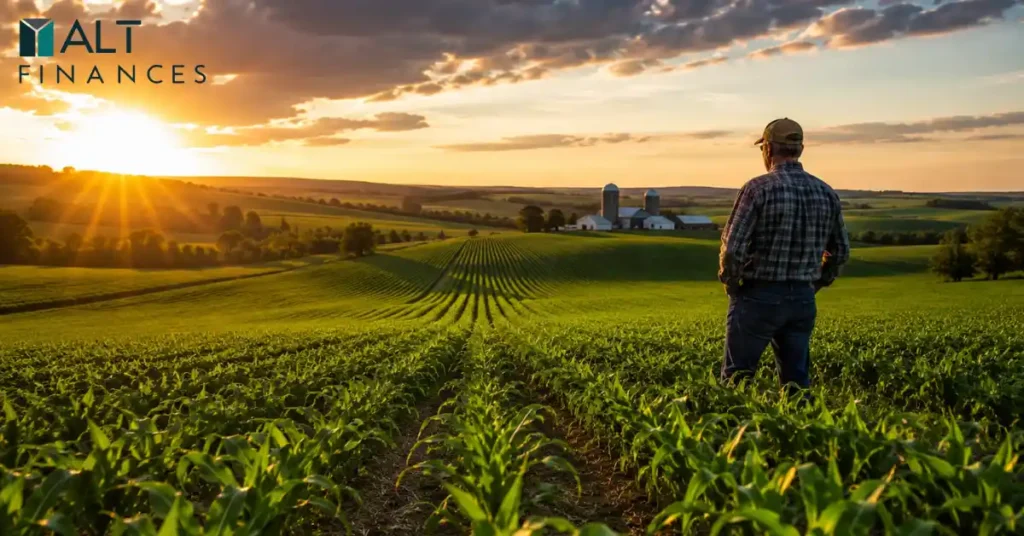
More than 95% of the world’s food is produced on land, according to the Food and Agriculture Organization. That makes agricultural land unusual among real assets: it is not simply a physical store of value, but a productive platform capable of turning soil, water, capital and technology into economic output.
That is the foundation of farmland investing. Investors are not merely buying acreage. They are potentially acquiring exposure to agricultural income, land values, food production and the increasingly constrained resources required to sustain them.
But the investment case is more complicated than the familiar argument that food demand will rise. The quality of the land, availability of water, crop economics, tenant structure, climate exposure, financing costs and local supply of agricultural property can matter more than acreage itself.
The central equation is:
Land → Agricultural Productivity → Farm Income → Lease or Operating Cash Flow → Land Value
That distinction is what separates productive farmland from simply owning rural real estate.
Why Productive Farmland Is a Strategic Real Asset
Farmland combines three characteristics that rarely exist together: physical land, productive capacity and recurring economic output.
Unlike a vacant parcel whose value may depend largely on future development potential, productive farmland can generate economic activity today. Land may be leased to an agricultural operator, used directly by an owner-operator or held through a fund or other investment structure.
The U.S. market illustrates the scale of the underlying asset. USDA’s Economic Research Service estimates that farm real estate land and structures accounted for a forecasted $3.67 trillion, or 83.6% of total U.S. farm assets, in 2025. Average U.S. farm real-estate value reached $4,350 per acre, up 4.3% from 2024 in nominal terms.
Those figures should not be interpreted as a forecast for future appreciation. They demonstrate something more fundamental: agricultural land represents a substantial pool of productive physical capital.
Where Farmland Investment Returns Come From
The economics of farmland generally have two broad components: income and changes in land value.
For a landowner leasing property, income may come through contractual rent. An investor with operating exposure can instead participate more directly in agricultural revenues and expenses.
Land appreciation represents the second potential component. Agricultural profitability, interest rates, local land supply, water access, development pressure and demand for productive acreage can all influence values.
USDA data also show why farmland cannot be treated as one homogeneous asset. In 2025, average U.S. cropland value was $5,830 per acre compared with $1,920 for pastureland. Average inflation-adjusted cropland rent was $161 per acre. Regional differences were substantial: average cropland value was $8,940 per acre in the Corn Belt but $2,640 in the Southern Plains.
The implication for investors is important: acreage alone tells very little about economic value.
Owning Farmland Is Not the Same as Running a Farm
One of the most important distinctions in agricultural investment is between owning the land and operating the business.
A passive farmland owner may primarily be exposed to:
Tenant Quality + Rent + Land Value
An agricultural operator faces a much broader set of variables:
Crop Prices + Input Costs + Weather + Labor + Management + Farm Revenue
Those are fundamentally different risk profiles.
An investor can therefore gain farmland exposure through direct ownership, agricultural partnerships, farmland funds and other private real-asset structures without necessarily taking responsibility for day-to-day farming.
Institutional farmland indexes reflect this distinction. NCREIF’s Farmland Property Index measures investment performance of income-producing agricultural properties acquired in the private market, with properties held on behalf of tax-exempt institutional investors, predominantly pension funds.
This is one reason farmland increasingly belongs in the conversation around institutional real assets rather than simply residential or commercial property.
What Makes One Acre More Valuable Than Another?
The most valuable farmland is not necessarily the largest.
Soil quality can influence yields. Water availability can determine what can reliably be produced. Climate affects crop suitability. Drainage, topography, road access, storage, processing infrastructure and proximity to agricultural markets can all affect the economics.
The deeper point is that productive capacity matters more than acreage.
A scarce parcel with poor soil and unreliable water may be economically inferior to a less expensive property with stronger agricultural fundamentals.
Water May Be the Hidden Variable
Water is arguably one of the most important variables in farmland economics.
FAO reports that agriculture accounts for more than 70% of global freshwater withdrawals, while land, soil and water resources face increasing pressure from degradation, scarcity and climate change.
For an investor, that means water should be considered alongside soil and location not treated as an afterthought.
Irrigated and non-irrigated farmland can have very different production economics. Groundwater availability, surface-water access, legal water rights, drought conditions and competing agricultural, municipal and industrial demand can all influence long-term productive capacity.
This creates an important analytical distinction:
Land Scarcity ≠ Productive Scarcity
The investment premium may ultimately belong to land that combines scarcity with durable access to the resources required to produce valuable crops.
Farmland and the Inflation Debate
Farmland is frequently described as an inflation hedge because it is a tangible asset connected to agricultural commodities.
The theory is straightforward: inflation can raise agricultural input prices and food prices, potentially affecting farm revenues and land economics.
But the relationship is not automatic.
Higher input costs can compress farm margins. Higher interest rates can increase financing costs and reduce the amount buyers can justify paying for land. Crop prices can fall even while broader consumer prices remain elevated.
The Federal Reserve has recently highlighted this tension. Its May 2026 Financial Stability Report said U.S. farmland values remained at historically high levels through 2025, while price-to-rent ratios were also historically high. The Fed noted that limited farmland inventory had helped sustain prices despite elevated interest rates and higher operating costs.
That is a more useful way to think about the inflation question: farmland may have characteristics that can interact with inflation, but it is not an inflation-proof asset.
Why Institutional Investors Are Interested
Farmland can fit naturally into long-duration real-asset strategies because investors can obtain exposure to physical land, agricultural production and potentially recurring income.
Its potential portfolio role comes from the combination of:
Current Income + Land Value + Productive Capacity
But institutional investors also have to consider the disadvantages.
Farmland is illiquid compared with listed equities and bonds. Transactions can require extensive property-level due diligence, local market knowledge and significant time. Valuation is also more property-specific than for a publicly traded security.
NCREIF‘s latest data demonstrate why investors should focus on the actual return components rather than assume that land appreciation drives every period. Its Farmland Property Index produced a 0.27% total return in the second quarter of 2026, consisting of 0.57% income and -0.30% appreciation.
That single quarter does not establish a long-term return expectation. It does, however, illustrate the difference between income generation and capital appreciation.
Technology Is Changing Agricultural Land Economics
Technology can change the productive economics of farmland without changing the underlying acreage.
Precision agriculture, satellite monitoring, soil sensors, improved irrigation, automated equipment and farm-management software can potentially increase resource efficiency and improve decision-making.
For investors, this creates an important question:
Can productivity improvements increase the economic output of existing land?
FAO’s 2025 land and water assessment emphasizes that improving productivity through better resource management, crop selection and sustainable practices can help address growing food demand without simply expanding agricultural land.
Technology therefore matters not because it eliminates agricultural risk, but because it can influence the productivity of the underlying real asset.
Climate Risk Is Part of the Valuation
The physical characteristics that make farmland valuable also expose it to environmental risk.
Drought, flooding, extreme heat, wildfire, soil erosion, pests and changing growing conditions can affect agricultural output. Water scarcity can compound those risks.
FAO estimates that more than 1.6 billion hectares of land have been degraded by unsustainable management, with more than 60% of that human-induced degradation occurring on agricultural land.
Climate risk is therefore not simply an environmental issue. It can become an economic issue through lower yields, higher costs, changing crop suitability and weaker land economics.
The effect varies dramatically by geography and crop type, making property-level analysis essential.
The Risks Behind Farmland Ownership
The appeal of a tangible asset can obscure the risks.
Commodity risk: Crop prices can materially affect farm revenues and tenant economics.
Weather risk: Drought, flooding and extreme weather can disrupt production.
Water risk: Restrictions or declining availability can reduce productive capacity.
Interest-rate risk: Higher borrowing costs can affect both agricultural operators and land valuations.
Tenant risk: A weak tenant can interrupt rental income even when the land itself remains valuable.
Liquidity risk: Farmland can take considerably longer to sell than publicly traded securities.
Regulatory risk: Water, environmental, land-use and agricultural rules can influence property economics.
Valuation risk: Investors can overpay when historical appreciation is extrapolated without sufficient attention to current income and financing conditions.
These risks explain why farmland should be viewed as a long-duration real asset rather than a simple appreciation trade.
Farmland Investing: The Real Investment Is Not the Land
The strongest insight in farmland investing is that the true asset is not simply the acreage.
It is the productive capacity of that acreage.
Consider two properties of identical size. One has fertile soil, reliable irrigation, strong infrastructure and access to profitable agricultural markets. The other has poorer soil, uncertain water availability and higher transportation costs.
They may contain the same number of acres. Economically, they are not the same asset.
This creates a more sophisticated framework:
Physical Asset → Productive Capacity → Agricultural Cash Flow → Land Value
Investors should therefore ask a different question.
Not simply:
“How much is this farmland worth?”
But:
“What makes this land productive, and how durable is that productivity?”
That is the central analytical advantage of treating agricultural land as a strategic real asset rather than simply another category of real estate.
Conclusion
Farmland investing is ultimately a long-duration bet on the economic productivity of physical land.
Farmland is physical.
Agriculture is productive.
Productivity creates economic value.
Income can support ownership returns.
Land values can change over time.
But risk remains embedded in weather, water, commodity prices, financing, tenants, regulation, liquidity and valuation.
The strongest investment thesis is therefore not simply that the world needs food. It is that high-quality agricultural land with durable productive capacity is a scarce economic asset.
For institutional investors, family offices and private real-asset strategies, that distinction matters. The opportunity is not created by owning farmland in the abstract. It comes from identifying land where soil, water, infrastructure, agricultural demand and operating economics combine to support durable productivity.
Farmland is not merely land held for appreciation. At its best, it is a productive real asset whose value is connected to the ability to convert soil, water, capital, technology and agricultural expertise into economic output over decades.
Frequently Asked Questions
What is farmland investing?
Farmland investing involves gaining economic exposure to agricultural land through ownership, leasing structures, funds, partnerships or other investment vehicles. Its potential returns can come from agricultural income and changes in land value, but results vary significantly by property and market.
How do investors make money from farmland?
Potential sources include rental income, agricultural operating income and changes in land value. The mix depends on whether the investor owns land, leases it to an operator or participates directly in agricultural operations.
Is farmland a good real-asset investment?
Farmland can have distinctive real-asset characteristics, including physical scarcity and productive capacity, but it is not automatically attractive. Valuation, water, tenant quality, agricultural economics, climate exposure and liquidity all matter.
What factors determine farmland value?
Soil quality, water access, crop suitability, location, infrastructure, agricultural profitability, local land supply, tenant economics, interest rates and alternative land uses can all influence value.
How does water availability affect farmland investing?
Water can directly influence what a property can produce and how reliably it can produce it. Irrigation, groundwater, surface-water access, legal water rights and drought conditions can therefore materially affect farmland economics.
Can farmland provide inflation protection?
Farmland may have characteristics that interact with inflation because agricultural prices, operating costs and land values can respond to changing price levels. However, the relationship is not guaranteed and can be offset by higher input costs, interest rates or weaker farm margins.
What are the biggest risks of investing in agricultural land?
Major risks include weather, drought, flooding, water scarcity, commodity-price volatility, tenant risk, operating risk, financing costs, regulation, climate exposure, illiquidity and overvaluation.
How do institutional investors gain exposure to farmland?
Institutions can gain exposure through direct ownership, partnerships, farmland funds and other private real-asset structures. NCREIF’s Farmland Property Index specifically tracks income-producing farmland properties acquired for institutional investment purposes.
Is farmland investing more like real estate or agriculture?
It is both. The land is a real estate asset, but its economic value is closely connected to agricultural productivity. Investors therefore need to understand both property economics and farm operating economics.
Investment Disclaimer
This article is for general informational and educational purposes only and does not constitute investment, financial, legal, tax, accounting, agricultural or real-estate advice.
Farmland and agricultural investments involve risks including market volatility, commodity-price fluctuations, weather and climate exposure, water availability, tenant and operating risk, financing costs, regulatory changes, valuation risk and limited liquidity. Historical farmland performance does not guarantee future results. Investors should conduct independent due diligence and consult qualified professional advisers before making investment decisions.

Contributing Writer for Alt Finances with experience in luxury events, travel, fashion, and the arts. Active investor through her family office across real estate, energy, and private equity. University of Miami – BBA.