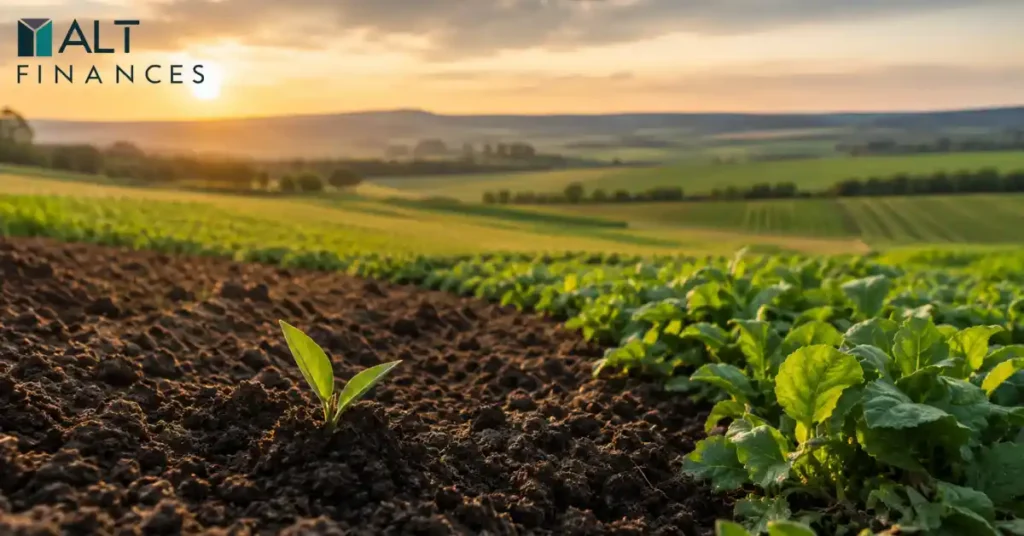
Some of the world’s most important productive assets sit beneath the surface and rarely appear on conventional investment screens. Farmland may be valued by acreage, location, water access and expected cash flow, but its economic productivity ultimately depends on a biological system that investors cannot simply see on a balance sheet. That is why soil as an investment asset is becoming a more relevant idea in farmland investment, natural capital and real assets.
The World Economic Forum recently highlighted the economic consequences of degraded land, noting that up to 40% of the world’s land is degraded and that healthy soils support productivity, resilience and long-term value across businesses and investment portfolios.
For investors, the argument is not that soil should suddenly be treated like gold or an equity security. It is that soil health can influence the economics of farmland, food systems, water security and natural capital. The chain is straightforward: Land → Productivity → Food → Natural Capital → Scarcity → Investment Value.
The Hidden Economics of Soil
Soil is productive infrastructure. It stores and cycles nutrients, regulates water, supports plant growth and provides habitat for biological systems that underpin agriculture. FAO describes soil as fundamental to food production while also linking it to water regulation, biodiversity, climate regulation and carbon sequestration.
That creates economic value even when soil itself is not separately priced.
A productive field can support stronger agricultural output. Better water infiltration and retention can improve resilience during weather extremes. Nutrient cycling can influence input requirements. Over longer periods, these characteristics can affect the economics of owning and operating farmland.
USDA’s Natural Resources Conservation Service similarly identifies water regulation, nutrient cycling, plant productivity and physical soil stability as core soil functions. It also notes that healthy soils can retain more water and provide a buffer against precipitation extremes.
| Soil Factor | Economic Effect | Potential Investment Relevance | Soil fertility | Supports productive crop systems | Potentially stronger farm economics | Water retention | Improves resilience to dry conditions | Lower exposure to water-related production risk | Soil structure | Supports infiltration and root growth | Can affect long-term land productivity | Organic matter | Supports nutrient and water retention | Potential operating and resilience benefits | Carbon storage | Links soil to climate and ecosystem services | Potential natural-capital value | Biodiversity | Supports ecosystem functions | Potential nature-related investment value | Erosion resistance | Helps preserve productive capacity | Protects long-term land economics |
|---|
The crucial point is that these factors do not automatically translate into higher investment returns. They influence the productive capacity and risk profile of an underlying real asset.
Why Productive Land Is More Than Acreage
Owning farmland and improving the productive quality of farmland are two different investment propositions.
The first is fundamentally an ownership strategy. An investor acquires land and seeks returns through agricultural income, appreciation, leasing arrangements or a combination of these factors.
The second is closer to an asset-improvement strategy. Capital and management are directed toward maintaining or improving the biological and physical condition that allows the land to produce economic output over time.
This distinction matters because two parcels with similar acreage can have very different economics. Crop selection, climate, water rights, soil depth, drainage, market access and management quality can materially change productive potential.
FAO‘s 2025 assessment of land and water resources reinforces the broader constraint: more than 60% of human-induced land degradation occurs on agricultural lands, while agriculture accounts for more than 70% of global freshwater withdrawals.
For farmland investors, the relevant question therefore becomes less about hectares alone and more about productive capacity per hectare, resilience and the durability of that capacity.
That is where soil as an investment asset begins to resemble an infrastructure thesis. Investors are not necessarily buying soil independently; they are acquiring exposure to the economic output that healthy productive systems make possible.
Regenerative Agriculture and the Economics of Soil Improvement
Regenerative agriculture has attracted growing attention because practices such as cover cropping, reduced tillage, crop diversification and managed grazing can improve soil functions. NRCS identifies reduced disturbance, soil cover, biodiversity and living roots as important principles of soil-health management.
But investors should resist the simplistic assumption that regenerative agriculture automatically means higher returns.
The economics can follow a more complicated path:
Upfront Transition Costs → Soil Improvement → Productivity/Resilience → Operating Economics → Potential Land Value
Farmers may initially face costs associated with new equipment, altered rotations, technical expertise, changed inputs or temporary disruption to established production systems. Benefits can also take time to emerge and vary significantly by crop, climate and starting soil condition.
That makes the investment horizon critical.
For a short-duration investment vehicle, the transition period may be a major constraint. For a long-term farmland owner, improving productive capacity may have a different economic value because the investor has more time to capture operating and asset-level benefits.
The distinction between environmental improvement and financial return is essential. Better soil can produce valuable ecosystem services without generating a directly monetizable cash flow.
Food Security Could Increase the Strategic Value of Soil
Food security adds another dimension to the investment case.
Agriculture depends on finite combinations of land, water, energy, biological resources and capital. When degradation reduces productive capacity, the consequences can extend beyond individual farms into commodity markets and supply chains.
WRI research has highlighted how water stress and unreliable supplies increasingly threaten agricultural production, while FAO identifies land, soil and water as foundations of global food security.
This creates a strategic relationship:
Healthy Soil + Reliable Water → Productive Agriculture → More Resilient Food Systems
For institutional investors and family offices, that relationship can make productive farmland relevant as a long-duration real asset. The investment case is not simply about commodity prices. It is about whether productive land remains capable of generating economic output under changing environmental conditions.
In that context, soil as an investment asset can be understood as part of a broader food-security and resilience thesis.
Can Soil Improvements Become Investable?
There are several routes through which investors can gain exposure.
Farmland ownership and agricultural funds provide the most direct route. Natural-capital strategies can provide broader exposure to land restoration and ecosystem services. Regenerative agriculture investments may combine land ownership with operating improvements. Carbon markets can potentially create additional revenue streams where soil-carbon projects satisfy credible measurement and verification requirements.
Water-related assets and sustainable food-system investments can also capture part of the same economic trend.
The opportunity is therefore not necessarily a standalone “soil fund.” It may be embedded inside a portfolio of real assets, agricultural businesses and nature-based investments.
McKinsey’s agriculture work illustrates the broader institutional trend: private-equity groups, financial investors and agricultural companies are increasingly examining investment opportunities, operational performance and natural-capital considerations across the food and agriculture value chain.
The challenge is monetization.
Soil improvements must be measured. Property rights must be clear. Carbon claims require credible verification. Revenue from environmental markets depends on market design and pricing. Agricultural cash flows remain exposed to weather, commodity prices and operating costs.
That means environmental value should not be confused with financial return.
The Natural Capital Opportunity and Its Limits
The strongest thesis for soil as an investment asset may actually be its connection with several forms of natural capital at once.
Carbon: Agricultural soils can store carbon, creating potential climate value, although permanence, additionality and measurement remain important challenges. FAO identifies agricultural soils as major carbon reservoirs with potential for additional sequestration.
Biodiversity: Soil contains complex biological communities that contribute to nutrient cycling, water functions and ecosystem resilience. FAO describes biodiversity as foundational to agrifood systems and food security.
Water: Soil structure affects infiltration, retention and runoff, linking land quality directly with water security.
Food: Ultimately, the economic output of soil is agricultural production itself.
| Investment Theme | Potential Value Driver | Key Risk | Farmland ownership | Agricultural income and land value | Commodity and valuation cycles | Regenerative agriculture | Productivity and resilience improvements | Transition costs and uncertain outcomes | Carbon farming | Potential carbon revenue | Verification and carbon-price risk | Water-related assets | Scarcity and essential demand | Regulation and capital intensity | Nature-based investments | Ecosystem and resilience services | Difficult monetization | Agricultural funds | Diversified farmland exposure | Manager and operating risk | Natural-capital strategies | Multiple ecosystem services | Measurement and market-development risk |
The important insight is that soil can create economic value without every benefit appearing as a separate revenue line.
The Risks Behind Soil and Farmland Investing
The investment case remains highly location-specific.
Climate risk can alter yields and operating costs. Water scarcity can undermine otherwise attractive farmland. Commodity prices can overwhelm improvements in farm-level productivity. Land prices can already capitalize expected future benefits, leaving limited room for additional returns.
Transition costs are another concern. A management practice that improves soil over a decade may not produce an attractive near-term return.
Measurement is equally important. NRCS notes that soil health cannot be determined through a single measurement; investors must evaluate multiple physical, chemical and biological indicators.
Carbon markets introduce another layer of uncertainty because credit quality, additionality, permanence, verification and pricing all affect the credibility of projected revenues.
There is also a fundamental capital-allocation question: Who captures the value created by healthier soil? The farmer, landowner, tenant, fund manager, carbon-credit buyer or wider food system may capture different portions of the economic benefit.
Unique Insight: Soil Is Natural Infrastructure
The deeper thesis is not simply that soil is valuable because farmers need it.
Soil represents a form of natural infrastructure that converts land, water, sunlight, capital and biological activity into economic output.
That makes soil as an investment asset fundamentally different from a conventional commodity or financial security. Its value appears indirectly through a chain of economic outcomes:
Higher Productivity → More Resilient Cash Flows → Stronger Farmland Economics → Greater Food-System Security
The investment question, therefore, is not whether soil itself can always be sold for a premium. It is whether investors can capture the economic value created by healthier, more productive and more resilient land without depending entirely on uncertain environmental markets.
That distinction could become increasingly important as natural-capital investing matures.
Conclusion
Soil is moving closer to the center of the investment conversation because the economics of food, land, water and natural capital are becoming harder to separate.
Soil affects productivity. Productivity affects land economics. Water affects resilience. Food security affects strategic value. Natural capital may create additional investment opportunities.
The World Economic Forum’s latest analysis captures the emerging shift: healthy soils are increasingly relevant to productivity, resilience and long-term economic value, yet remain largely invisible in conventional business and investment decision-making.
The key question is therefore no longer simply:
How much is farmland worth?
It is:
How much economic value can productive, resilient soil generate over decades and who is positioned to capture it?
For long-term investors, that is why soil as an investment asset deserves attention not as a guaranteed new asset class, but as an underlying driver of real-asset economics, food security and natural-capital value.
Frequently Asked Questions
What is soil as an investment asset?
Soil as an investment asset refers to the economic value embedded in healthy, productive soil rather than soil being treated as a standalone security. Its value can appear through agricultural productivity, farmland economics, resilience, water functions, carbon and other ecosystem services.
Why is soil becoming an investment theme?
Land degradation, water scarcity, climate volatility and food-security pressures are increasing attention on the productive capacity of farmland and natural resources. Healthy soil can support the resilience and long-term productivity of these underlying assets.
How does soil health affect farmland value?
Soil health can influence productive capacity, water management, input efficiency and resilience. However, its effect on land value depends heavily on location, crop economics, water availability, management and what buyers are willing to pay.
What is regenerative agriculture?
Regenerative agriculture generally refers to farming approaches intended to improve or maintain soil and ecosystem functions through practices such as cover crops, reduced disturbance, crop diversity and managed grazing. Results vary by farm and operating context.
Can investors make money from improving soil health?
Potentially, but there is no automatic return. Value may come through agricultural income, improved resilience, land appreciation or environmental markets. Transition costs, commodity prices and measurement challenges can materially affect outcomes.
How does soil affect food security?
Healthy soils support agricultural production and water functions that underpin food systems. Degradation can reduce productive capacity and increase vulnerability to climate and water stress.
What is natural capital investing?
Natural-capital investing involves allocating capital to assets, businesses or projects whose economics depend on natural resources and ecosystem services, including land, water, forests, agriculture and biodiversity.
Can soil generate carbon-market value?
Potentially. Agricultural soils can store carbon, but carbon-market value depends on credible measurement, additionality, permanence, verification and market pricing. Carbon revenue should not be assumed.
How does water availability affect farmland investment?
Water availability can materially influence agricultural productivity and resilience. A high-quality soil profile cannot compensate indefinitely for inadequate or unreliable water access.
What are the risks of farmland and soil investment?
Major risks include climate volatility, water scarcity, commodity prices, land valuations, transition costs, operating performance, policy changes, measurement limitations and uncertainty around environmental markets.
Why are institutional investors interested in natural capital?
Institutional investors increasingly examine natural capital because land, water, agriculture and ecosystems can affect long-term economic activity, supply chains and asset risk. The investment case still depends on credible cash flows and risk-adjusted returns.
How can soil quality affect agricultural productivity?
Soil structure, organic matter, nutrient cycling and water-holding capacity can influence plant growth and resilience. NRCS identifies these functions as important components of productive and healthy soil systems.

Contributing Writer for Alt Finances with experience in luxury events, travel, fashion, and the arts. Active investor through her family office across real estate, energy, and private equity. University of Miami – BBA.