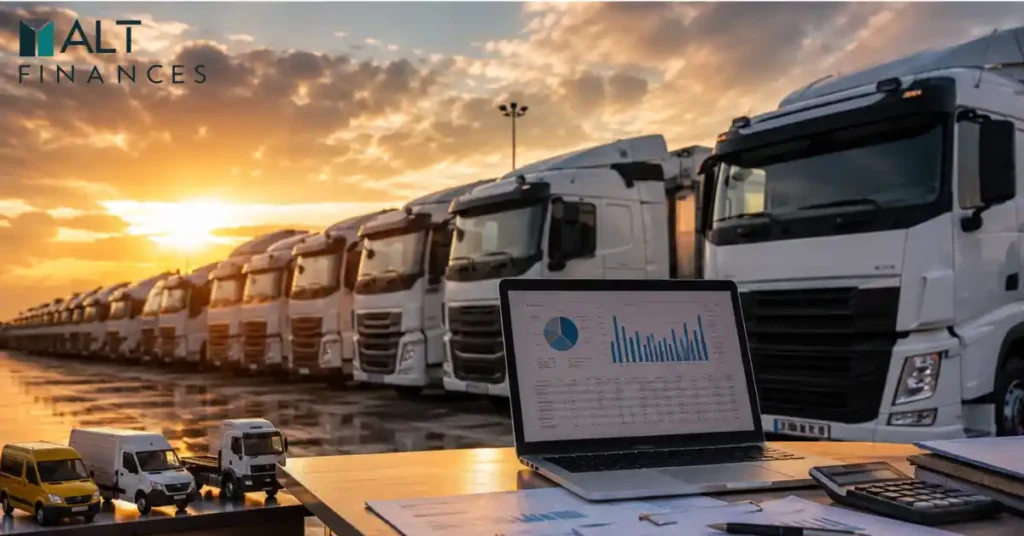
A delivery van, tractor-trailer, bus or service vehicle can be both a piece of equipment and a source of revenue and that dual role is what makes fleet finance such an unusual credit market. Millions of businesses depend on commercial vehicles to move goods, transport people, complete projects and generate income. Behind those physical assets sits a financing ecosystem in which lenders turn vehicle purchases into recurring streams of credit.
That makes business vehicle finance more than a conventional loan against a depreciating asset. From the lender’s perspective, the economics depend on a combination of borrower cash flow, vehicle value, funding costs, servicing and eventual recovery.
The basic chain is straightforward:
Fleet Demand → Vehicle Acquisition → Financing → Recurring Payments → Asset Depreciation → Recovery Value → Lender Economics
But the economics underneath that chain are considerably more complicated.
How Business Vehicle Finance Works
Commercial fleets can include trucks, vans, buses, trailers, delivery vehicles, construction vehicles and specialized service equipment. Businesses can finance these assets through several structures, including vehicle loans, hire purchase arrangements and different forms of leasing.
The distinction matters.
With a conventional secured vehicle loan, the borrower generally owns the vehicle while the lender holds a security interest. Under hire purchase, ownership typically transfers after contractual payments and conditions are satisfied. Finance leases and operating leases can allocate ownership, residual-value exposure and end-of-term obligations differently.
The legal, tax and accounting treatment varies by jurisdiction and structure, so investors should not treat every lease as economically identical to a loan.
The Federal Reserve’s survey of finance companies illustrates how important specialized financing institutions are to this ecosystem. Finance companies provide debt and lease financing to businesses and consumers and focus heavily on collateralized assets. Its data also separately tracks business motor-vehicle loans, fleet-related lending and motor-vehicle leases.
For lenders, the fundamental equation is:
Asset Value + Borrower Cash Flow + Repayment Capacity
The vehicle matters. But so does the business operating it.
How Lenders Actually Make Money From Fleet Finance
The obvious source of revenue is interest or financing income.
A lender advances capital to acquire a vehicle and receives scheduled payments over time. Depending on the structure, the lender may also receive origination or other contractual fees.
But the true economics are broader.
A simplified framework is:
Borrower Yield – Funding Cost – Credit Losses – Operating Costs = Potential Net Economics
This is not a universal accounting formula. It is a way of thinking about the business.
A lender can charge an attractive financing rate and still produce disappointing economics if its own funding becomes expensive, defaults increase, servicing costs rise or recovered vehicles sell for less than expected.
Portfolio scale can help. A lender with thousands of similar assets may be able to standardize underwriting, documentation, servicing, collections and remarketing. Scale can therefore turn individual vehicle contracts into a more operationally efficient credit portfolio.
But scale does not automatically create attractive returns. The quality of underwriting and funding remains decisive.
The Federal Reserve’s research also shows why funding deserves attention: finance companies do not have bank deposits as a traditional funding source and instead rely on sources such as notes, bonds, debentures, bank loans and structured financing.
The Vehicle Is Collateral but Not Just Collateral
A commercial vehicle is different from many forms of collateral because it can actively produce economic output.
A truck generates value by moving freight. A delivery van generates value by completing deliveries. A bus generates value by transporting passengers.
That creates a crucial connection between the physical asset and the borrower’s ability to repay.
Yet the collateral itself must be evaluated carefully.
| Factor | Why It Matters to the Lender |
|---|---|
| Vehicle age and mileage | Influences remaining useful life and resale prospects |
| Condition and maintenance | Affects recovery and remarketing value |
| Make and model | Determines secondary-market demand |
| Specialized equipment | Can increase utility but reduce the potential buyer pool |
| Geography | Affects demand, recovery logistics and resale markets |
| Utilization | Helps indicate how intensively the asset is being used |
| Residual value | Influences downside protection in leases and certain financing structures |
A relatively standardized delivery van with an active secondary market may have a very different recovery profile from a highly specialized construction vehicle.
This is why sophisticated lenders analyze the asset rather than simply assigning it a generic collateral value.
Fleet Cash Flow Is the First Line of Defense
The strongest collateral is not necessarily the vehicle itself. It is the cash flow generated by the business using that vehicle.
The credit relationship can be viewed as:
Revenue → Operating Cash Flow → Debt Service → Asset Value
A fleet operator may own valuable vehicles and still become a weak credit if freight demand collapses, fuel and labor costs rise sharply, insurance becomes more expensive or a major customer is lost.
This is particularly important during economic downturns.
A lender therefore needs to understand what the vehicles actually do. Are they supporting long-term contracts? Are they heavily dependent on spot freight markets? Does one customer represent a substantial share of revenue? How sensitive is the business to fuel prices or labor costs?
The vehicle can protect the lender after a default, but the business’s operating cash flow is what helps prevent that default in the first place.
Technology Is Changing Fleet Lending
Fleet finance is increasingly connected to data.
Telematics, GPS systems and connected vehicles can provide information about mileage, utilization, location and maintenance. Digital underwriting can combine traditional financial information with alternative data, while automated servicing and asset tracking can improve operational efficiency.
For lenders, better information can potentially improve credit decisions and identify deterioration earlier.
But technology does not eliminate risk.
Data can be incomplete or inaccurate. Connected systems create cybersecurity and privacy considerations. Automated underwriting can also produce poor decisions if the underlying data or models are flawed.
The opportunity is therefore less about replacing traditional credit analysis and more about making the existing process more information-rich.
For investors in specialty finance, that distinction matters. Technology may improve underwriting and servicing economics, but the underlying credit cycle remains.
The Electric Fleet Question
Electrification introduces another layer of uncertainty.
Electric commercial vehicles can change acquisition costs, maintenance requirements, charging needs and operating economics. For lenders, however, one of the most important questions may be what those vehicles are worth several years after origination.
Residual-value risk becomes especially important when technology changes rapidly.
Battery condition, degradation, charging infrastructure, changing vehicle specifications, government incentives and the development of second-hand EV markets can all influence future values.
That creates both opportunity and uncertainty for fleet financiers.
A lender financing an electric fleet is therefore underwriting more than a borrower. It is also making an implicit assessment of the future market for the underlying technology.
Why Institutional Investors Are Watching the Platform
The fleet-finance opportunity extends beyond individual vehicle loans.
A specialized lender can originate thousands of contracts, collect recurring payments, service the portfolio and potentially finance or securitize pools of receivables. The Federal Reserve explicitly tracks securitized motor-vehicle loans and leases within its finance-company data framework.
This is where fleet finance starts to resemble other areas of asset-backed finance.
The investment proposition is not simply:
Vehicle + Loan = Return
It is closer to:
Origination + Underwriting + Funding + Servicing + Asset Management + Recovery = Portfolio Economics
That distinction helps explain why specialist finance companies, leasing businesses, captive finance arms and alternative lenders can compete in this market.
Recent market activity also illustrates the strategic value of vehicle-leasing platforms. In August 2026, Reuters reported that Australia’s FleetPartners received a A$813.1 million acquisition offer from a Sumitomo-led consortium, following several competing approaches. The bidding interest highlights that vehicle leasing businesses can be valued for more than the physical assets on their balance sheets they can also provide financing, fleet-management and recurring-revenue capabilities.
The Risks Behind the Collateral
The phrase “asset-backed” can create a misleading sense of security.
Vehicles depreciate. Markets change. Borrowers default. Recovery takes time and money.
A lender can suffer losses when borrower cash flow deteriorates at the same time that vehicle values decline. Repossession, transportation, storage, refurbishment and remarketing can further reduce recoveries.
There is also funding risk.
If a lender relies heavily on short-term or floating-rate funding while holding longer-duration vehicle assets, changes in financing costs can pressure economics. Concentration can create another vulnerability if a portfolio is heavily exposed to one industry, geography, vehicle type or borrower segment.
Current market activity provides a reminder that vehicle-related credit is part of the broader financial system. In September 2026, Reuters reported that UK banks were using vehicle leases among higher-risk assets pledged as collateral in Bank of England liquidity operations.
That does not make vehicle leases inherently risky or safe. It demonstrates something more important: vehicle-related receivables can become financial assets that interact with broader funding and liquidity markets.
The Unique Investment Insight
The deeper business vehicle finance thesis is not simply that lenders make money by charging interest on vehicles.
The more important insight is that the lender is financing an income-producing asset while simultaneously taking exposure to the business operating it.
A truck has value because it can move freight.
A van has value because it can support deliveries.
A bus has value because it can transport passengers.
The lender is therefore exposed to both the asset and the cash flow generated by the asset.
That creates a distinctive credit model:
Productive Asset → Business Revenue → Debt Service → Collateral Protection
For investors, the critical question becomes: How much of the lender’s economics comes from contractual financing income, and how much ultimately depends on residual value and asset recovery?
That question can reveal risks hidden behind apparently well-secured portfolios.
A fleet portfolio may contain valuable physical assets yet produce weaker-than-expected economics if funding costs rise, borrower cash flows deteriorate, depreciation accelerates or recovery expenses consume collateral value.
Conclusion
Business vehicle finance represents an often-overlooked corner of specialty finance because its underlying assets are familiar but its financial structure is not.
Businesses need vehicles.
Vehicles require capital.
Lenders provide that capital.
Repayments create recurring cash flow.
Vehicles provide collateral.
Recovery determines downside protection.
Funding and credit costs determine lender economics.
The real investment analysis therefore goes beyond asking how many vehicles sit behind a financing portfolio. Investors need to examine who is borrowing, what the fleet generates, how vehicles are depreciating, what their residual values could be, how much the lender pays for funding and how efficiently it can service and recover assets.
The hidden market behind fleet finance is ultimately not about vehicles.
It is about converting productive physical assets and business cash flows into scalable credit portfolios and capturing the difference between what borrowers pay, what funding costs and what losses ultimately consume.
Frequently Asked Questions
What is business vehicle finance?
Business vehicle finance is financing provided to businesses for commercial vehicles and fleet assets. It can include secured vehicle loans, hire purchase and leasing structures, with economics depending on borrower credit quality, vehicle value, contractual terms and funding costs.
How do lenders make money from fleet finance?
Lenders can generate financing or interest income and, where applicable, contractual fees. Their economics are ultimately affected by funding costs, credit losses, servicing expenses, residual values and recovery costs.
What is commercial vehicle finance?
Commercial vehicle finance covers financing for vehicles used in business operations, including trucks, vans, buses, trailers, delivery vehicles and specialized commercial equipment.
How does fleet financing work?
A lender or finance company provides capital for a fleet asset, while the business makes contractual payments. Depending on the structure, ownership and residual-value exposure can remain with either the borrower, lender or leasing company.
Why do lenders use vehicles as collateral?
Vehicles are identifiable physical assets that can potentially be recovered and sold if a borrower defaults. However, collateral provides a recovery mechanism rather than a guarantee against losses.
How does vehicle depreciation affect fleet finance?
Depreciation reduces the value of the underlying asset over time. Faster-than-expected depreciation can weaken collateral protection and increase potential losses following default.
What is the difference between vehicle loans and leasing?
A vehicle loan generally involves financing an asset that the borrower owns subject to the lender’s security interest. Leasing separates the right to use the vehicle from ownership, with different structures determining payment obligations and residual-value exposure.
Why are residual values important to lenders?
Residual value matters because the expected future value of a vehicle can influence lease economics, collateral protection and potential recovery proceeds.
Can private credit funds invest in fleet finance?
Private credit investors can participate in specialty-finance and asset-backed structures involving vehicle receivables, depending on the fund, transaction structure, jurisdiction and applicable investment mandate.
Investment & Financial Disclaimer
This article provides general informational content and does not constitute financial, investment, legal, tax, accounting or lending advice. Business vehicle finance and asset-backed credit can involve significant credit, liquidity, funding, collateral, residual-value, operational, regulatory and market risks. The existence of physical collateral does not guarantee repayment or prevent investment losses. Investors should conduct independent due diligence and consult qualified professional advisers before making investment decisions.

Ana Goldenberg is a Contributing Editor at Alt Finances with a career rooted in the high-stakes worlds of banking and private placements. From profiling global philanthropists to managing complex financial operations at Wells Fargo, she bridges the gap between editorial storytelling and disciplined financial expertise.