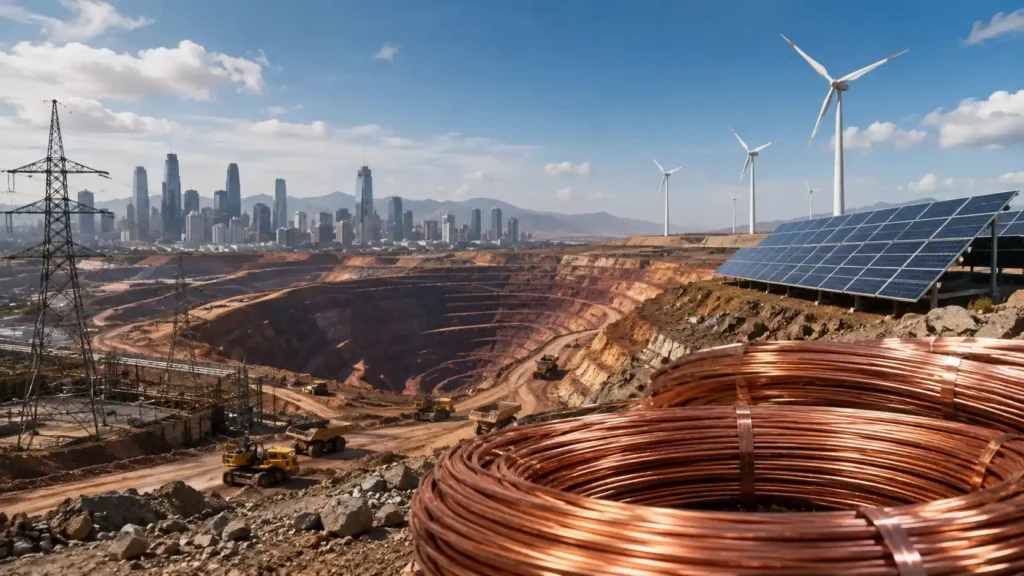
The next phase of the global energy transition will be determined by more than technology and capital. It will depend on whether the physical resources required to build a more electrified economy can be developed quickly enough. That is turning copper assets into an increasingly strategic part of the investment landscape. Power grids, renewable generation, electric vehicles, data centers and AI infrastructure all require vast networks of electrical equipment, making copper increasingly important to infrastructure investment and long-term capital allocation.
The investment question, however, is bigger than where copper prices go next. The more consequential question is who controls the mines, development projects, processing capacity and infrastructure capable of supplying the metal. New copper supply faces long development timelines, declining ore grades, rising costs and permitting challenges. S&P Global‘s recent research estimates that a new copper mine takes about 17 years on average from discovery to production, while other projects can face substantially longer timelines when permitting delays are included.
That creates a distinctive opportunity and a complicated risk for institutional investors and private capital.
Why Electrification Is Driving Copper Demand?
Electrification is reshaping infrastructure investment, driving expansion in transmission networks, renewable power generation, electric vehicles, charging infrastructure, batteries, industrial equipment and digital infrastructure.
Copper sits inside many of these systems because of its electrical conductivity and established role in power transmission and distribution. As a result, copper demand is increasingly linked to several investment cycles at once: grid modernization, renewable energy, industrial electrification, electric vehicles and data-center expansion.
The AI infrastructure boom adds another layer. Large data centers require substantial power connections, electrical distribution equipment and grid infrastructure. The investment chain therefore extends beyond technology companies into utilities, construction, equipment manufacturers, energy infrastructure and ultimately the mining sector.
S&P Global projects global copper demand could rise substantially through 2040, driven by power generation, transmission and digital infrastructure, while warning that supply expansion faces declining grades, higher costs and long development timelines.
Investor perspective: The important signal is not simply higher potential copper consumption. It is the growing number of infrastructure sectors competing for the same physical resource. That can influence capital allocation across mining companies, infrastructure projects, private capital and commodity-focused strategies, while leaving investors exposed to demand cycles, technological changes and commodity-price volatility.
The Supply Problem Behind the Copper Investment Thesis
Demand alone does not create an attractive mining investment. The real investment thesis begins with the difficulty of expanding supply.
Copper mining depends on technically complex projects that can require years of exploration, feasibility work, permitting, construction and infrastructure development. Existing mines also face declining ore grades, meaning operators may need to process more material to produce the same amount of copper.
S&P Global reported that average mined copper head grades fell materially between 2012 and 2022, increasing the amount of material that operators need to process. Its more recent research also highlights rising capital intensity, inflation in equipment and labor costs, increasingly complex extraction conditions and stricter environmental and social requirements.
A large copper resource does not guarantee an attractive investment. Projects still require substantial capital, infrastructure, regulatory approvals and years of development before production begins.
That distinction is crucial for investors. Copper assets are not interchangeable. A producing mine with established infrastructure has a fundamentally different risk profile from an early-stage exploration project. Similarly, a brownfield expansion can face a different development pathway from a new mine in a remote jurisdiction.
The economics also change when copper prices rise. Higher prices can encourage exploration and make marginal projects more attractive. However, higher prices can simultaneously increase competition for equipment, skilled labor, financing and development services. They do not automatically solve permitting, geological or infrastructure constraints.
| Copper Investment Theme | Primary Growth Driver | Key Risk |
|---|---|---|
| Grid modernization | Electricity demand and transmission investment | Permitting and construction delays |
| Renewable energy | Expansion of power generation | Project economics and policy changes |
| Electric vehicles | Transport electrification | Adoption rates and technology shifts |
| Data centers | AI and cloud computing | Power availability and technology changes |
| Copper mining | Structural demand for refined metal | Commodity prices, costs and project execution |
| Recycling | Rising demand for secondary supply | Collection, processing and availability |
The table highlights an important distinction: copper exposure can occur at several points in the investment chain, and each has different risk drivers. A mining company is exposed to geology and operating costs, while an infrastructure investor may be more concerned with project finance, regulation and electricity demand.
For institutional investors, that creates room for differentiated capital allocation rather than a simple bet on copper prices. Capital can flow toward established producers, development-stage projects, exploration, processing infrastructure or businesses that provide royalties and streaming exposure.
The challenge is determining which assets can actually convert long-term demand into sustainable economic returns.
Why Governments and Investors Want Copper Assets?
Copper’s strategic importance becomes clearer when supply security enters the equation. Governments increasingly view critical minerals as essential to industrial resilience, energy security and national competitiveness. For investors, that means a project’s value can depend on more than its expected production profile.
Resource nationalism is one factor. Major copper-producing regions can seek greater domestic participation in mining projects, higher fiscal revenues or more control over strategic resources. At the same time, consuming economies increasingly want to diversify supply away from concentrated processing and production networks.
China remains particularly important because of its position across the global copper processing chain. That does not mean copper supply depends on one country, but it does mean investors need to consider processing capacity alongside mine ownership. The IEA has warned that refining and processing of many critical minerals has become increasingly concentrated geographically, creating potential vulnerabilities when trade relationships deteriorate.
Mining companies are responding through new exploration, mine expansions, acquisitions and partnerships, while governments are promoting domestic mineral development and supply-chain diversification.
For institutional investors, this creates several potential routes to copper assets. Exposure can come through established mining companies, development-stage projects, exploration, royalty businesses, streaming companies or specialized commodity funds. Each provides a different balance of liquidity, operational exposure and commodity sensitivity.
A copper asset’s long-term attractiveness therefore depends not only on its cost position but also on location, infrastructure, permitting, political stability and processing access.
Investor perspective: Capital is increasingly likely to favor copper projects that combine attractive geology with credible infrastructure, stable jurisdictions and realistic development pathways. However, strategic importance should not be confused with guaranteed profitability. Policy changes, cost inflation, commodity cycles and execution risk remain central to investment outcomes.
Comparing Copper Investment Opportunities
Investors can access copper through several structures, each offering a different combination of commodity exposure, liquidity and operational risk.
Producing mining companies provide direct exposure to copper output and prices, but investors also inherit labor, energy, environmental, financing and operational risks. Development projects offer exposure to future production but require capital before revenues arrive. Exploration assets carry even greater uncertainty because geological success is far from guaranteed.
Royalty and streaming businesses provide another approach. Instead of directly operating mines, these companies typically provide capital in exchange for contractual rights to a portion of future production or revenues. That structure can alter the risk profile, although it does not eliminate exposure to mining operations or commodity markets.
Commodity funds offer yet another route. They can provide more liquid exposure to copper prices without requiring investors to select individual mining assets. However, commodity exposure does not necessarily capture the strategic value of owning a high-quality deposit or production asset.
| Copper Asset Type | Investment Opportunity | Primary Challenge |
|---|---|---|
| Copper Mining Companies | Exposure to production and copper prices | Operating, cost and geopolitical risk |
| Development Projects | Potential future production growth | Financing, permitting and construction |
| Exploration Assets | Early exposure to new discoveries | High geological and development uncertainty |
| Royalty & Streaming Companies | Contractual exposure to mining revenues or production | Counterparty and commodity-cycle risk |
| Commodity Funds | More liquid copper-price exposure | Limited direct exposure to individual assets |
Copper assets should therefore be viewed as a spectrum rather than a single investment category. Different exposure types can help balance liquidity and development risk, but none eliminates commodity-cycle risk. Copper prices can fall even when the long-term electrification thesis remains intact.
That distinction is particularly important for institutional investors. A strong structural demand story can coexist with weak short-term returns if investors pay too much for assets, mining costs rise sharply or economic growth slows.
Investor perspective: The most attractive copper investment may depend on the investor’s time horizon and risk tolerance. Producers, developers, explorers, royalty companies and funds offer fundamentally different exposure. Capital allocation therefore matters as much as the underlying copper thesis.
The Geopolitical Race for Copper
Copper is becoming increasingly intertwined with geopolitical strategy.
Latin America remains central to global copper production, while African countries are attracting growing mining investment as companies seek additional resources. At the same time, major economies are developing critical-mineral strategies designed to strengthen domestic supply chains and reduce excessive dependence on concentrated sources.
A mining jurisdiction with large deposits may attract significant capital, but investors must evaluate taxation, permitting, political stability, infrastructure and government participation. Conversely, jurisdictions with strong institutions may offer greater predictability but higher labor, regulatory or development costs.
Processing creates another strategic layer. Mining and refining do not have to occur in the same country. As governments seek greater control over strategic supply chains, investors may increasingly evaluate smelters, refineries, transportation networks and other infrastructure alongside mines.
The energy transition also creates an unusual feedback loop. Governments want more copper to build electrification infrastructure, but mining itself requires substantial energy, water, transportation and capital. A copper project therefore depends partly on the infrastructure that the wider energy transition is trying to expand.
Resource nationalism can intensify this competition. Governments may seek greater local ownership or processing requirements to retain more economic value. While such policies can support domestic development, they can also increase project complexity and reduce investor certainty.
Investor perspective: Jurisdiction may become nearly as important as geology when assessing long-term copper exposure. Institutional investors and private capital need to consider political risk, trade policy, infrastructure, processing capacity and government strategy alongside traditional mining metrics.
The Future of Copper Investment
The long-term copper thesis rests on several infrastructure trends, led by grid modernization. Rising electricity demand and aging transmission networks are driving investment, while renewable generation requires new connections between power sources and consumers.
Electric vehicles provide another source of demand, although the pace of adoption will depend on consumer economics, charging infrastructure, government policy and technological development.
Then there is AI infrastructure. Data centers require large quantities of electricity and sophisticated electrical equipment. As hyperscale computing expands, investment in power generation, transmission and data-center infrastructure can create additional copper-intensive demand.
Copper recycling can increase secondary supply. Technological innovation can reduce copper intensity in certain applications. Alternative materials may replace copper in some uses. A global economic slowdown could also weaken industrial demand.
The investment thesis should therefore be framed around structural demand versus cyclical pricing. Electrification can remain a powerful long-term trend while copper prices still experience sharp periods of weakness.
Investor perspective: Long-term investors should focus on the durability of infrastructure demand, the quality of individual assets and the economics required to bring new supply online. The biggest opportunity may lie where strategic demand meets scarce, economically viable supply not simply where forecasts point to higher copper prices.
Unique Insight
The deeper investment story is that copper assets represent more than exposure to a commodity cycle.
Copper sits at the intersection of:
electrification → infrastructure → energy security → industrial policy → geopolitical competition → capital allocation.
That chain changes how investors can think about the sector.
A copper mine is not simply a producer of a raw material. It can become an input into power-grid expansion, renewable generation, electric transportation, industrial production and digital infrastructure. As governments place greater emphasis on secure mineral supply chains, ownership of high-quality resources can acquire strategic importance.
Yet strategic importance does not automatically create shareholder value.
The critical question remains whether an asset can produce copper economically after accounting for capital expenditure, operating costs, environmental requirements, taxes, financing costs and geopolitical risks.
That is why the strongest copper thesis is not necessarily the asset with the greatest exposure to a rising copper price. Depending on market conditions, value may instead emerge from a low-cost producing mine, a high-quality deposit with infrastructure access, a strategically located processing facility, or a royalty and streaming structure with attractive contractual economics.
This creates a more sophisticated investment framework:
Geology + economics + infrastructure + jurisdiction + technology + geopolitics.
That combination explains why copper is increasingly attracting institutional investors and private capital while remaining a highly cyclical and risk-intensive market.
Frequently Asked Questions
What are copper assets?
Copper assets include producing mines, development projects, exploration properties, processing facilities, royalty and streaming interests, and other investments connected to copper production and supply.
Why is copper important for electrification?
Copper’s electrical conductivity makes it an important material for power grids, electrical equipment, renewable-energy systems, industrial electrification and many forms of transportation infrastructure.
Why is copper demand expected to grow?
Demand may benefit from overlapping investment cycles involving grid modernization, renewable energy, electric vehicles, data centers, industrial electrification and broader infrastructure development. However, actual demand will depend on economic growth, technology and adoption rates.
What industries consume the most copper?
Electrical equipment, construction, power infrastructure, industrial machinery and transportation represent major areas of copper use. The precise mix changes across markets and economic cycles.
Why are copper mines difficult to develop?
Large projects can require extensive exploration, permitting, financing, infrastructure construction and environmental review. Development can therefore take many years and require substantial capital.
How do investors gain exposure to copper assets?
Investors can gain exposure through mining companies, development projects, exploration companies, royalty and streaming businesses, commodity funds and other resource-focused investment vehicles.
What are the risks of copper mining investments?
Major risks include copper-price volatility, operating costs, project delays, geological uncertainty, environmental regulation, financing costs, political risk and resource nationalism.
Why is copper considered a critical mineral?
Copper is essential to many electrical and industrial systems and has become increasingly important to energy-transition infrastructure. Governments therefore increasingly consider secure copper supply a strategic economic issue.
How do AI data centers affect copper demand?
AI data centers require large amounts of electrical infrastructure, including power connections, distribution equipment and related grid investment. That can create additional indirect demand for copper-intensive infrastructure.
Why are institutional investors interested in copper?
Institutional investors may view copper as an exposure to long-term infrastructure, electrification and industrial investment trends. However, they must also assess commodity cycles, asset valuations, operating risks and geopolitical conditions.
Why are copper assets becoming an important long-term investment theme?
Copper assets are becoming increasingly important because electrification, grid modernization, renewable energy, electric vehicles and AI infrastructure all depend on expanding physical infrastructure. The investment case therefore extends beyond copper prices to the ownership, development and financing of resources capable of supplying that infrastructure.

Marcie Bilawsky
Marcie Bilawsky is a Financial Writer & Research Contributor at AltFinances, covering investing, alternative assets, wealth management, and global financial markets. Her work focuses on making complex financial trends, investment themes, and emerging market opportunities easier to understand through research-driven analysis.