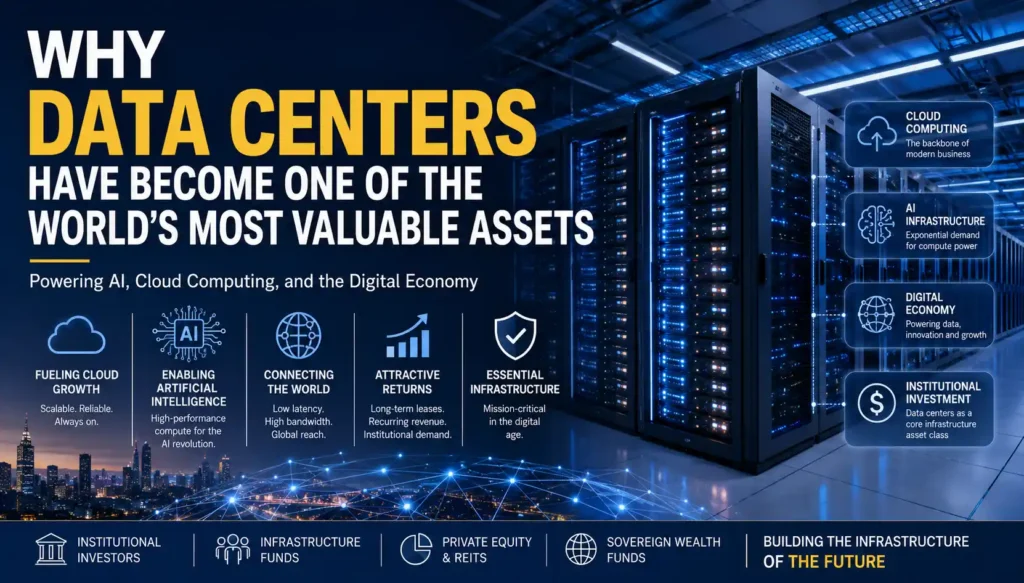
Data center investments have rapidly emerged as one of the most compelling themes in global finance. Within just a few years, investors have shifted from viewing data centers as a niche real estate category to seeing them as strategic assets that underpin the modern digital economy. The explosive growth of artificial intelligence, cloud computing, and digital services has transformed computing capacity into a resource as critical as energy, transportation, or telecommunications infrastructure.
Nearly every digital activity now depends on data centers. Streaming platforms, financial markets, enterprise software, e-commerce, social networks, and AI applications all require vast amounts of computing power and secure digital infrastructure. As organizations accelerate digital transformation, demand for storage, processing, and connectivity continues to expand at an extraordinary pace.
Institutional investors have taken notice. Pension funds, sovereign wealth funds, infrastructure managers, private equity firms, and REITs are deploying billions of dollars into data center real estate and AI infrastructure. The appeal is straightforward: these facilities often provide long-term contracts, recurring revenue, and exposure to powerful structural trends including cloud computing adoption and enterprise technology spending.
In many respects, computing capacity is becoming as valuable as physical infrastructure itself. The facilities quietly processing global data flows increasingly resemble the power stations and transportation networks that defined previous industrial eras. As a result, data centers are emerging as one of the defining investments of the digital age.
Understanding Data Centers as a Modern Asset Class
At their core, data centers are highly specialized facilities that house servers, networking equipment, and storage systems that process and distribute digital information. Although they resemble industrial buildings, their value lies less in square footage and more in the availability of electricity, connectivity, and computing capacity.
A typical data center includes:
- Server infrastructure that performs computing tasks.
- Cooling systems that maintain equipment performance.
- Redundant power supplies and backup generators.
- High-speed fiber connections linking customers to global networks.
- Security systems designed to protect both physical and digital assets.
The industry has evolved into several business models. Colocation facilities lease space and connectivity to multiple customers, while hyperscale data centers are massive campuses built primarily for cloud computing giants and large technology companies.
These facilities have become essential components of digital infrastructure because modern economies increasingly rely on uninterrupted access to data and computing resources. A temporary outage can disrupt banking systems, healthcare providers, logistics networks, and entire supply chains.
Unlike traditional commercial real estate, data center real estate derives its value from operational capabilities rather than tenant foot traffic or office demand. A location with abundant electricity, low-latency fiber networks, and room for expansion can command significant premiums regardless of local commercial property conditions.
The distinction is increasingly important because investors are no longer simply buying buildings. They are investing in technological capacity that powers the global economy.
Why AI Is Fueling Unprecedented Demand?
Artificial intelligence has fundamentally changed the economics of the data center market.
Generative AI systems require enormous amounts of computing power. Training and operating advanced AI models depend on thousands of high-performance graphics processing units operating simultaneously. These workloads consume dramatically more electricity and processing resources than traditional enterprise applications.
As a result, demand for AI infrastructure has surged.
Several factors are driving this expansion:
- Enterprise adoption of generative AI applications.
- Increasing cloud services consumption.
- Growth in machine learning and analytics workloads.
- Rising demand for high-performance computing.
- Expansion of AI-enabled software products.
Many markets are now experiencing shortages of available capacity. Developers are racing to secure land, electricity, and equipment to meet rapidly growing demand.
The acceleration of artificial intelligence infrastructure also changes investment assumptions. Data centers that once required modest power capacity now seek hundreds of megawatts of electricity. In some regions, power availability has become the primary constraint on growth rather than construction capital.
The result is a profound shift in investor perception. Computing infrastructure is increasingly viewed as a strategic asset class capable of benefiting from one of the most transformative technology cycles in decades.
Why Investors Are Buying Data Centers?
Institutional capital has poured into data centers because the sector combines infrastructure characteristics with technology-driven growth.
Pension funds, sovereign wealth funds, and private equity firms are increasingly allocating capital to digital infrastructure, mirroring the trend of family offices buying farmland instead of office buildings as investors seek long-duration, inflation-resistant assets.
Long-term leases and recurring revenues have attracted infrastructure investors seeking stable cash flows. At the same time, exposure to cloud computing and AI provides growth potential that many traditional infrastructure sectors struggle to match.
Major investor groups entering the sector include:
- Infrastructure funds.
- Sovereign wealth funds.
- Pension funds.
- Private equity firms.
- Data center REITs.
- Insurance companies and institutional asset managers.
Many investors also appreciate the diversification benefits of alternative investments tied to digital infrastructure rather than economic cycles alone.
The appeal becomes clearer when comparing data centers with other infrastructure categories.
| Infrastructure Asset | Primary Revenue Driver | Long-Term Growth Catalyst |
|---|---|---|
| Data Centers | Computing capacity and long-term leases | AI adoption and cloud computing growth |
| Commercial Real Estate | Rent from office, retail, and industrial tenants | Population and business expansion |
| Energy Infrastructure | Electricity generation and distribution | Energy transition and rising consumption |
| Telecommunications Infrastructure | Connectivity and network usage | Mobile data growth and digital communication |
This comparison highlights why institutional investing increasingly favors digital assets. Traditional real estate markets often experience cyclical demand patterns, whereas data centers benefit from structural trends driven by digitization.
Furthermore, many data center operators maintain relationships with investment-grade tenants and global technology companies. Such partnerships can provide visibility into future demand, making the sector particularly attractive to long-duration investors.
Yet the industry is not immune to competition or oversupply risks. Capital is flowing rapidly into new projects, and investors must carefully assess local markets, power availability, and technological obsolescence.
Risks, Sustainability, and Infrastructure Challenges
Despite the enthusiasm surrounding data center investments, the sector faces meaningful challenges.
The most immediate issue is electricity consumption. Modern AI infrastructure requires enormous amounts of power, placing significant strain on regional energy grids. In certain markets, developers wait years for access to sufficient electricity capacity.
Environmental concerns also continue to grow.
Key sustainability challenges include:
- Rising electricity consumption.
- Significant water usage for cooling systems.
- Carbon emissions from energy-intensive operations.
- Construction material requirements.
- Community concerns regarding local infrastructure impacts.
In response, many operators are investing heavily in renewable energy procurement, advanced cooling technologies, and energy-efficient designs.
Construction costs represent another challenge. Building hyperscale data centers requires significant capital expenditures, including specialized equipment and power infrastructure. Rising interest rates and supply chain disruptions have further increased development costs.
Regulatory issues also deserve attention. Governments increasingly scrutinize energy consumption, environmental impacts, and cybersecurity standards. Data sovereignty regulations in various jurisdictions may influence where companies choose to locate infrastructure.
Geographic constraints are equally important. Prime data center markets require a rare combination of affordable land, robust fiber connectivity, stable regulation, and abundant electricity supplies. Suitable locations are becoming increasingly scarce.
These risks underscore a critical point: while digital infrastructure may offer compelling growth opportunities, it is neither simple nor risk-free.
Comparing Data Centers With Other Infrastructure Assets
The investment characteristics of data centers differ meaningfully from other infrastructure categories.
Commercial real estate typically generates income through occupancy rates and rental growth. Energy infrastructure often relies on regulated returns and long-term contracts. Telecommunications infrastructure benefits from increasing data usage and network expansion.
Data centers combine elements of all three categories while introducing technology-related risks and opportunities.
| Asset Class | Primary Advantage | Best Suited For |
| Data Centers | Exposure to AI and cloud growth | Long-term growth investors |
| Commercial Real Estate | Stable income from diversified tenants | Income-focused investors |
| Energy Infrastructure | Essential service demand | Defensive infrastructure investors |
| Telecommunications Infrastructure | Recurring connectivity revenues | Investors seeking steady cash flows |
Data centers generally require higher capital intensity and greater operational expertise than many traditional real estate sectors. However, they also offer stronger growth prospects due to increasing demand for computing power.
The ideal investor profile therefore tends to include institutions capable of making long-term commitments and managing complex operational risks. Infrastructure investing increasingly involves technological understanding alongside traditional financial analysis.
The convergence of technology and infrastructure has created an entirely new category of assets that does not fit neatly within historical investment frameworks.
The Future of Digital Infrastructure Investing
The long-term outlook for digital infrastructure remains closely tied to global technology trends.
Artificial intelligence expansion appears likely to increase demand for computing resources for years to come. Edge computing, which processes information closer to end users, may create entirely new categories of server farms and regional data centers.
The expansion of AI and cloud computing reinforces the importance of infrastructure investing, as investors increasingly view computing capacity as essential infrastructure rather than simply another form of commercial real estate.
Governments are also beginning to view digital infrastructure as a strategic national priority. Concerns surrounding economic competitiveness, technological sovereignty, and cybersecurity are encouraging public and private investment in domestic infrastructure capacity.
Several themes are likely to shape future investment activity:
- Expansion of AI workloads.
- Development of next-generation networking technologies.
- Increased investment in renewable energy integration.
- Growth in sovereign digital infrastructure strategies.
- Greater focus on energy efficiency and sustainability.
The future of the data center market will ultimately depend on balancing extraordinary demand growth with operational constraints such as electricity supply, regulation, and environmental concerns.
Nevertheless, the trajectory of digital transformation suggests that demand for computing infrastructure will remain one of the defining investment themes of the coming decade.
Unique Insight: From Owning Space to Owning Digital Capacity
Data center investments represent something far more significant than another real estate trend.
Historically, investors built wealth by owning physical assets such as office towers, ports, roads, and shopping centers. Today, value increasingly resides in digital capacity. Computing power has become an essential economic resource that supports everything from financial transactions to artificial intelligence applications.
This transformation changes how investors evaluate infrastructure. Connectivity, power access, and processing capabilities now matter as much as location and physical structures. In some cases, they matter even more.
AI is accelerating this transition by turning data centers into strategic infrastructure assets rather than simple technology facilities. Governments increasingly view digital infrastructure as critical to national competitiveness and economic resilience.
The implications are profound. Future wealth creation may depend as much on ownership of digital infrastructure as ownership of traditional physical infrastructure.
The world’s most valuable assets may no longer be highways, office towers, or shopping centers. Instead, they may be the highly specialized facilities quietly processing the data, AI models, cloud services, and financial transactions that underpin the modern economy.
Frequently Asked Questions
What are data center investments?
Data center investments involve allocating capital to facilities that house computing and networking equipment. Investors may gain exposure through direct ownership, infrastructure funds, private equity, or data center REITs.
Why are data centers attracting institutional investors?
They offer exposure to long-term digital transformation trends, recurring revenue models, and growing demand for cloud computing and AI infrastructure.
How does AI increase demand for data centers?
AI applications require enormous computing resources and electricity, leading to rising demand for new computing capacity and specialized facilities.
Are data centers considered real estate or infrastructure?
They are increasingly viewed as a hybrid asset class that combines elements of commercial real estate and essential digital infrastructure.
What are hyperscale data centers?
Hyperscale data centers are massive facilities designed to support cloud providers and large technology companies with extensive computing requirements.
What risks are associated with investing in data centers?
Major risks include power shortages, regulatory changes, environmental concerns, construction costs, technological change, and potential oversupply.
How do data center REITs work?
Data center REITs own and operate facilities that generate income through long-term leasing arrangements with technology companies and enterprises.
Why is power availability so important for data centers?
Computing infrastructure depends on reliable electricity. Without adequate power capacity, new facilities cannot operate or expand.
Will AI continue to drive demand for digital infrastructure?
Most industry forecasts expect AI adoption to remain a major driver of demand for computing power and digital infrastructure investment.
Why are Data center investments becoming one of the world’s fastest-growing asset classes?
Data center investments are benefiting from structural trends including artificial intelligence adoption, cloud computing growth, enterprise technology spending, and the ongoing expansion of the digital economy.

Administrator at Alt Finances, leading editorial strategy and contributing in-depth coverage of investing, wealth management, alternative assets, and global financial markets. Through research-driven articles and analysis, he helps readers understand the ideas, industries, and market forces shaping modern finance.