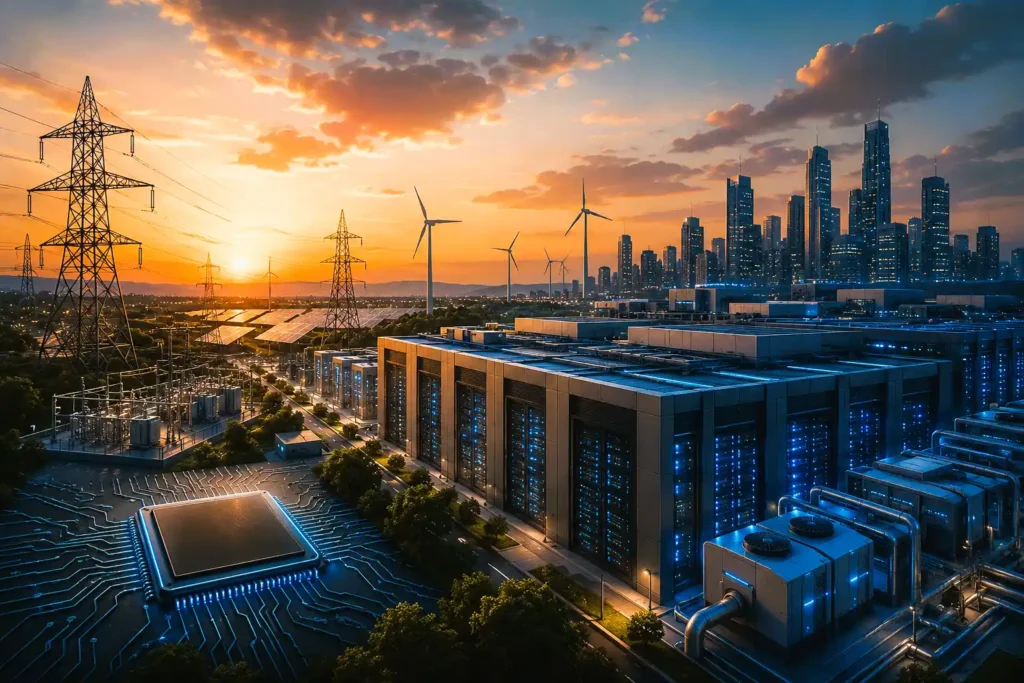
The AI Infrastructure Investment is becoming one of the most important investment narratives of the decade. While headlines often focus on leading chip designers, the broader story increasingly revolves around AI infrastructure investment and the physical systems required to support large-scale artificial intelligence deployment. As organizations accelerate AI adoption, demand for computing power continues to rise, creating new requirements for data centers, cloud platforms, networking equipment, energy generation, and digital infrastructure.
Artificial intelligence does not operate in isolation. Every AI model relies on an ecosystem that includes semiconductors, cloud computing infrastructure, power infrastructure, and complex supply chains. Consequently, AI infrastructure investment is emerging as a multi-industry capital allocation theme rather than a narrow technology trade.
Research from organizations such as the International Energy Agency (IEA), McKinsey & Company, Goldman Sachs Research, and BlackRock Investment Institute highlights growing attention on AI data centers, electricity demand, and infrastructure modernization. As a result, institutional investors increasingly view AI infrastructure as a long-term investment trend linked to productivity growth, industrial investment, and global competitiveness rather than a short-term market phenomenon.
Why the AI Investment Story Extends Beyond Nvidia?
The early phase of the AI boom centered on advanced chips and the companies producing them. However, The AI Infrastructure Investment Boom: Beyond Nvidia reflects a much larger ecosystem.
Every AI application requires several interconnected layers. First, semiconductor manufacturers must increase production capacity to meet demand for advanced processors. Second, cloud providers such as Microsoft and Amazon Web Services (AWS) must expand computing resources to support enterprise workloads. Third, networking providers must move enormous quantities of data efficiently across increasingly complex systems.
This ecosystem also includes engineering firms, construction companies, cooling technology providers, utility operators, transmission developers, and data center developers. Each participant contributes to the infrastructure required to train and deploy large AI models.
The scale of capital expenditure is significant. Major cloud providers have announced substantial investments in AI-related infrastructure, while governments around the world seek to strengthen semiconductor manufacturing and domestic technology capabilities. These developments indicate that AI growth increasingly depends on infrastructure expansion rather than software innovation alone.
For investors, this matters because value creation may occur across multiple industries. The semiconductor industry remains important, yet the broader AI supply chain may capture a growing share of future infrastructure spending. Capital allocation decisions therefore extend beyond technology companies and into industrial, energy, and infrastructure sectors.
Why this matters to investors: AI infrastructure broadens the opportunity set across multiple industries. However, infrastructure development requires substantial capital, long timelines, and favorable economic conditions. Investors must therefore evaluate the entire ecosystem rather than focusing exclusively on individual technology leaders.
The Physical Infrastructure Powering Artificial Intelligence
The rapid growth of AI workloads has transformed demand for AI data centers and hyperscale data centers. These facilities house thousands of servers and advanced processors that perform the computational tasks required by modern artificial intelligence systems.
Yet computing power is only one piece of the equation. Data centers require enormous amounts of electricity, sophisticated cooling systems, reliable networking equipment, and resilient power infrastructure. According to the IEA and industry analysts, AI deployment could contribute to rising electricity demand in many regions over the coming years.
Consequently, grid modernization has become a central investment theme. Existing transmission networks were not designed for the concentration of energy consumption associated with large AI clusters. Utilities therefore face pressure to expand generation capacity while upgrading transmission and distribution systems.
Renewable energy also plays an increasingly important role. Many technology companies have established sustainability targets and are seeking cleaner energy sources to support future growth. However, balancing reliability, affordability, and sustainability remains a significant challenge.
The infrastructure requirements extend well beyond power generation. Water usage, cooling technologies, backup systems, fiber networks, and land availability all influence where future data centers can be developed.
Before examining investment implications, it is useful to compare key infrastructure drivers.
| Infrastructure Theme | Primary Growth Driver | Key Challenge |
|---|---|---|
| Semiconductor Infrastructure | AI computing demand | Manufacturing complexity |
| AI Data Centers | Model training and inference | Energy consumption |
| Power & Utilities Infrastructure | Rising electricity demand | Permitting and grid constraints |
| Digital Infrastructure | Data movement and connectivity | Capacity expansion |
The table illustrates an important reality: every component of the AI ecosystem faces a distinct growth opportunity alongside a unique operational challenge.
Semiconductor facilities require massive investment and advanced manufacturing expertise. Data centers need reliable access to power. Utilities must navigate permitting processes and infrastructure bottlenecks. Meanwhile, digital infrastructure operators must continuously expand network capacity to accommodate increasing traffic.
Together, these trends reinforce the idea that artificial intelligence is becoming a catalyst for broader infrastructure modernization.
Why this matters to investors: Infrastructure demand appears likely to remain strong if AI adoption continues. Nevertheless, energy availability, permitting delays, construction costs, and financing conditions may influence project economics and investment outcomes.
Opportunities, Risks, and Capital Allocation
The expansion of AI infrastructure is reshaping capital allocation across the global economy. Large-scale projects require billions of dollars in financing and often involve long development timelines.
On one hand, growing demand for computing power creates opportunities for infrastructure developers, utilities, engineering firms, and equipment suppliers. On the other hand, significant risks remain.
Energy constraints represent one of the most discussed challenges. In some regions, electricity demand growth may outpace available capacity. Grid congestion, transmission limitations, and permitting delays could slow development schedules.
Supply chain risks also deserve attention. The semiconductor industry remains highly specialized and geographically concentrated. Disruptions in manufacturing, trade policy changes, or geopolitical tensions could affect infrastructure deployment.
Regulatory considerations add another layer of complexity. Environmental approvals, land-use requirements, energy policies, and sustainability standards can influence project timelines and costs.
Furthermore, financing conditions matter. Infrastructure projects often depend on long-term funding arrangements. Higher interest rates or tighter credit conditions could affect future investment activity.
These factors suggest that AI infrastructure should not be viewed as a guaranteed investment opportunity. Outcomes depend on AI adoption rates, technological innovation, energy availability, regulation, competition, and macroeconomic conditions.
Comparing AI Infrastructure Investment Themes
| Infrastructure Asset | Investment Opportunity | Primary Risk |
| Semiconductor Infrastructure | Expanding AI chip capacity | Cyclical demand fluctuations |
| AI Data Centers | Growing compute requirements | Power availability constraints |
| Power & Utilities Infrastructure | Long-term electricity demand | Regulatory uncertainty |
| Digital Infrastructure | Connectivity and cloud growth | Technology obsolescence |
The table highlights the diversity of opportunities within AI infrastructure investment.
Semiconductor Infrastructure focuses on expanding manufacturing capacity and supporting the AI supply chain. Growth drivers remain strong, but capital intensity is extremely high and technological complexity creates execution risk. This theme may appeal to investors comfortable with industrial and technology cycles.
AI Data Centers benefit from increasing demand for model training and inference. Long-term demand appears favorable, although energy availability and operational costs remain critical considerations. Investors seeking exposure to physical technology infrastructure often focus on this segment.
Power & Utilities Infrastructure is increasingly linked to AI growth because rising electricity demand requires new generation, transmission, and distribution assets. While demand visibility may be relatively strong, regulatory oversight and permitting risks remain important.
Digital Infrastructure includes fiber networks, cloud computing infrastructure, networking equipment, and connectivity assets. These systems support data movement across AI ecosystems. Although demand trends appear favorable, technological change can create competitive pressures.
Ideal investors vary by theme. Infrastructure funds and pension funds may favor utilities and data center assets with long-duration cash-flow characteristics. Growth-oriented investors may prefer semiconductor-related opportunities. Family offices and alternative investment managers increasingly evaluate diversified exposure across several infrastructure categories.
Why this matters to investors: Diversification across infrastructure layers may reduce reliance on any single technology company or market segment. However, each theme carries distinct risks, capital requirements, and competitive dynamics.
The Future of AI Infrastructure Investing
Looking ahead, AI infrastructure development will likely intersect with several broader economic trends.
Sovereign AI initiatives are encouraging governments to invest in domestic computing capacity and semiconductor production. At the same time, energy innovation is becoming increasingly important as countries seek reliable power sources for future digital economies.
Digital transformation continues across industries ranging from healthcare and manufacturing to finance and logistics. As AI adoption expands, demand for cloud computing, networking capacity, and advanced data centers may continue to grow.
Infrastructure modernization also supports broader goals related to productivity growth and global competitiveness. Nations that successfully develop technology infrastructure, energy systems, and semiconductor capabilities may strengthen their positions in the evolving digital economy.
Still, future outcomes remain uncertain. AI deployment patterns, energy policy decisions, financing costs, and technological breakthroughs will all influence the pace of investment.
Why this matters to investors: AI infrastructure increasingly resembles a long-duration capital investment cycle. Strategic positioning therefore requires patience, disciplined analysis, and careful assessment of both opportunities and risks.
Unique Insight
The most important lesson from The AI Infrastructure Investment Boom: Beyond Nvidia is that AI infrastructure investment represents a broad industrial transformation rather than a single-company growth story.
Institutional investors increasingly analyze artificial intelligence through an ecosystem lens. Energy systems, semiconductors, cloud infrastructure, networking equipment, AI data centers, and digital infrastructure function as interconnected components of the same economic engine. If demand for computing power continues to rise, investment flows may extend across multiple industries for years rather than concentrating solely in a handful of technology companies.
This perspective shifts the focus from short-term market enthusiasm toward long-term infrastructure development. Instead of asking which company will dominate AI, investors increasingly ask which infrastructure assets are necessary to sustain large-scale AI deployment. That distinction may define the next phase of capital allocation across the global economy.
Frequently Asked Questions
What is AI infrastructure investment?
AI infrastructure investment refers to capital allocated toward the physical and digital systems required to develop, train, deploy, and operate artificial intelligence technologies. This includes semiconductors, AI data centers, cloud computing infrastructure, networking equipment, power infrastructure, and related supply chains.
Why is AI investing expanding beyond Nvidia?
AI requires an entire ecosystem of infrastructure. While advanced chips remain essential, organizations also need data centers, energy generation, transmission networks, cooling systems, and cloud platforms to support large-scale deployment.
Why do AI data centers require so much electricity?
AI workloads involve intensive computing processes that require large numbers of processors operating continuously. These systems consume significant power and also require energy-intensive cooling technologies.
Which industries benefit from AI infrastructure spending?
Potential beneficiaries include the semiconductor industry, utilities, engineering firms, construction companies, networking providers, cloud operators, renewable energy developers, and digital infrastructure operators.
How are cloud providers supporting AI growth?
Cloud providers expand computing capacity, storage, networking resources, and specialized AI services that allow organizations to deploy artificial intelligence applications without building their own infrastructure.
What role do utilities play in AI infrastructure?
Utilities provide the electricity generation, transmission, and distribution capacity required to support expanding AI data centers and digital infrastructure networks.
Why is grid modernization important for AI?
Grid modernization helps ensure that electricity can be delivered reliably to energy-intensive computing facilities while supporting broader infrastructure expansion and economic growth.
What are the biggest risks of AI infrastructure investment?
Major risks include energy shortages, permitting delays, supply chain disruptions, regulatory changes, financing challenges, technological shifts, and slower-than-expected AI adoption.
How are institutional investors approaching AI infrastructure?
Many institutional investors increasingly evaluate infrastructure assets as part of a long-term investment strategy tied to digital transformation, industrial modernization, and productivity growth.
Why is AI infrastructure investment considered a long-term investment theme?
AI infrastructure investment often involves large capital commitments, multi-year development timelines, and assets designed to support sustained growth in artificial intelligence adoption, cloud computing, and digital infrastructure over extended periods.

Contributing Writer for Alt Finances with experience in luxury events, travel, fashion, and the arts. Active investor through her family office across real estate, energy, and private equity. University of Miami – BBA.