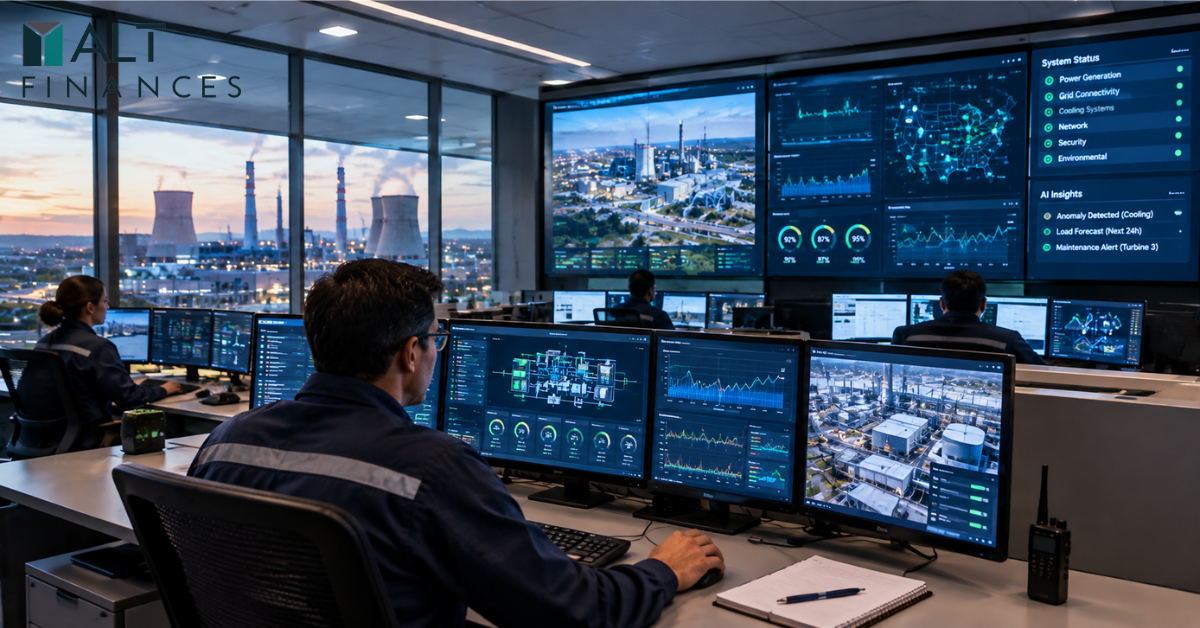
Artificial intelligence is moving beyond software and into the physical systems that support modern economies.
Power networks, transportation systems, manufacturing facilities, data centers, water infrastructure and other critical assets are increasingly using connected technologies to monitor operations, automate processes and make decisions.
That creates a new investment consideration.
An infrastructure asset is valuable not only because of what it owns or produces, but also because of how well its operators can see, understand and manage the systems on which its performance depends.
As AI becomes more deeply integrated into critical infrastructure, operational visibility is becoming an increasingly important part of infrastructure risk management.
For investors, that raises a practical question:
Could the quality of an asset’s operational visibility become part of its investment value?
AI Is Entering Physical Infrastructure
AI adoption in critical infrastructure is different from using an AI assistant or an automated business application.
In operational environments, software can interact with physical processes.
Examples include systems that monitor equipment, identify anomalies, optimize energy use, forecast maintenance requirements or support operational decision-making.
The World Economic Forum recently highlighted this transition, noting that AI is increasingly entering operational technology environments while organizations face the challenge of maintaining visibility across complex physical systems.
Operational technology, commonly called OT, includes systems used to monitor or control physical processes.
That makes reliability particularly important.
A software failure may interrupt a digital service. A failure involving industrial or infrastructure systems can potentially interrupt physical operations.
Why Visibility Matters to Infrastructure Investors
Infrastructure investors typically evaluate factors such as expected cash flows, demand, operating costs, regulation, financing and asset life.
Operational technology adds another layer:
Can management reliably understand what is happening across the asset?
A large infrastructure facility can contain thousands of connected devices, sensors, controllers and software systems.
If operators cannot establish an accurate picture of these systems, problems can become harder to identify.
That matters because infrastructure revenues depend on continued operations.
The relationship is straightforward:
Operational Visibility → Better Risk Identification → Better Operational Resilience
This does not mean visibility guarantees higher returns.
It means that operational resilience can become part of the broader risk assessment investors perform when evaluating infrastructure assets.
The Hidden Complexity of Modern Infrastructure
Modern infrastructure is becoming increasingly interconnected.
A data center depends on electricity, cooling, networking and physical security.
A power facility depends on generation equipment, control systems, transmission connections and communications.
A manufacturing facility can depend on industrial controllers, sensors, robotics and software.
As more systems become connected, the operational environment becomes more complex.
This creates a potential mismatch:
More Connectivity = More Data
but not necessarily:
More Data = Better Visibility
Data must be collected, understood and connected to the systems and processes that operators actually manage.
For investors, this distinction matters because technological sophistication on paper does not automatically translate into operational resilience.
AI Can Improve Infrastructure Management
AI can also become part of the solution.
Infrastructure operators can use advanced analytics and machine-learning systems to identify patterns in equipment performance, detect unusual behavior, forecast maintenance needs and improve resource allocation.
Predictive maintenance is one example.
Instead of relying entirely on fixed maintenance schedules, operators can analyze equipment data to identify conditions that may indicate deterioration.
The potential benefit is straightforward:
Detect Problems Earlier → Reduce Unplanned Downtime → Protect Asset Availability
The actual results depend on data quality, system design, implementation and the specific asset.
AI should therefore be treated as a tool rather than a guarantee of improved infrastructure performance.
The Operational Technology Challenge
Many critical infrastructure environments were not designed around today’s level of connectivity.
Some systems have been operating for years or decades. Others were built for reliability and isolation rather than continuous integration with modern digital networks.
That creates a challenge when new technologies are introduced.
An operator may have modern AI capabilities while still depending on older control systems and equipment.
The result can be a complicated technology environment containing:
- Legacy systems
- Modern sensors
- Industrial controllers
- Cloud platforms
- Network infrastructure
- AI applications
- Third-party software
- Remote-access technologies
Understanding how these components interact becomes increasingly important.
The World Economic Forum’s recent analysis emphasizes that visibility across operational technology environments is a prerequisite for managing AI adoption responsibly in critical infrastructure.
Why This Can Become an Investment Issue
Infrastructure investors generally care about the durability of an asset’s cash-generating capacity.
Operational problems can affect that capacity through downtime, higher maintenance costs, regulatory consequences, equipment failures or interruptions to service.
Therefore, operational resilience can have financial implications.
Consider two infrastructure assets with similar physical characteristics and comparable expected revenues.
One has modern monitoring, strong asset data, documented system dependencies and clear operational controls.
The other has fragmented systems, limited visibility and poorly documented dependencies.
The second asset may require greater operational investment to reach the same level of resilience.
That difference does not automatically justify a different valuation.
But it can influence risk assessment, capital expenditure planning and investment due diligence.
The Rise of the Infrastructure Risk Premium
Traditional infrastructure analysis often focuses on financial and physical risks.
The growing use of AI and connected systems introduces another category:
Digital-Operational Risk
This includes the possibility that failures in connected technology, poorly managed system dependencies or inadequate visibility could affect physical operations.
The concept of an AI infrastructure risk premium should therefore be understood carefully.
It does not mean that every infrastructure asset using AI deserves a higher or lower valuation.
Instead, investors may increasingly distinguish between assets according to how effectively they manage the operational risks created by greater digitalization.
An asset with stronger operational controls may be easier to monitor and manage.
An asset with poor visibility may require additional investment before its technology environment can be considered adequately understood.
Critical Infrastructure Makes the Issue More Important
The stakes become higher when infrastructure provides essential services.
Electricity, transportation, communications, water and industrial systems can have consequences beyond the individual asset.
The World Economic Forum notes that AI adoption in critical infrastructure creates new requirements for understanding the operational technology environment before increasingly autonomous systems are introduced.
For infrastructure owners, that makes visibility part of responsible technology deployment.
For investors, it creates another question during due diligence:
How dependent is the asset’s performance on digital systems that management cannot fully monitor or control?
What Investors Should Examine
Operational visibility does not need to become a separate investment discipline.
It can be incorporated into existing infrastructure due diligence.
Investors can ask:
1. What systems control the asset?
Identify the major operational and industrial systems supporting the asset.
2. How old are those systems?
Older technology may require different maintenance, integration and replacement strategies.
3. How connected is the infrastructure?
Connectivity can improve monitoring while also increasing technological complexity.
4. Can operators see system dependencies?
Understanding which systems depend on others can be critical during disruptions.
5. What data is available?
AI and advanced analytics depend heavily on reliable and relevant operational data.
6. How much capital expenditure is required?
Technology modernization can represent a significant future capital requirement.
7. Who manages the systems?
Operational resilience depends not only on technology but also on people, processes and accountability.
8. How dependent is revenue on continuous operation?
The greater the financial consequences of downtime, the more important operational resilience may become.
AI Infrastructure Is Not Just Data Centers
The phrase AI infrastructure is often associated with data centers and computing capacity.
AI may run on chips and servers, but its growth depends on a much larger physical network.
Compute + Power + Cooling + Connectivity + Industrial Systems + Grid Capacity
That makes electricity networks, transmission lines, fiber, cooling systems, power equipment and industrial infrastructure part of the AI investment chain.
The AI economy cannot scale faster than the infrastructure that powers it.
Unique Insight: The Next Infrastructure Advantage May Be What Investors Cannot See
The most interesting development is not simply that infrastructure is becoming more intelligent.
It is that visibility itself can become a form of operational resilience.
Two assets can have similar physical capacity but different levels of information about their condition.
The asset with better visibility may allow operators to identify problems earlier, allocate maintenance capital more efficiently and understand dependencies more clearly.
That does not guarantee superior investment performance.
But it creates a potentially important distinction in an infrastructure market where many assets are increasingly connected and digitally managed.
The emerging framework is:
Physical Asset Quality + Financial Strength + Operational Visibility = Infrastructure Resilience
And resilience matters because infrastructure value ultimately depends on the ability to deliver its essential service over time.
What This Means for Private Capital
Private infrastructure investors have historically evaluated assets through financial, operational, regulatory and physical lenses.
The increasing integration of AI adds another layer.
For private equity infrastructure funds, pension investors, insurers and other long-term capital providers, technology risk may increasingly become part of the broader operational due-diligence process.
That does not require investors to become technology specialists.
It requires them to ask better questions of operators, technical advisers and management teams.
The objective is to understand whether technology is improving the asset’s resilience or simply increasing its complexity.
Conclusion
AI is changing infrastructure not only by creating demand for more physical assets, but also by changing how those assets are monitored and operated.
As critical infrastructure becomes more connected, the ability to maintain reliable operational visibility becomes increasingly important.
For investors, this creates a new way to think about infrastructure risk.
The strongest asset may not simply be the one with the newest technology.
It may be the one where technology, physical systems, data, people and operational controls work together in a way that management can actually understand and manage.
That makes operational visibility an increasingly relevant consideration in infrastructure investment.
The potential AI infrastructure risk premium is therefore less about assigning a simple premium or discount to assets using artificial intelligence.
It is about recognizing that, in a more connected infrastructure economy, what management can see may influence what management can protect and ultimately what investors can value with confidence.
Frequently Asked Questions
What is the AI infrastructure risk premium?
The AI infrastructure risk premium describes the emerging investment consideration that digitally connected infrastructure may carry different operational risks depending on how effectively its technology systems are monitored, integrated and managed.
Why is operational visibility important in critical infrastructure?
Operational visibility helps asset operators understand the condition and relationships between physical and digital systems. Better visibility can support earlier identification of operational problems and more informed maintenance decisions.
How is AI being used in infrastructure?
AI can support areas such as predictive maintenance, anomaly detection, operational optimization and analysis of large volumes of infrastructure data. Results depend on implementation, data quality and the specific application.
Does AI automatically make infrastructure more valuable?
No. AI can create benefits but also introduce additional technological complexity and risks. Investment value still depends on cash flows, valuation, regulation, financing, operations and other factors.
What should infrastructure investors examine before investing?
Investors should consider the asset’s technology environment, operational systems, connectivity, data quality, modernization requirements, management capabilities and the potential financial impact of operational disruptions.
Investment Disclaimer
This article is for general informational and educational purposes only and does not constitute legal, tax, accounting, investment or financial advice. Infrastructure investments can involve substantial risks, including operational, technological, regulatory, construction, financing, interest-rate, liquidity and valuation risks. Past performance is not indicative of future results. Investors should conduct independent due diligence and consult qualified professional advisers before making investment decisions.

Administrator at Alt Finances, leading editorial strategy and contributing in-depth coverage of investing, wealth management, alternative assets, and global financial markets. Through research-driven articles and analysis, he helps readers understand the ideas, industries, and market forces shaping modern finance.