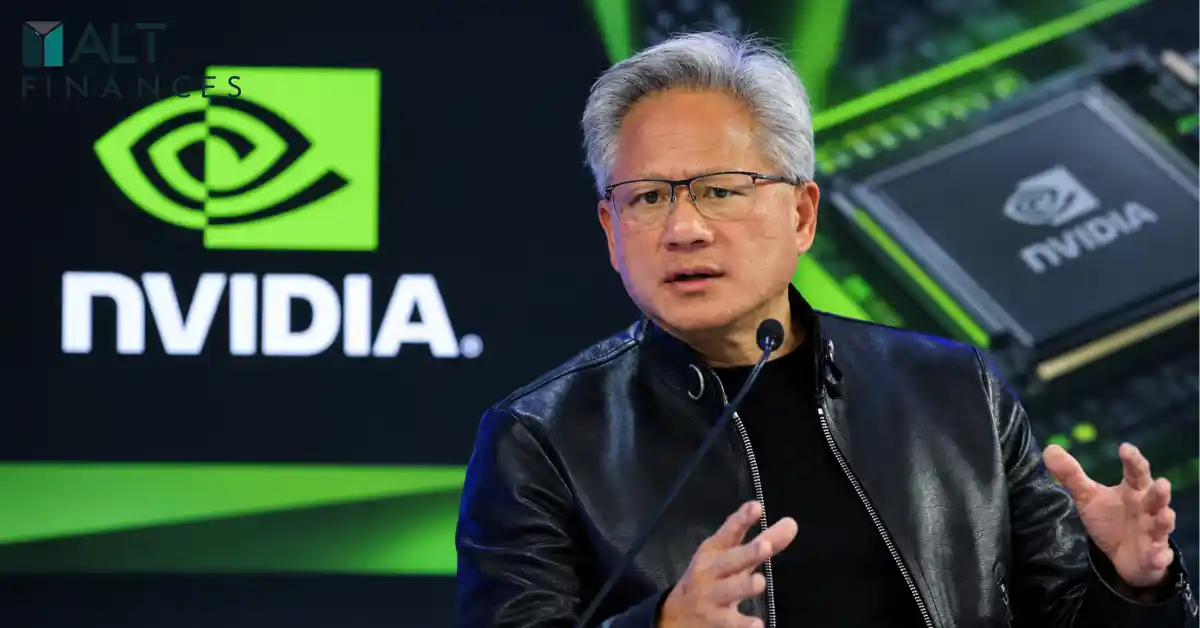
Jensen Huang did not simply build a successful chip company. He helped position NVIDIA around the computing infrastructure required to make modern artificial intelligence possible.
That distinction matters because AI increasingly depends on far more than processors. It requires accelerated computing, software, networking, data centers, electricity, cooling, land and increasingly sophisticated financing. NVIDIA’s strategy has expanded across many of these layers, turning the company from a graphics-chip specialist into a broader platform for AI infrastructure.
The scale of that transformation is visible in NVIDIA’s latest results. For the second quarter of fiscal 2027, revenue reached $96.2 billion, while Data Center revenue reached $89 billion, up 117% from a year earlier.
The story behind those numbers is not simply demand for GPUs. It is the evolution of NVIDIA’s business model under Huang from hardware to a connected infrastructure ecosystem.
From Graphics Chips to the AI Compute Era
Huang co-founded NVIDIA in 1993 with Chris Malachowsky and Curtis Priem. The company initially focused on 3D graphics for gaming and multimedia. NVIDIA introduced the GPU in 1999, creating a processor architecture capable of handling large numbers of calculations in parallel.
That architecture eventually became useful far beyond computer graphics.
In 2006, NVIDIA introduced CUDA, allowing developers to use GPUs for general-purpose parallel computing. Six years later, NVIDIA GPUs helped power the AlexNet neural network, a milestone in the development of modern AI.
The important strategic decision was to treat the GPU as a computing platform rather than only a graphics component. That gave NVIDIA an opportunity to participate in scientific computing, machine learning and eventually large-scale AI.
The transition also changed the economics of the company. Instead of competing only on graphics performance, NVIDIA could build an ecosystem around accelerated computing.
CUDA: The Software Layer That Changed NVIDIA’s Position
The hardware is only part of NVIDIA’s infrastructure advantage.
CUDA provides the software layer that allows developers to use NVIDIA GPUs for accelerated computing. Its toolkit includes libraries, development tools, a compiler and runtime components, while CUDA-X extends the ecosystem across applications such as AI and high-performance computing.
For investors, this matters because software can influence the usefulness and longevity of hardware.
A developer building applications around CUDA is not simply choosing a physical processor. The development environment, libraries, optimization tools and existing code can become part of the technology stack surrounding that processor.
NVIDIA’s own 2025 annual review said more than six million developers and 40,000 companies were building on its platforms at that time.
That ecosystem does not make NVIDIA immune to competition. But it helps explain why the company’s strategy extends beyond selling individual generations of GPUs.
From GPUs to AI Factories
NVIDIA’s next step has been to integrate computing, networking and software into larger systems designed specifically for AI.
The company now describes these facilities as AI factories. Unlike conventional data centers designed for many types of computing, AI factories are purpose-built around continuous AI workloads, including training and inference.
NVIDIA’s DSX platform is designed to help infrastructure operators plan and operate AI factories across computing, networking, software and facility infrastructure. NVIDIA says the architecture can integrate energy, chips, infrastructure, models and applications into a coordinated system.
This represents an important shift in the company’s role.
NVIDIA is no longer simply supplying the processor inside the data center. It is increasingly supplying the architecture around the processor.
That includes GPUs, CPUs, networking systems, software and reference designs. NVIDIA also works with companies including Cisco, Dell, HPE, Lenovo and Supermicro to deploy AI infrastructure.
The broader AI infrastructure buildout is therefore becoming an ecosystem rather than a single-product market.
Why Land, Power and Data Centers Now Matter
The next constraint for AI may not always be semiconductor supply.
Large AI systems require enormous amounts of electricity, cooling capacity, physical space and grid connectivity. NVIDIA’s strategy increasingly reflects that reality.
In August 2026, NVIDIA announced that it would provide credit support for land, power and shell capacity at SB Energy’s PORTS-Pike campus in Ohio. The initial project covers 4.25 IT gigawatts, with an option for another 3.75 gigawatts. OpenAI is expected to be the customer, while SB Energy will build, own and operate the data center under a long-term lease.
NVIDIA has described land, power and shell often abbreviated as LPS as critical resources for AI factories. Its position is that securing these resources can help infrastructure support multiple generations of computing equipment.
This is significant for capital markets because a data center increasingly resembles a long-lived infrastructure asset rather than simply a building filled with servers.
It also creates opportunities and constraints across power generation, transmission, cooling, construction, networking and real estate.
The New Financial Infrastructure Behind AI
Huang’s strategy has also moved closer to the financial system.
In August 2026, NVIDIA announced partnerships with Apollo, BlackRock, Blackstone, Brookfield, Goldman Sachs and KKR to establish AI compute infrastructure financing platforms. NVIDIA said the arrangements were intended to mobilize more than $500 billion of third-party capital over time, subject to definitive agreements.
The significance is broader than the headline figure.
AI infrastructure requires capital on a scale that many technology companies cannot fund entirely from operating cash flow. Financing structures can therefore become as important as chip performance when companies need to build large computing facilities.
NVIDIA’s stated objective is to make compute infrastructure more financeable by connecting equipment, long-term demand and institutional capital.
Reuters has also reported growing investor caution around the debt required to finance AI infrastructure, highlighting an important counterpoint: rapid infrastructure expansion creates financing opportunities, but also raises questions about leverage, capital concentration and visibility into future returns.
What Huang’s Strategy Means for Investors
The investment implications extend well beyond NVIDIA itself.
The AI buildout creates potential demand across several layers:
| Infrastructure Layer | NVIDIA’s Role | Economic Importance |
|---|---|---|
| GPUs | Accelerated computing | AI training and inference |
| CUDA | Software ecosystem | Developer adoption and optimization |
| Networking | Data-center connectivity | Moving data between computing systems |
| AI Factories | Full-stack infrastructure | Large-scale AI deployment |
| Financing | Capital partnerships | Funding compute and infrastructure expansion |
This broader stack means investors evaluating the AI economy need to look beyond semiconductor companies.
Data-center operators, networking companies, power developers, cooling providers, semiconductor manufacturers and infrastructure financiers can all participate in the buildout.
NVIDIA’s own filings illustrate the scale of the underlying demand, but they also highlight concentration risks. In fiscal 2026, two direct customers accounted for 22% and 14% of total revenue. In the second quarter of fiscal 2027, one direct customer represented 16% of total revenue.
That concentration makes the relationships between NVIDIA, hyperscalers, AI laboratories and infrastructure providers economically important.
The Infrastructure Advantage and Its Limits
NVIDIA’s position is not guaranteed.
The company’s own filings describe the semiconductor and accelerated-computing markets as intensely competitive, with rapid technological change. Competitors include AMD, Intel, Huawei and custom silicon developed by major cloud companies.
Custom AI chips represent an especially important challenge. Hyperscalers increasingly have incentives to design specialized processors that can reduce costs or optimize workloads for their own systems.
There are also capital-intensity risks.
If AI infrastructure is built faster than sustainable demand develops, data-center operators and financiers could face lower utilization or weaker economics. Energy constraints can delay projects, while rapid hardware cycles can create depreciation and technology-obsolescence risks.
NVIDIA is also exposed to customer concentration, supply-chain constraints, export controls and the highly cyclical nature of semiconductor investment.
The question is therefore not whether AI infrastructure will grow. It is whether infrastructure spending can generate sufficient utilization, productivity and revenue to justify the capital being committed.
The Real Huang Strategy
The most important part of Huang’s strategy may be the connection between layers.
NVIDIA’s evolution can be viewed as a progression:
Graphics processors → CUDA → accelerated computing → AI data centers → networking → AI factories → infrastructure financing.
Each stage expanded the role of the previous one.
CUDA made the hardware more useful. Networking connected increasingly large computing systems. Full-stack platforms made those systems easier to deploy. AI factories connected computing with power, cooling and facility design. Financing partnerships now attempt to connect the infrastructure with long-duration institutional capital.
That does not mean NVIDIA controls the entire AI economy. Researchers, cloud providers, semiconductor manufacturers, AI laboratories, utilities, construction companies and infrastructure operators all contribute essential pieces.
But Huang’s strategic contribution has been to connect many of those pieces into a common computing platform.
Conclusion
Jensen Huang’s significance to NVIDIA’s transformation lies less in the popularity of GPUs than in the company’s expanding definition of what an AI platform can be.
NVIDIA began with graphics processors, built CUDA into a major software ecosystem and expanded into accelerated computing, networking and integrated AI systems. In 2026, the company is increasingly involved in the physical and financial infrastructure needed to deploy those systems at scale.
The result is a business increasingly positioned at the intersection of semiconductors, software, data centers, energy and institutional capital.
Whether that strategy produces sustainable economics will depend on continued technological execution, ecosystem adoption, infrastructure utilization and the ability of the wider AI economy to generate enough value to support its enormous capital requirements.
For investors, that may be the more important question behind the NVIDIA story: not simply how many chips are sold, but how the infrastructure built around those chips becomes productive.
FAQs
Who is Jensen Huang?
Jensen Huang is NVIDIA’s co-founder, president and CEO. He founded the company in 1993 and has led it since its creation.
How did Jensen Huang build NVIDIA’s AI business?
NVIDIA evolved from graphics processors into accelerated computing, then expanded its CUDA software ecosystem, data-center platforms, networking and full-stack AI infrastructure.
Why is CUDA important to NVIDIA?
CUDA provides the software environment that allows developers to use NVIDIA GPUs for accelerated computing, supported by libraries, tools and development frameworks.
What are AI factories?
AI factories are purpose-built infrastructure systems that combine computing, networking, software and facility resources to continuously produce AI outputs such as model inference and other workloads.
What are the biggest risks to NVIDIA’s AI infrastructure strategy?
Key risks include competition from custom chips and rival architectures, customer concentration, rapid technology cycles, semiconductor supply constraints, energy limitations, export restrictions and the possibility that infrastructure investment grows faster than sustainable AI demand.
Investment disclaimer: This article is provided for informational and educational purposes only and does not constitute investment, financial or tax advice. Readers should conduct their own research and consult qualified professional advisers before making financial decisions.

Contributing Editor for Alt Finances, vision-driven with 20+ years in family office, asset management, and corporate development. Holds UN Special Consultative Status and is 100 Women in Finance Board Chair. Tulane University – A.B. Freeman School of Business.