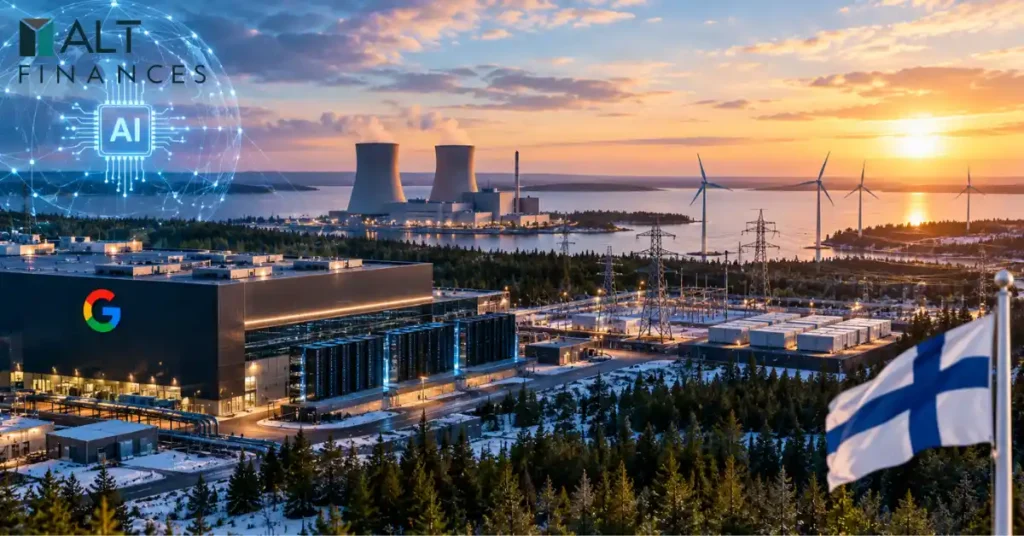
The next bottleneck in artificial intelligence may not be computing power. It may be electricity.
As AI models require more computing capacity, the economics of AI infrastructure investment increasingly depend on something far more physical: access to power, land, cooling, grid connections and industrial infrastructure. Google’s newly announced €13 billion investment in Finland illustrates how the AI buildout is becoming an energy and infrastructure story as much as a technology one.
Google announced on September 9 that it plans to invest at least €13 billion in Finland during 2027 and 2028, including data centers and supporting infrastructure in Hamina, Kajaani, Muhos and Vaala. The company also announced long-term energy partnerships involving nuclear power, wind generation and battery storage.
The broader investment chain is becoming clearer:
AI Demand → Data Centers → Electricity Demand → Grid Capacity → Energy Contracts → Infrastructure Investment
Google’s Finland Investment Goes Beyond Data Centers
Google describes the €13 billion commitment as its largest single investment in Europe. The spending is not limited to computing facilities. It combines digital infrastructure with energy projects and partnerships intended to strengthen Finland’s electricity system.
That distinction matters for investors.
Traditional data center investment focuses primarily on buildings, land, connectivity, power availability and tenant demand. AI infrastructure investment adds another layer: the availability and economics of the electricity required to operate increasingly intensive computing workloads.
Google already has a long-standing presence in Finland. In Hamina, it converted a former paper mill into a data center beginning in 2009. Google says the facility uses seawater-based cooling and has also supported offsite heat recovery for local homes and businesses.
The new strategy connects that existing digital footprint with power procurement, grid planning and energy storage.
That makes the investment more than a conventional hyperscale expansion.
Why Finland Is Attractive to AI Infrastructure
Finland offers several characteristics relevant to large electricity-intensive facilities: a relatively low-carbon power system, nuclear generation, substantial renewable resources, established industrial infrastructure, a cold climate and an experienced transmission operator.
Fingrid reported in August that electricity consumption growth in Finland is expected to accelerate, driven particularly by data centers and electric boiler projects. By mid-August, data-center projects with signed grid connection agreements represented nearly 5 GW of planned final capacity, based on information supplied by developers. Fingrid also cautioned that a connection agreement does not guarantee that a project will ultimately be built at full scale.
The point is important: power generation is not the same thing as grid access.
A data center needs an available connection, sufficient transmission and distribution capacity, reliable electricity and the ability to operate within the technical requirements of the power system.
Finland’s climate can also provide an operational advantage for data centers because lower ambient temperatures can reduce some cooling requirements. Google’s Hamina facility provides a practical example through its seawater-based cooling system.
AI Infrastructure Investment Is Becoming Energy Investment
The AI infrastructure stack increasingly looks like:
Chips → Servers → Data Centers → Electricity → Grid → Generation → Storage
The International Energy Agency estimates that global data-center electricity consumption could more than double to around 945 TWh by 2030 in its base case, with AI identified as the most important driver alongside broader digital-service demand. The IEA also stresses that the precise trajectory remains uncertain because hardware efficiency, software efficiency, AI adoption and energy-system constraints can all change the outcome.
That creates several potential investment exposures.
They include utilities, nuclear generation, renewable developers, transmission infrastructure, grid equipment, battery storage, data-center real estate, cooling systems and power-management technology.
But these are not interchangeable assets.
A utility’s economics depend on regulation, generation costs and capital requirements. A data-center developer depends on occupancy, customer concentration, construction costs and financing. A battery project depends on market design, utilization and revenue streams. A transmission project faces permitting and construction risks.
The common denominator is physical infrastructure supporting digital demand.
The Nuclear Power Connection
The most significant element of Google’s Finnish strategy may be its agreement with Fortum.
The companies announced a 22-year power purchase agreement linked to the life extension and upgrade of Fortum’s Loviisa nuclear power plant. The agreement begins with a smaller contracted capacity in 2028 and reaches up to 50% of the plant’s capacity during 2030–2049.
Fortum says its broader Loviisa life-extension program involves approximately €1 billion of investment, with around €700 million of required capital expenditure still subject to investment decisions at the time of the announcement. The company says Google’s PPA provides revenue certainty supporting the investment program and could enable an additional 10 MW power increase beyond a previously planned 38 MW uprate.
For Google, the arrangement secures long-term access to nuclear generation.
For Fortum, it creates a long-duration commercial commitment around an existing generation asset.
For investors, the more interesting point is the connection between long-term electricity demand and long-duration infrastructure capital.
Google says Loviisa currently supplies about 10% of Finland’s electricity and employs approximately 580 people. The company and Fortum are also exploring cooperation around new nuclear generation, renewable capacity and flexibility solutions.
This does not mean every nuclear plant will receive similar contracts. It does show how large technology companies can become important counterparties in energy markets.
Wind Power and Battery Storage Add Another Layer
Google is not relying exclusively on nuclear power.
The company announced additional onshore wind PPAs that bring the total new-to-the-grid onshore wind capacity supported by its Finnish PPAs to 629 MW. Google also said it is working with partners to enable its wind portfolio to participate in Fingrid’s ancillary markets.
The strategy also includes a contracted 94 MW battery system near Kajaani, expected to be operational in late 2027. Google says the battery is intended to provide flexibility and help balance the Finnish grid.
This combination is significant because large electricity users need more than simply annual energy volumes. They operate within a system where generation varies, demand changes and grid balancing is essential.
The emerging model therefore combines:
Nuclear + Wind + Grid + Storage
rather than treating electricity procurement as a single-source decision.
The Grid May Become the Next Bottleneck
The AI infrastructure investment story ultimately returns to the grid.
Adding generation does not automatically make electricity available at the location where a data center needs it. Projects can face interconnection constraints, transmission limitations, permitting requirements, equipment shortages and construction delays.
Fingrid’s recent data illustrates the scale of the challenge. The transmission operator has reported exceptionally high interest in new connections, with more than 100 GW of electricity-consumption connection enquiries in 2024–2025, more than half associated with data-center projects. These enquiries are preliminary and non-binding, however, so they should not be treated as confirmed future demand.
That distinction is crucial for investors.
AI demand is not the same as electricity demand. Electricity demand is not the same as utility revenue. Utility revenue is not the same as investor returns.
Each layer has its own economics.
The Capital-Intensity Problem
The AI buildout requires capital across multiple layers at once:
Data Center Capex + Compute Hardware + Power Contracts + Grid Infrastructure + Energy Assets
That creates opportunities for infrastructure funds, private credit, utilities, real-estate investors and other providers of long-duration capital. But it also creates financing risk.
Large projects can face higher interest costs, construction delays, technology changes, customer concentration and uncertainty over future utilization.
The lesson is not that AI infrastructure automatically creates superior investment opportunities. It is that investors may need to analyze the entire physical system supporting AI rather than focusing exclusively on chips, cloud platforms or data-center real estate.
The Risk of Mistaking AI Demand for Guaranteed Energy Returns
The strongest AI infrastructure investment thesis still has significant uncertainties.
AI demand could grow rapidly, but hardware efficiency could improve. Computing workloads could shift between locations. Data-center projects can be delayed. Electricity markets can change. Regulators can impose new requirements. Financing costs can rise.
Even where electricity demand increases, infrastructure owners must recover large capital expenditures while managing operational and regulatory risks.
The investment question is therefore not simply whether AI consumes more electricity.
It is which assets can provide reliable power at an economic cost, where grid capacity exists, and under what contractual and regulatory structure.
That is a much more demanding investment question.
The Emerging AI-Energy Investment Chain
Google’s Finland strategy illustrates a broader transition:
AI Models → Compute → Data Centers → Power Demand → Generation → Grid → Storage
The bottleneck can move from one layer to another.
Today, the constraint may be advanced computing hardware. Tomorrow, it could be electricity availability. In another market, the limiting factor may be transmission capacity, cooling infrastructure or the ability to secure a grid connection.
This is why AI infrastructure investment increasingly needs to be viewed as an interconnected physical system.
Investors examining the opportunity should therefore look beyond headline spending and consider power availability, grid access, electricity pricing, data-center utilization, capital expenditure, PPA structure, energy mix, cooling costs, land, connectivity, regulation and financing costs.
Unique Insight: AI Is Turning Electricity Into a Strategic Input
The deeper AI infrastructure investment thesis is not simply that AI requires more data centers.
The more important economic shift is that AI is turning electricity into a strategic input for digital growth.
Google’s Finland commitment demonstrates this clearly.
The €13 billion is not simply:
€13 billion → Data Centers
It is increasingly:
€13 billion → Digital Infrastructure + Nuclear Power + Wind + Batteries + Grid Resilience + Energy Contracts
That matters because the companies controlling the physical bottlenecks behind AI capacity can become strategically important even when they do not develop AI models themselves.
For investors, the key question becomes:
Which infrastructure assets control the physical bottlenecks that determine whether AI capacity can actually be built and operated?
That is the deeper AI infrastructure investment question.
Conclusion
Google’s Finland investment illustrates a broader transformation in the economics of artificial intelligence.
AI creates compute demand.
Compute creates data-center demand.
Data centers create electricity demand.
Electricity demand creates infrastructure investment.
Infrastructure investment creates opportunities across energy and real assets.
But the opportunity is not risk-free. Future AI demand, electricity consumption, project utilization, financing costs, regulation and grid availability remain uncertain.
Google’s agreement with Fortum is particularly significant because it connects a hyperscale technology company with a long-duration nuclear asset. Its wind PPAs and battery project show a broader approach in which generation, storage and grid flexibility become part of the infrastructure strategy.
The most important consequence of the AI infrastructure boom may therefore be that artificial intelligence is no longer purely a technology investment. It is increasingly becoming an energy, real-estate, utility, grid and infrastructure story.
Google’s Finland bet shows how the race to build AI capacity is connecting digital capital with physical power and for investors, that connection could become one of the defining infrastructure themes of the next decade.
Frequently Asked Questions
What is AI infrastructure investment?
AI infrastructure investment refers to capital deployed across the physical and digital systems required to develop and operate AI, including computing equipment, data centers, electricity supply, grids, cooling, storage and connectivity.
Why is Google investing $15 billion in Finland?
Google announced at least €13 billion of investment in Finland for 2027–2028, covering digital infrastructure, supporting infrastructure and energy partnerships intended to support growing demand for its services and AI capabilities.
Why is Finland attractive for AI data centers?
Finland combines a relatively low-carbon electricity system, nuclear and renewable generation, existing industrial infrastructure, a cold climate and established data-center experience. These factors can support large electricity-intensive facilities, although they do not eliminate investment risks.
Why is nuclear power important for AI infrastructure?
Nuclear plants can provide large volumes of low-carbon electricity that are not dependent on weather conditions. Google’s Loviisa agreement demonstrates how long-term technology-company demand can be connected with investment in existing nuclear infrastructure.
How do power purchase agreements support data centers?
A PPA establishes a contractual relationship for electricity supply and can provide greater visibility around long-term power procurement. The economic effect depends on the specific contract terms, market conditions and the underlying generation asset.
Why are batteries important for AI data centers?
Battery storage can provide grid flexibility, help balance variable renewable generation and support electricity-system stability. Google’s 94 MW Finnish battery project is designed around these functions rather than simply supplying the data center with electricity.
Could utilities benefit from AI infrastructure growth?
Potentially, but rising electricity demand does not automatically translate into superior utility returns. Utilities still face capital requirements, regulation, financing costs, electricity-market risks and the need to build or maintain generation and grid infrastructure.
What is the role of grid infrastructure in AI investment?
Grid infrastructure determines whether available generation can actually reach a data center. Transmission capacity, interconnection availability and reliability can therefore become as important as electricity generation itself.
What risks do AI infrastructure investors face?
Key risks include uncertain AI demand, high capital expenditure, financing costs, construction delays, power-price volatility, regulatory changes, grid constraints, technology shifts and customer concentration.
Why is AI becoming an energy investment?
Because AI computing requires physical data centers, and data centers require substantial electricity. As AI expands, capital is increasingly being deployed not only into computing infrastructure but also into generation, grids, storage and other energy assets that enable that computing capacity.
Investment & Energy Disclaimer
This article provides general informational content and does not constitute financial, investment, legal, tax, energy-market, infrastructure or utility advice. AI infrastructure and energy investments can involve substantial technology, construction, financing, regulatory, commodity-price, electricity-market, grid, demand and liquidity risks. Future AI demand, electricity requirements, infrastructure spending, energy prices and investment returns are uncertain. Investors should conduct independent due diligence and consult qualified professional advisers before making investment decisions.

Administrator at Alt Finances, leading editorial strategy and contributing in-depth coverage of investing, wealth management, alternative assets, and global financial markets. Through research-driven articles and analysis, he helps readers understand the ideas, industries, and market forces shaping modern finance.