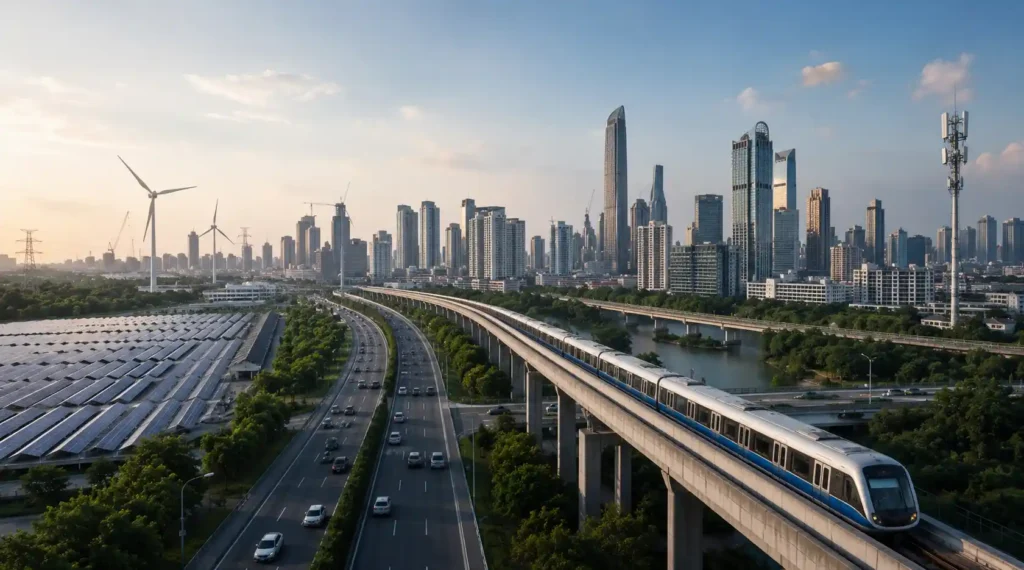
Infrastructure investing opportunities have become one of the defining themes in global capital markets as investors seek resilient assets capable of delivering stable income, inflation protection, and long-term growth. From pension funds and sovereign wealth funds to private equity firms and family offices, institutional investors increasingly recognize that infrastructure investing offers exposure to the essential systems that keep modern economies functioning regardless of market cycles.
Unlike many traditional alternative investments, infrastructure assets generate value by supporting economic activity through transportation, utilities, communications, and energy networks. As governments confront aging infrastructure, climate challenges, and rapid digital transformation, private capital has become indispensable in financing large-scale projects. Consequently, infrastructure finance has evolved into one of the world’s fastest-growing institutional investment sectors.
Today’s infrastructure landscape extends far beyond highways and airports. Renewable energy infrastructure, digital infrastructure, logistics hubs, telecommunications networks, water systems, healthcare facilities, and data centers now form the backbone of global economic resilience. At the same time, investors appreciate the combination of recurring cash flows, asset diversification, and inflation-linked revenues that infrastructure investments frequently provide. As economies modernize and technology reshapes essential services, infrastructure investing has emerged as a strategic allocation capable of balancing dependable income with attractive long-term appreciation.
Understanding Infrastructure Investing
Infrastructure investing refers to allocating capital into physical and digital assets that provide essential services to businesses, governments, and consumers. Unlike conventional equity investments that depend primarily on corporate earnings growth, infrastructure investments derive value from long-term usage of indispensable facilities.
Many projects operate under concession agreements, regulated pricing frameworks, or long-term contracts, producing relatively predictable cash flows over decades. Consequently, institutional investors often consider infrastructure among the most defensive segments of alternative investments.
Infrastructure assets generally include:
- Transportation infrastructure
- Utilities
- Renewable energy infrastructure
- Digital infrastructure
- Telecommunications
- Water infrastructure
- Logistics facilities
- Social infrastructure
Investors access these assets through listed infrastructure companies, direct ownership, private infrastructure funds, publicly traded infrastructure trusts, and public-private partnerships. Increasingly, private infrastructure funds have become the preferred vehicle for institutional investing because they provide professional asset management alongside access to large-scale projects unavailable in public markets.
Infrastructure investing also benefits from powerful macroeconomic trends including urbanization, population growth, energy transition, and digitalization. These structural forces continue supporting long-term demand regardless of shorter-term market fluctuations, making infrastructure particularly attractive for long-term investments.
Why Infrastructure Has Become a Preferred Alternative Asset?
Institutional investors increasingly allocate larger portions of their portfolios toward infrastructure because the asset class offers characteristics that complement traditional stocks and bonds.
First, infrastructure assets frequently generate predictable recurring income. Utilities, toll roads, electricity transmission networks, and telecommunications infrastructure often operate under regulated pricing models or long-term customer contracts that reduce revenue volatility.
Second, infrastructure serves as an effective inflation hedge investments strategy. Many concession agreements include inflation-linked pricing adjustments, allowing revenues to rise alongside inflation while preserving purchasing power.
Third, infrastructure contributes meaningful asset diversification. Performance drivers often differ from public equities because essential infrastructure continues operating throughout economic cycles.
Finally, governments worldwide continue expanding infrastructure spending to improve productivity, strengthen supply chains, support climate objectives, and enhance digital connectivity. This sustained investment pipeline creates abundant global infrastructure investment opportunities for long-term institutional capital.
Rather than functioning purely as financial assets, infrastructure investments represent ownership in the physical and digital foundations of economic growth. That distinction increasingly explains why sophisticated investors continue increasing allocations.
Core Infrastructure Sectors Driving Global Growth
Modern infrastructure investing encompasses a diverse collection of sectors whose importance continues expanding alongside technological and demographic change.
Transportation infrastructure remains fundamental, including airports, toll roads, railways, seaports, and logistics corridors that facilitate global trade.
Utilities continue attracting investors through electricity transmission, gas distribution, district energy systems, and regulated water infrastructure.
Meanwhile, renewable energy infrastructure has rapidly become one of the fastest-growing investment segments. Wind farms, solar parks, battery storage systems, and electricity interconnectors support global decarbonization while offering long-term contracted revenues.
Digital infrastructure has transformed infrastructure investing even further. Fiber-optic networks, mobile towers, cloud facilities, edge computing infrastructure, and hyperscale data centers now underpin artificial intelligence, cloud computing, streaming services, and enterprise digitization.
Healthcare facilities, universities, government buildings, and affordable housing represent social infrastructure that combines stable public funding with essential community services.
Core Infrastructure Investment Sectors
| Infrastructure Sector | Typical Assets | Investment Benefits |
|---|---|---|
| Transportation | Airports, ports, railways, toll roads | Stable demand, inflation-linked revenues |
| Utilities | Electricity grids, gas pipelines, water systems | Predictable cash flows, regulated returns |
| Renewable Energy | Wind farms, solar plants, battery storage | Long-term contracts, sustainability exposure |
| Digital Infrastructure | Data centers, fiber networks, telecom towers | High growth driven by AI and digitalization |
| Telecommunications | Broadband networks, wireless infrastructure | Essential connectivity and recurring income |
| Logistics | Warehouses, freight hubs, distribution centers | E-commerce growth and supply-chain resilience |
| Social Infrastructure | Hospitals, schools, public facilities | Government-backed demand and stability |
Each sector exhibits distinct risk characteristics and return profiles. Nevertheless, they all share one defining feature: they provide services that economies cannot function without. This essential nature underpins resilient demand while supporting attractive long-term investment performance.
Public-Private Partnerships and Infrastructure Finance
Governments increasingly rely on public-private partnerships (PPPs) to deliver major infrastructure projects without placing excessive strain on public finances. PPPs distribute construction, operational, financing, and maintenance responsibilities between public authorities and private investors.
Common infrastructure financing models include:
- Public-private partnerships (PPPs)
- Project finance
- Build-Operate-Transfer (BOT)
- Design-Build-Finance-Operate (DBFO)
- Long-term concession agreements
- Asset recycling programs
Project financing typically limits investor exposure to individual projects while utilizing predictable operating revenues to repay debt over extended periods. Consequently, lenders and equity investors carefully evaluate demand forecasts, regulatory frameworks, political stability, and construction risks before committing capital.
Institutional investors including pension funds, insurance companies, sovereign wealth funds, and infrastructure-focused private equity managers—have become increasingly important providers of long-duration capital. Their investment horizons naturally align with infrastructure assets that often operate for thirty to fifty years.
This growing collaboration between governments and private investors reflects a practical reality: future infrastructure requirements far exceed public budgets alone. Therefore, successful economic modernization increasingly depends upon sophisticated infrastructure finance solutions capable of mobilizing substantial private capital.
Infrastructure Investing vs. Other Alternative Investments
Infrastructure occupies a distinctive position within diversified investment portfolios because it combines defensive characteristics with long-term structural growth.
Real estate often generates dependable rental income but can experience greater sensitivity to occupancy cycles and commercial property demand.
Private equity typically offers higher capital appreciation potential; however, returns depend heavily on operational improvements, acquisitions, and successful exits.
Renewable energy investments overlap considerably with infrastructure, although some projects involve higher technological or merchant electricity price risks.
Private credit delivers contractual income but generally lacks direct exposure to long-term economic expansion through ownership of productive assets.
Comparing Alternative Asset Classes
| Alternative Asset Class | Income Stability | Growth Potential | Best Suited For |
| Infrastructure | Very High | High | Long-term institutional investors |
| Real Estate | High | Moderate | Income-focused investors |
| Private Equity | Moderate | Very High | Growth-oriented investors |
| Renewable Energy Investments | High | High | Sustainability-focused investors |
| Private Credit | High | Moderate | Income and capital preservation |
These asset classes frequently complement rather than replace one another. Nevertheless, infrastructure stands apart because it combines recurring income, inflation protection, diversification, and exposure to essential economic systems within a single allocation. That balanced profile explains its growing popularity among institutional investing professionals.
The Future of Infrastructure Investing
The next generation of infrastructure extends well beyond traditional civil engineering projects. Artificial intelligence, electrification, and climate adaptation are reshaping investment priorities across global markets.
AI requires enormous computing capacity, accelerating demand for hyperscale data centers, fiber connectivity, semiconductor manufacturing facilities, and advanced power infrastructure. Digital infrastructure therefore represents one of the fastest-growing investment categories.
Similarly, clean energy deployment requires extensive upgrades to electricity transmission networks, battery storage, renewable generation, hydrogen infrastructure, and electric vehicle charging networks.
Smart cities integrate transportation, utilities, communications, and environmental monitoring into interconnected digital ecosystems that improve efficiency while supporting sustainable urban growth.
Climate resilience investments—including flood protection systems, resilient water infrastructure, wildfire mitigation, and coastal defenses are also expected to attract increasing institutional capital as extreme weather events become more frequent.
These developments suggest that tomorrow’s infrastructure portfolios will blend physical assets with advanced digital technologies, creating increasingly diversified investment opportunities.
Unique Insight
Infrastructure investing opportunities represent one of the most durable long-term investment themes because they generate value by enabling economic activity rather than relying solely on discretionary consumer demand. Roads facilitate commerce, electricity powers industry, fiber networks transmit information, and water systems sustain communities regardless of changing consumer preferences.
Even more importantly, physical and digital infrastructure are becoming inseparable. Modern transportation systems depend upon cloud computing, artificial intelligence, sensors, telecommunications, and data analytics. Likewise, renewable energy infrastructure requires sophisticated digital control systems and intelligent electricity grids to operate efficiently.
Governments worldwide face unprecedented infrastructure funding requirements driven by aging assets, population growth, decarbonization, and technological transformation. Public finances alone cannot satisfy these needs. Consequently, private capital is evolving from a complementary funding source into an essential partner for national economic modernization.
The most compelling Infrastructure investing opportunities therefore no longer reside exclusively in highways, airports, or pipelines. Increasingly, they include hyperscale data centers, fiber-optic networks, renewable energy systems, battery storage, smart logistics platforms, and digital ecosystems that will support global economic development for decades. Few asset classes combine recurring income, inflation resilience, diversification, and structural growth as effectively as modern infrastructure.
Frequently Asked Questions
What is infrastructure investing?
Infrastructure investing involves allocating capital into essential physical and digital assets such as transportation networks, utilities, telecommunications systems, renewable energy facilities, and water infrastructure that generate long-term revenues.
Why is infrastructure considered an alternative investment?
Infrastructure typically requires long investment horizons, specialized expertise, and private market access. Consequently, investors classify it alongside other alternative investments rather than traditional public equities or bonds.
What types of infrastructure assets can investors own?
Investors may own airports, toll roads, ports, electricity grids, pipelines, renewable energy projects, telecom towers, data centers, fiber networks, logistics facilities, hospitals, schools, and water utilities.
How do infrastructure investments generate returns?
Returns primarily come from recurring operating income, regulated revenues, concession payments, long-term contracts, and gradual capital appreciation as assets mature.
Are infrastructure investments protected against inflation?
Many infrastructure assets incorporate inflation-linked pricing mechanisms, allowing revenues to increase alongside inflation and helping preserve investor purchasing power.
What are public-private partnerships (PPPs)?
PPPs are contractual arrangements where governments collaborate with private investors to finance, build, operate, and maintain public infrastructure while sharing risks and responsibilities.
Who typically invests in infrastructure?
Major investors include pension funds, sovereign wealth funds, insurance companies, family offices, endowments, private equity firms, and specialized private infrastructure funds.
What risks are associated with infrastructure investing?
Key risks include construction delays, regulatory changes, political uncertainty, financing costs, operational challenges, technological disruption, and demand fluctuations for certain assets.
How is digital infrastructure changing the investment landscape?
Digital infrastructure—including data centers, fiber networks, telecommunications towers, and cloud facilities—has become essential to AI, cloud computing, e-commerce, and global digital transformation, significantly expanding infrastructure investment opportunities.
Why are Infrastructure investing opportunities becoming increasingly attractive?
Infrastructure investing opportunities continue attracting investors because they combine stable income, inflation protection, portfolio diversification, exposure to essential assets, and participation in long-term trends such as digital transformation, energy transition, and rising global infrastructure investment.

Administrator at Alt Finances, leading editorial strategy and contributing in-depth coverage of investing, wealth management, alternative assets, and global financial markets. Through research-driven articles and analysis, he helps readers understand the ideas, industries, and market forces shaping modern finance.