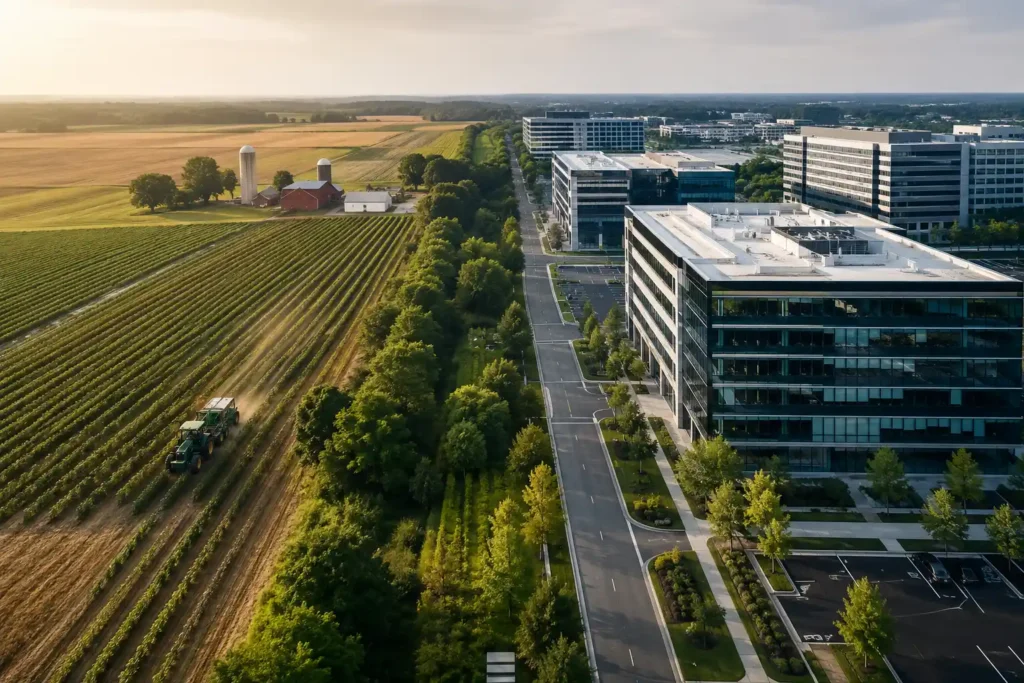
Family office farmland investments have emerged as one of the most significant shifts in the world of private wealth allocation, as ultra-high-net-worth families reconsider what truly defines valuable real estate. In the first few years after the pandemic transformed workplace culture, many family offices began questioning the long-term appeal of traditional office towers and started exploring farmland investing as a more resilient form of ownership. The conversation around agricultural real estate has moved far beyond farming itself; it now reflects a broader search for scarce, productive, and durable assets.
For decades, office buildings represented prestige, stability, and institutional quality. Yet changing work patterns, rising financing costs, and uncertain occupancy trends have challenged the traditional commercial property model. Meanwhile, productive land has gained attention as a new form of trophy real estate, where value comes from scarcity, cash flow, and long-term usefulness rather than location alone.
Today, wealthy investors increasingly view farmland as a strategic asset capable of supporting wealth preservation, portfolio diversification, and generational planning. As global markets become more volatile, many investors are moving toward real assets that can produce income, protect purchasing power, and remain relevant across economic cycles.
The rise of Family office farmland investments reflects a larger transformation in how elite investors define luxury: not simply owning iconic properties, but controlling assets that create lasting value.
Why Family Offices Are Reallocating Capital?
The changing relationship between investors and commercial office buildings is one of the biggest forces behind the growing interest in farmland. For years, prime office properties were considered among the safest forms of institutional real estate. Trophy towers in global financial centers attracted pension funds, sovereign investors, and private capital because they combined prestige with dependable rental income.
However, the commercial real estate landscape has shifted. Hybrid work arrangements have reduced demand for traditional office space, while companies have reassessed how much physical space they actually require. Even high-quality buildings in major cities now face questions about future occupancy, tenant expectations, and redevelopment costs.
At the same time, higher interest rates have created additional pressure. Office buildings often depend on significant financing, and rising borrowing costs can reduce returns while increasing refinancing risks. As a result, some investors have started looking for assets with simpler long-term fundamentals.
Family offices typically approach investing differently from traditional funds. Rather than focusing only on quarterly performance, they often prioritize capital preservation over decades. Their investment decisions frequently consider inheritance planning, family legacy, and protection against economic uncertainty.
This mindset has made farmland increasingly attractive. Unlike office properties that depend heavily on business cycles and tenant demand, farmland serves a fundamental global need: food production. The land itself remains limited, and demand for agricultural output continues to grow alongside population expansion.
Many high-net-worth investors are also seeking alternative real estate investments that combine financial performance with strategic value. Farmland fits this category because it can generate operating income while maintaining long-term appreciation potential.
The shift does not mean family offices have abandoned traditional real estate entirely. Instead, many are adjusting allocations. Prime residential assets, hospitality properties, infrastructure, and agricultural holdings are increasingly joining portfolios once dominated by offices and commercial buildings.
This evolution shows a broader change in wealth management: investors are placing greater importance on resilience, usefulness, and scarcity.
Why Farmland Has Become the New Trophy Asset?
For generations, luxury real estate was often defined by appearance and location. A Manhattan skyscraper, a London townhouse, or a Mediterranean estate symbolized status and financial success. However, the modern definition of premium ownership is becoming more strategic.
Today, farmland is increasingly viewed as a high-value asset because it combines several qualities that sophisticated investors seek: limited supply, productive capacity, income generation, and long-term durability.
Unlike many forms of property, land cannot easily be replicated. The amount of high-quality agricultural land available worldwide is restricted by geography, climate, water availability, and environmental conditions. This scarcity creates a foundation for long-term value.
Unlike purely decorative assets, productive land can actively generate returns. Farms can produce revenue through crop sales, livestock operations, leases, and specialized agricultural activities. Well-managed properties may also benefit from improvements in technology, irrigation systems, and operational efficiency.
Modern productive land investments are no longer viewed as simple purchases of rural property. They often involve professional management, scientific farming techniques, and institutional-level strategies. Investors may partner with agricultural operators who understand markets, sustainability, and regional conditions.
Another factor supporting farmland’s appeal is its relationship with essential resources. Water rights, fertile soil, and agricultural productivity are becoming increasingly valuable as climate conditions change and global food systems face pressure.
This makes farmland different from many traditional luxury assets. A luxury residence may appreciate because of location and exclusivity, but farmland can appreciate while simultaneously producing something the global economy requires.
For wealthy families focused on generational wealth, this combination is powerful. Land ownership has historically represented permanence, and agricultural assets can often be passed through generations while continuing to create economic value.
The rise of farmland also reflects a broader movement toward real assets investing, where investors prefer tangible resources over purely financial instruments. In uncertain economic environments, physical assets with practical utility often become more attractive.
Income, Inflation Protection, and Wealth Preservation
One of the strongest reasons behind the growth of Family office farmland investments is farmland’s ability to combine income production with long-term capital preservation.
Agricultural assets can create multiple revenue streams. Owners may earn income through leasing arrangements with farmers, direct agricultural operations, specialty crops, livestock production, or partnerships with professional operators. This operational flexibility allows investors to structure farmland holdings according to their objectives.
For many investors, farmland also functions as an inflation hedge asset. Agricultural products often experience price increases during inflationary periods, which can support land values and operating revenues. While farmland performance varies by region, crop type, and management quality, the connection between food demand and economic conditions gives the asset class unique characteristics.
This differs from some office building investments, where rising costs can negatively affect profitability if tenants reduce space or resist higher rents. Farmland, when managed effectively, can benefit from strong demand for essential commodities.
Portfolio diversification is another important factor. Agricultural assets often behave differently from stocks, bonds, and urban commercial property. By adding farmland, investors can reduce dependence on traditional markets and create a more balanced wealth strategy.
A typical comparison of major real assets highlights why farmland attracts long-term investors:
| Real Asset | Primary Income Source | Long-Term Investment Advantage |
|---|---|---|
| Farmland | Crop production, leases, agricultural operations | Productive income, scarcity, food demand, and generational value |
| Prime Office Buildings | Commercial rent from tenants | Prestige locations and institutional ownership potential |
| Luxury Residential Properties | Rental income or resale value | Exclusivity, lifestyle appeal, and location scarcity |
| Vineyards & Wine Estates | Wine production, hospitality, land value | Brand value, heritage, and specialized scarcity |
| Timberland | Timber harvesting and land appreciation | Renewable resource income and long-term asset growth |
The attraction of farmland extends beyond simple returns. Many investors see it as a form of wealth preservation because it connects ownership to essential resources. Land has survived political changes, market cycles, and economic transformations for centuries.
However, successful farmland investing requires expertise. Soil quality, climate conditions, water access, crop selection, and operational management all influence performance. The strongest investors typically treat farmland as an active asset rather than a passive purchase.
As more private capital enters the agricultural sector, farmland continues to transition from a niche investment category into a recognized institutional asset class. This development highlights a wider trend: wealthy investors are increasingly choosing assets that combine financial returns with lasting real-world value.
Sustainability, Food Security, and the Investment Case
The investment case for farmland extends beyond financial performance. Increasingly, family offices and institutional investors view agricultural land as a strategic asset connected to some of the world’s most important challenges: food security, climate adaptation, and sustainable resource management.
Global population growth, changing consumption patterns, and pressure on agricultural systems have increased attention on productive land. According to research from organizations such as the USDA Economic Research Service and global agricultural investment groups, demand for food production remains a long-term economic force. This has strengthened the argument for institutional farmland investing, where professional investors acquire and manage agricultural assets at scale.
Modern farmland ownership has also evolved through technology and sustainability practices. Many agricultural investors are adopting precision farming, improved irrigation, soil monitoring, and regenerative agriculture techniques. These methods can increase productivity while protecting the long-term health of the land.
For investors focused on ESG principles, farmland offers a unique opportunity. Unlike some assets that only reduce environmental impact, well-managed agricultural properties can actively contribute to sustainability by improving soil quality, protecting ecosystems, and supporting responsible resource management.
Sustainability advantages often include:
- Regenerative farming methods that improve soil health and long-term productivity
- Water management strategies that protect critical agricultural resources
- Technology-driven farming systems that increase efficiency and reduce waste
- Biodiversity initiatives that support healthier ecosystems
These factors have helped transform farmland from a traditional rural asset into a sophisticated investment category. Wealth managers increasingly recognize that sustainable agriculture can strengthen both environmental outcomes and financial durability.
Food security also adds a strategic dimension. Governments, corporations, and private investors are paying closer attention to agricultural supply chains, especially as climate risks and geopolitical uncertainty affect global markets. Ownership of productive land can provide exposure to a sector tied directly to human necessity.
This is why many investors now consider farmland a core component of wealth preservation strategies. The asset combines physical scarcity with economic importance, creating a profile that appeals to families thinking beyond one market cycle.
Farmland vs. Traditional Trophy Real Estate
The evolution of luxury property investing reveals a changing definition of value. Historically, trophy real estate meant landmark buildings, luxury residences, or famous estates located in elite markets. Today, investors increasingly ask a different question: does the asset simply represent wealth, or does it actively create and protect wealth?
Prime office buildings, luxury homes, vineyards, timberland, and farmland all have unique advantages. However, each category responds differently to inflation, economic cycles, and changing investor priorities.
| Asset Class | Inflation Protection | Best Suited For |
|---|---|---|
| Farmland | Strong through agricultural pricing, land scarcity, and essential demand | Investors seeking productive assets, diversification, and legacy wealth |
| Prime Office Buildings | Depends on rental growth, occupancy, and market conditions | Investors comfortable with commercial cycles and major urban markets |
| Luxury Residential Properties | Moderate through scarcity and premium locations | Investors seeking lifestyle value, prestige, and selective appreciation |
| Vineyards & Wine Estates | Linked to brand value, production, and specialty markets | Investors interested in operational assets with cultural appeal |
| Timberland | Strong through renewable resource demand and land value | Long-term investors seeking natural resource exposure |
Farmland differs from traditional real estate because it operates as both property and business. A successful farm requires management decisions, production strategies, and market awareness. This creates complexity, but it also creates opportunity.
Luxury residential assets often attract buyers because of exclusivity. A historic villa or penthouse in a major city may hold significant emotional and cultural value. However, these properties typically depend heavily on location and buyer demand.
Vineyards and wine estates occupy a unique position between lifestyle investment and agricultural business. They offer prestige, tourism potential, and brand development opportunities, yet they require specialized operational knowledge.
Timberland provides another comparison. Like farmland, it represents a natural resource asset with long-term appreciation potential. However, timber cycles operate differently, with returns often depending on harvesting schedules and forestry management.
Office buildings remain important assets, especially in prime locations with strong tenants. Yet the post-pandemic environment has introduced new questions about long-term demand. Investors now evaluate office properties more carefully, focusing on flexibility, tenant quality, and adaptability.
For many high-net-worth investors, the answer is not choosing one asset over another. Instead, modern portfolios often combine multiple real estate categories to balance income, prestige, resilience, and growth.
The Future of Family Office Real Estate Investing
The next era of private real estate investing will likely focus less on symbolic ownership and more on strategic ownership. Across global markets, investors are increasingly prioritizing assets that solve practical problems while preserving capital.
The rise of farmland reflects this broader movement. Family office farmland investments represent a shift toward productive assets that can generate income while supporting long-term investment objectives.
Technology will play an important role in the future of agricultural ownership. Artificial intelligence, satellite monitoring, automation, and data-driven farming systems are changing how investors evaluate land. These tools allow owners to improve efficiency, predict risks, and optimize operations.
Institutional interest is also expanding. Large investment firms, agricultural funds, and specialized operators are increasing exposure to farmland because they recognize its role within diversified portfolios.
At the same time, climate adaptation will become increasingly important. Investors will pay closer attention to water availability, regional climate patterns, and sustainable production methods. The most valuable farmland will likely be land that can remain productive under changing environmental conditions.
For next-generation wealth holders, agricultural assets also carry an emotional and strategic appeal. Many younger investors are interested in combining financial performance with environmental responsibility. Farmland offers a way to connect investment decisions with broader values.
This does not mean traditional real estate will disappear. Iconic buildings, luxury homes, and premium developments will continue attracting capital. However, the definition of a premium asset is expanding.
The future may belong to investments that combine financial strength with real-world usefulness.
Unique Insight: Why Farmland Is Becoming the Ultimate Luxury Asset?
The rise of Family office farmland investments represents a deeper transformation in how wealthy families define luxury real estate.
For decades, prestige was measured by visibility. Owning a famous office tower, a landmark apartment, or a recognizable property in a global city represented success. But today’s sophisticated investors increasingly measure luxury through control, resilience, and strategic importance.
The most valuable assets may no longer be those that simply dominate a skyline. Instead, they may be the assets that quietly influence essential systems.
Farmland demonstrates this shift because it combines several rare qualities at once:
- Scarcity created by limited high-quality land supply
- Income generation through agricultural production
- Protection against inflation and economic uncertainty
- Long-term relevance through global food demand
- Legacy value for future generations
For family offices, this aligns perfectly with a long-term investment philosophy. Their objective is rarely just short-term appreciation. Instead, they often focus on protecting wealth across decades and creating assets that future generations can inherit.
Productive assets can sometimes outperform purely symbolic assets because they continue creating value even when market sentiment changes. A premium office tower may lose appeal if workplace trends shift, but productive land remains connected to fundamental human needs.
This explains why farmland has entered conversations previously dominated by traditional trophy properties. It offers something increasingly rare in modern markets: tangible ownership tied to lasting usefulness.
For many of the world’s wealthiest families, the ultimate luxury is no longer owning the tallest office building. It is controlling irreplaceable land that produces food, protects wealth, supports sustainability, and can remain valuable for generations.
Frequently Asked Questions
Why are family offices investing in farmland?
Family offices are investing in farmland because they want assets that combine income generation, scarcity, and long-term stability. Farmland provides exposure to agricultural production while supporting diversification away from traditional commercial real estate.
Is farmland a good long-term investment?
Farmland can be an attractive long-term investment because it offers potential appreciation, operating income, and exposure to essential resources. However, performance depends on location, management, climate conditions, and market demand.
How does farmland generate income?
Farmland can generate income through crop production, agricultural leases, livestock operations, specialty farming, and partnerships with professional operators.
Why are office buildings becoming less attractive?
Office buildings face challenges from hybrid work trends, changing tenant requirements, higher interest rates, and uncertainty around future demand. Prime properties remain valuable, but investors are evaluating them more selectively.
Is farmland considered trophy real estate?
Yes, farmland is increasingly considered a form of trophy real estate because premium agricultural assets offer scarcity, prestige, income potential, and strategic value.
What risks are associated with farmland investing?
Risks include climate events, water shortages, commodity price changes, regulatory issues, operational complexity, and differences in regional agricultural performance.
How do family offices diversify real estate portfolios?
Family offices diversify through a mix of commercial properties, residential assets, infrastructure, timberland, vineyards, and agricultural real estate to balance income and risk.
Can farmland protect against inflation?
Farmland can provide inflation protection because agricultural products often respond to rising prices, while land itself remains a scarce physical asset.
What makes agricultural real estate attractive to institutional investors?
Agricultural real estate attracts institutions because it offers diversification, long-term demand, operational income, and exposure to a globally essential industry.
Why are Family office farmland investments becoming a major wealth preservation strategy?
Family office farmland investments are becoming a major wealth preservation strategy because they combine productive income, real asset ownership, scarcity, and long-term generational value in one investment category.

Administrator at Alt Finances, leading editorial strategy and contributing in-depth coverage of investing, wealth management, alternative assets, and global financial markets. Through research-driven articles and analysis, he helps readers understand the ideas, industries, and market forces shaping modern finance.