An asset changes character when the market around it begins to acquire the infrastructure of institutional finance. The institutionalization of collectibles is therefore about more than wealthy buyers spending more on rare objects; it is about valuation, authentication, financing, ownership and liquidity becoming increasingly organized around assets once viewed primarily through the lens of passion.
That distinction matters. A painting, vintage watch or classic Ferrari can possess cultural and emotional value without being a particularly attractive investment. But once investors can establish credible provenance, observe repeated transactions, compare valuations, obtain financing and eventually sell through established channels, the asset begins to resemble an alternative investment market. For sophisticated investors, the question is no longer simply whether an object is rare. It is whether the market surrounding it is mature enough to support capital at scale.
From Passion Asset to Investable Market
The difference between owning a collectible and owning an asset within an investable market is infrastructure.
Traditional financial assets benefit from continuous price discovery, standardized reporting, established custody systems and relatively clear exit mechanisms. Collectibles operate differently. Their value can depend on condition, provenance, rarity, reputation, cultural relevance and the identity of the buyer.
Yet the surrounding ecosystem has become considerably more sophisticated. Auction houses generate transaction records; specialist dealers provide market intelligence; appraisers establish valuations; insurers underwrite physical risks; lenders can use selected collectibles as collateral; and digital platforms increasingly organize ownership and trading.
The art market demonstrates both the opportunity and the limitations. Art Basel and UBS estimated global art sales at $59.6 billion in 2025, up 4% from 2024, while public auction sales increased 9% to $20.7 billion. Yet the recovery remained below the market’s 2022 peak, illustrating that a structured market can still experience substantial cycles.
| Collectible Category | Market Characteristics | Institutional Investment Consideration |
|---|---|---|
| Fine art | Established auction houses, extensive provenance and specialist valuation | Strong infrastructure, but significant valuation and liquidity variation |
| Luxury watches | Active secondary markets and model-level price data | More measurable pricing, but highly brand and reference dependent |
| Classic cars | Specialist auctions, documented histories and condition-based valuation | Scarcity can be compelling, but storage and transaction costs matter |
| Fine wine | Established trading platforms and provenance systems | Portfolio diversification potential, but market cycles and storage remain important |
| Sports memorabilia | Growing auction activity and authentication systems | Demand can be strong, but highly dependent on cultural relevance |
For investors, the lesson is straightforward: market infrastructure can improve access without eliminating risk. Capital allocation should focus not only on the collectible itself, but also on the depth, transparency and credibility of the market in which it trades.
The Collectible Markets Attracting Institutional Attention
Not every collectible has the characteristics required for serious investment.
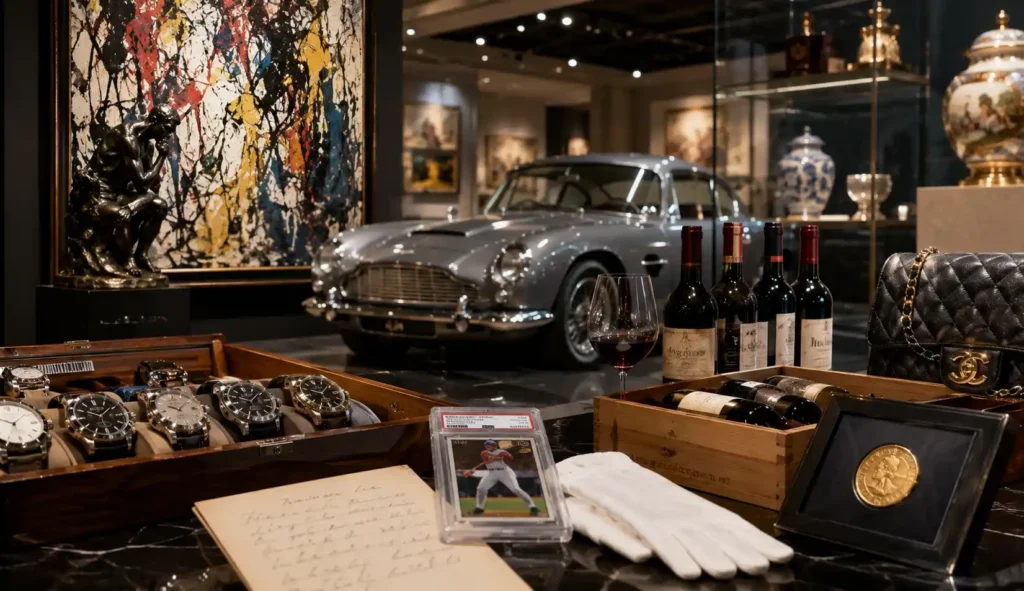
Fine art remains one of the most developed categories because it combines global auction networks, specialist expertise, extensive provenance records and decades of transaction history. Luxury watches have developed similarly sophisticated secondary markets, while classic cars benefit from specialist auction houses and detailed documentation around ownership, restoration and originality.
Knight Frank’s 2026 Luxury Investment Index illustrates why selectivity matters. Its basket of luxury collectibles declined just 0.4% in 2025 after two years of losses, while the ten-year index remained up 38.6%. Performance also varied sharply by category: its cited watch indices strengthened, while fine wine declined 2.5% in 2025.
That dispersion undermines the idea of a single “collectibles asset class.” A Patek Philippe reference, a rare Old Master and a bottle of Bordeaux may all qualify as passion assets, but their liquidity, valuation mechanisms and investor bases are fundamentally different.
For investors, this makes category selection more important than the collectibles label itself. The opportunity lies in markets where scarcity meets sustained demand, credible authentication and sufficient transaction depth not simply where an object carries a high price.
Why Auction Houses and Marketplaces Matter
Auction houses perform a function that increasingly resembles financial-market infrastructure: they create observable transactions.
Sotheby’s, Christie’s, Phillips and Bonhams provide a global marketplace in which buyers and sellers establish prices through competitive bidding. Repeated sales can generate comparable transactions and increasingly detailed historical datasets.
That infrastructure matters because valuation becomes considerably more difficult when transactions are rare. A public auction price cannot establish the intrinsic value of every similar object, but a sufficiently deep record of comparable sales can provide a reference point.
The 2025 art market illustrates both sides of the equation. Global transaction volume reached an estimated 41.5 million, while the United States, United Kingdom and China represented 76% of global art sales by value. Yet the market remained concentrated, particularly at the high end.
Luxury auctions also demonstrate the strength of specialized markets. Christie’s Geneva Rare Watches sale in May 2025 generated CHF21.18 million, with 92% of lots sold. Its Hong Kong Spring Luxury Week generated approximately $92.9 million across jewellery, watches, wine and handbags.
Still, auction prices are not equivalent to continuous market prices. A trophy asset may attract exceptional bidding because two highly motivated collectors happen to compete for it. Conversely, a lack of buyers can make a supposedly valuable asset difficult to sell.
For investors, auction data should therefore be treated as evidence, not certainty. Price discovery is improving, but collectibles remain considerably less transparent than publicly traded securities.
Fractional Ownership and the Financialization of Collectibles
Fractional ownership represents another step in the institutionalization of collectibles.
Historically, owning a $10 million painting required $10 million or access to a very small circle of wealthy collectors. Fractional structures can divide economic ownership into smaller interests, potentially allowing more investors to participate in assets previously accessible only to major collectors.
The concept is attractive because it reduces the minimum capital requirement. However, it does not automatically create liquidity.
Investors still need to understand who legally owns the underlying asset, where it is held, who controls the sale, what fees apply and whether a secondary market actually exists. Platform failure, custody arrangements, valuation disputes and restricted exit mechanisms can materially alter the investment proposition.
Deloitte’s 2025 Art & Finance Report shows that art is becoming increasingly integrated into wealth-management infrastructure. It found that 51% of wealth managers surveyed now offer art-related services, compared with only about a quarter in 2011, while its research also highlights fractional investment, art-secured lending, AI and blockchain as areas shaping the sector.
For investors, fractional ownership should be viewed as an access mechanism rather than a risk-elimination mechanism. Lower entry costs can broaden participation, but liquidity, governance, fees and legal ownership remain critical.
Family Offices, Institutional Investors and Wealth Preservation
Collectibles occupy an unusual position within wealthy portfolios because their appeal does not depend entirely on financial return.
A family office may value a painting for cultural significance, a watch for heritage, a classic car for historical importance or memorabilia for family legacy. That creates a combination of financial and non-financial utility rarely found in conventional assets.
Deloitte’s research also points to an important generational shift: next-generation collectors increasingly emphasize cultural impact and legacy alongside financial considerations.
This helps explain why collectibles can fit naturally into wealth-preservation strategies. However, wealth preservation is not synonymous with outperformance.
Unlike equities, bonds or rental property, many collectibles generate no regular cash flow. Their economic value depends primarily on future demand.
The investment equation is therefore closer to:
Scarcity + Demand + Provenance + Condition + Reputation + Liquidity
than:
Earnings + Dividends + Interest + Rent
For investors, collectibles may complement a broader portfolio, but their role must be defined carefully. Cultural value, wealth transfer and potential appreciation can coexist, yet none guarantees superior risk-adjusted returns.
Technology Is Building the Infrastructure Behind Collectibles
Technology is gradually addressing some of the structural weaknesses of collectible markets.
Digital provenance can improve ownership records. Advanced imaging can assist condition assessment. AI may support authentication and valuation research. Blockchain-based records can create additional documentation around ownership and transaction history.
But technology should not be confused with certainty.
A digital certificate cannot make an asset inherently valuable. A blockchain record cannot eliminate disputes over authenticity. AI can support specialists without replacing specialist judgment.
The more important development may be the aggregation of fragmented information. As market platforms combine transaction history, provenance, condition data and ownership records, investors can potentially make better-informed comparisons.
For investors, technology matters because better information can reduce friction. It does not remove the fundamental risks of subjective valuation, changing tastes and limited liquidity.
Collectible-Backed Lending and Financialization
Another sign of institutional maturity is the ability to turn collectibles into collateral.
The basic mechanism is:
Asset → Collateral → Credit → Liquidity
Art-backed lending is the most established example, but specialized financing can also extend to luxury assets and other high-value collectibles.
This can allow an owner to access capital without immediately selling an asset. For wealthy investors, that can be particularly useful in estate planning, liquidity management or portfolio restructuring.
Yet lending against collectibles introduces its own risks. Valuations can change, markets can become illiquid and collateral can prove difficult to liquidate during stressed conditions.
The lender therefore faces a different problem from conventional secured lending: the collateral may be valuable, but its value is not necessarily easy to realize quickly.
For investors, financing increases the utility of collectibles but does not transform them into conventional fixed-income assets. Both lenders and owners must account for valuation volatility, liquidity discounts and the cost of maintaining the underlying asset.
The Costs and Risks Behind Collectibles Investing
The most important mistake in collectibles investing is confusing appreciation with realized return.
An appraisal may increase. An auction estimate may rise. A comparable asset may sell for more than it did five years earlier. None of those facts automatically means the owner achieved that return.
The eventual result can be reduced by:
- Auction commissions
- Dealer spreads
- Taxes
- Insurance
- Storage
- Restoration
- Authentication
- Financing costs
- Transportation
- Selling costs
Knight Frank’s recent data reinforces why investors should resist simple extrapolation. Its Luxury Investment Index fell during 2023 and 2024 before stabilizing in 2025, demonstrating how higher interest rates and changing demand can affect passion assets.
Collectibles also face fraud, provenance disputes, condition deterioration, changing tastes and concentration risk. Most importantly, liquidity can disappear precisely when an investor wants to sell.
For investors, the correct calculation is not “What could this object be worth?” but “What could I realistically realize after every cost and under different market conditions?” That distinction separates collecting from disciplined alternative-asset analysis.
Which Collectibles Could Become More Institutionalized?
The next phase of the institutionalization of collectibles will probably favor categories that combine scarcity with infrastructure.
| Institutionalization Driver | Market Impact | Investor Consideration |
|---|---|---|
| Transparent auction records | Improves price discovery | Historical prices still require context |
| Authentication and provenance | Reduces uncertainty | Verification is never absolute |
| Specialist funds and platforms | Expands institutional access | Fees and governance become important |
| Fractional ownership | Lowers entry barriers | Secondary-market liquidity may remain limited |
| Asset-backed lending | Creates financial utility | Collateral values can move sharply |
| Digital market infrastructure | Improves information flow | Technology does not guarantee valuation accuracy |
The strongest candidates for institutionalization are therefore not necessarily the rarest objects. They are assets surrounded by deep collector communities, credible authentication, repeat transactions, established marketplaces and increasingly professional reporting.
That distinction matters. A unique object may be extraordinarily valuable while remaining almost impossible to price independently. Meanwhile, a less spectacular collectible with thousands of observable transactions may provide a much stronger foundation for an investable market.
For investors, institutionalization should be measured by market quality rather than headlines. Depth, transparency and exit mechanisms may ultimately matter more than the headline value of the underlying collectible.
Unique Insight: The Market Around the Asset Is Becoming the Asset
The deepest investment implication of the institutionalization of collectibles is not that collectibles are becoming more popular.
It is that passion assets are acquiring the infrastructure of financial markets.
The traditional model was:
Ownership → Passion → Rarity → Personal Enjoyment
The emerging model increasingly adds:
Valuation → Authentication → Market Data → Financing → Fractional Ownership → Institutional Capital
That does not make every collectible investable.
Instead, it creates a more interesting question: Which passion assets can develop enough market depth, transparency, liquidity and institutional infrastructure to support professional capital?
This is where collectibles increasingly intersect with alternative investments. The future may belong less to objects that are merely rare and more to markets capable of turning rarity into credible, repeatable and verifiable economic value.
Conclusion
The institutionalization of collectibles represents a broader evolution in alternative investing.
Scarcity matters. Provenance matters. Market infrastructure matters. Liquidity matters. Valuation matters. Institutional participation matters. And transaction costs matter just as much.
The crucial question is therefore not simply whether a painting, watch, car or bottle of wine becomes more valuable.
It is:
Can the market surrounding that collectible become transparent, verifiable, liquid and sophisticated enough for institutional capital to participate at scale?
For sophisticated investors, collectibles may offer a distinctive combination of tangible ownership, cultural value, wealth preservation and potential financial appreciation. But they remain illiquid assets whose outcomes depend heavily on expertise, market depth and execution.
The real frontier is not collecting more valuable objects.
It is building investable markets around scarce objects.
Frequently Asked Questions
What is the institutionalization of collectibles?
The institutionalization of collectibles is the development of professional valuation, authentication, financing, marketplaces, ownership structures and reporting that can turn passion assets into more structured alternative-investment markets.
Why are collectibles becoming alternative investments?
Greater market infrastructure, specialist expertise, auction data and professional wealth-management services have made selected collectibles easier to analyze and access.
What are passion assets?
Passion assets are tangible assets acquired partly for enjoyment, cultural significance or personal interest, including art, watches, cars, wine and memorabilia.
Which collectibles are considered investments?
Fine art, rare watches, classic cars, fine wine, jewellery and sports memorabilia can function as investment assets, although their investment characteristics vary substantially.
How do auction houses influence collectible prices?
Auction houses create observable transactions and comparable sales that contribute to price discovery and market transparency.
Can collectibles diversify an investment portfolio?
They may provide exposure to different demand drivers, but diversification benefits vary by category and should not be assumed.
What is fractional ownership of collectibles?
It divides economic ownership of a high-value collectible among multiple investors, potentially reducing the capital required to participate.
How does authentication affect collectible value?
Credible authentication and provenance can reduce uncertainty and support buyer confidence, while disputed provenance can materially damage value.
Can investors borrow against collectibles?
Yes. Certain high-value collectibles can serve as collateral for specialized lending, although valuation and liquidity risks remain significant.
What are the biggest risks of collectibles investing?
Illiquidity, transaction costs, fraud, valuation uncertainty, condition deterioration, changing tastes, concentration and tax considerations are among the major risks.
Are collectibles liquid investments?
Generally, no. Even highly sought-after collectibles can take time to sell, and realized prices may differ significantly from appraisals or previous auction results.
What makes a collectible market investable?
The strongest markets tend to combine scarcity, sustained demand, reliable provenance, transparent price discovery, credible authentication, market depth and practical exit mechanisms.

Contributing Writer for Alt Finances with experience in luxury events, travel, fashion, and the arts. Active investor through her family office across real estate, energy, and private equity. University of Miami – BBA.