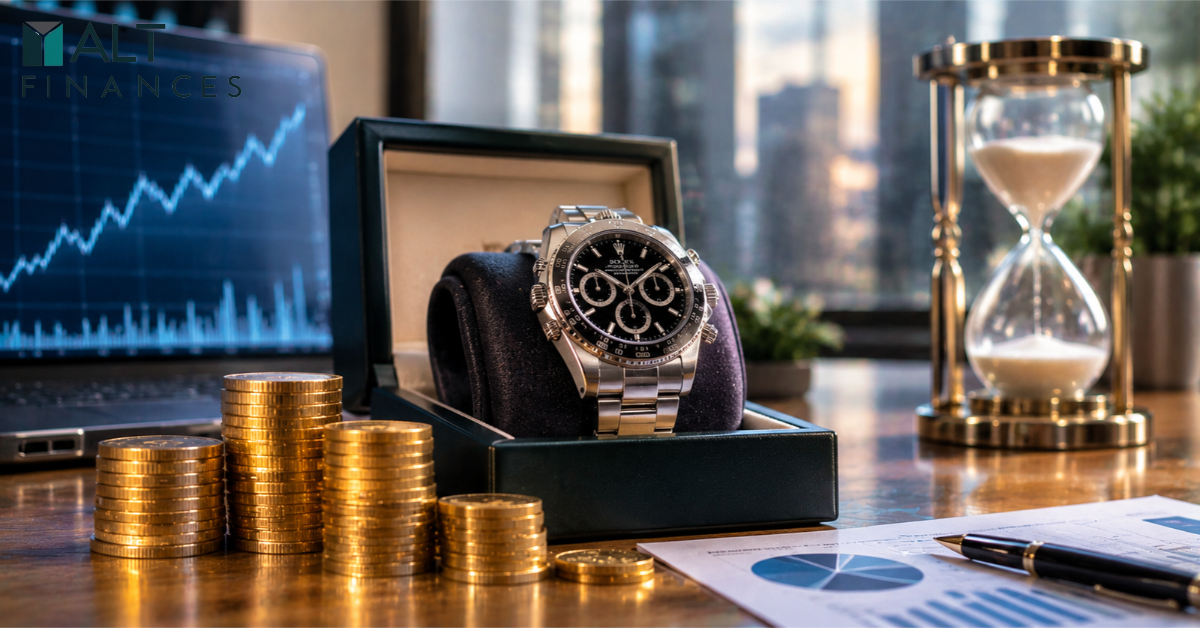
Fractional ownership can make expensive luxury watches accessible to smaller investors, but the return shown on a platform dashboard is not necessarily the amount an investor receives. Acquisition charges, ongoing costs and selling deductions can turn an apparently attractive gain into a modest net return or a loss.
Important 2026 update: The secondary watch market has shown signs of recovery, but longer-term performance remains uneven. As of November 2, 2026, WatchCharts’ Overall Market Index was up 7.8% over one year, yet down 8.0% over five years. That contrast matters: a rising market index does not guarantee that a particular watch will appreciate, or that a fractional investor will profit after fees.
1. Introduction: The Appealand the Hidden Cost
A rare Rolex, Patek Philippe or Audemars Piguet can cost tens of thousands of dollars or considerably more. Fractional watch investing offers another route: multiple investors contribute capital toward a single timepiece and receive an economic interest linked to its value or eventual sale.
The appeal is straightforward. Investors can gain exposure to a collectible without paying the full purchase price, arranging storage or managing the sale themselves. But fractional ownership does not remove the costs of owning a physical luxury asset. It redistributes them and introduces platform, custody and liquidity considerations.
The important question is therefore not simply how much a watch appreciates. It is how much of that appreciation reaches the investor after every applicable charge.
2. How Fractional Watch Investing Works
A fractional watch platform typically identifies a watch, arranges its purchase, verifies its condition and provenance, and places it in professional storage. Investors then purchase units, shares or contractual interests representing a portion of the investment.
The legal structure varies. In one arrangement, a special-purpose company may own the watch and investors hold shares or other securities in that company. In another, investors may hold contractual rights to a proportion of the economic proceeds without directly owning a physical portion of the timepiece.
That distinction is important. An investor who buys a fraction does not necessarily have the right to possess, wear, independently sell or vote on decisions involving the watch.
Platforms may select watches based on brand, rarity, condition, provenance and resale demand. Investors should examine the purchase price against independent market evidence rather than assuming that a prestigious reference is automatically a sound investment.
For more context on how collectibles are becoming structured investment markets, see AltFinances’ analysis of the institutionalization of collectibles.
3. The Fees Investors Actually Pay
Fractional watch platforms do not all use the same fee structure. Some charge upfront, others recover costs during the holding period or at sale, and some combine several methods.
Common charges include:
Acquisition or platform fee: Covers sourcing, authentication, transaction arrangements and platform operations. It may be charged separately or incorporated into the purchase price.
Management fee: Pays for administration, asset monitoring and investment management. Depending on the structure, it may be annual, fixed or included in another charge.
Storage and insurance: Physical watches need secure storage, appropriate insurance and periodic condition monitoring. These costs may be prepaid, deducted annually or charged when the asset is sold.
Administration costs: Legal, audit, payment-processing and other operational expenses may be charged directly or passed through to investors.
Selling commission: A platform, auction house or dealer may charge a commission when the watch is sold.
Performance fee: Some investment arrangements may retain a share of profits above a specified threshold. Investors should check how the threshold, losses and calculation period are defined.
A real platform example illustrates why reading current terms matters. Splint Invest’s published fee information describes an upfront platform fee of 4%–10%, with storage and insurance costs included in the investment amount and adjusted at exit. Its FAQ states that there is no exit fee when the platform sells an investment. The platform’s marketplace and app descriptions have also presented separate trading or sales charges, so investors should check the exact terms for the asset and transaction they are considering rather than assume one fee schedule applies universally.
The key is to calculate the total cost across the entire holding period not just the advertised entry charge.
4. A Simple Example: What Happens to a $10,000 Investment?
Imagine you invest $10,000 in a luxury watch through a fractional investment platform and hold it for three years.
Suppose the platform charges a 5% fee when you invest. This means $500 goes toward the fee, leaving $9,500 to buy the watch.
After three years, the watch’s value increases by 20%. It is now worth $11,400. However, you still have to pay the other costs.
| Investment details | Amount |
|---|---|
| Your initial investment | $10,000 |
| Upfront platform fee | -$500 |
| Amount used to buy the watch | $9,500 |
| Watch’s value after a 20% increase | $11,400 |
| Management fees over three years | -$285 |
| Storage and insurance costs | -$142.50 |
| Selling fee | -$684 |
| What you receive after all these costs | $10,288.50 |
Your final result
$288.50 profit
You invested $10,000 and received $10,288.50 after three years.
The watch’s value increased by 20%.
Your actual profit was only 2.9%.
Your average annual return was approximately 1%.
This example shows why investors should look beyond the watch’s price increase. Even when a luxury watch becomes more valuable, platform fees, management costs, storage, insurance and selling charges can take away much of the profit.
These figures are hypothetical, not the fees of a specific platform. They also assume the watch sells for $11,400 and exclude taxes and performance fees. If the final selling price is lower, your profit could disappear or turn into a loss.
5. Advertised Returns vs. Realized Returns
A platform’s displayed valuation is not necessarily a price at which the watch can be sold.
There are several different figures investors should distinguish:
Purchase price: What the platform paid to acquire the watch, including any dealer premium or transaction costs.
Estimated valuation: An appraisal or model-based estimate of current market value.
Dealer asking price: What a seller or dealer hopes to receive, which may be higher than the price buyers are willing to pay.
Completed resale price: What a buyer actually paid in a completed transaction.
Net investor proceeds: The amount distributed after selling costs, platform charges and other deductions.
WatchCharts tracks a basket of 300 watches from the ten largest brands in its Overall Market Index, weighted by transaction value and rebalanced annually. Its index is useful for understanding broad secondary-market trends, but it is not a valuation of every watch or a forecast of an individual investor’s return. Investors can review the WatchCharts luxury watch market index to see how the broader market has moved.
Dealer margins, auction commissions, condition, box and papers, service history and the specific reference can all affect the final sale price. A watch valued at $20,000 on a platform may not attract a buyer willing to pay that amount.
For a closer look at the factors that influence demand for particular timepieces, read why collectors continue to pursue rare watches.
6. The Risks Beyond Fees
Fees are only one part of the investment decision.
Liquidity is limited. A platform may offer a secondary marketplace, but that does not guarantee a buyer will be available when an investor wants to exit. Trading may occur only during designated windows, and discounts may be necessary to attract buyers.
Ownership rights can be indirect. Investors need to know whether they own shares in a legal entity, hold a contractual claim or have another form of economic interest. They should also understand what happens if the platform fails, enters insolvency or changes its operating model.
Custody and insurance matter. Investors should establish who physically holds the watch, whether the insurance policy covers the full agreed value, who is insured, and what happens if the watch is stolen, damaged or disputed.
Watch prices can fall. The strong price gains seen in parts of the luxury watch market during the pandemic were followed by a correction. The latest WatchCharts figures show a one-year recovery alongside a negative five-year change. Performance also differs considerably by brand and reference.
Finally, collectible watches do not normally produce interest, dividends or rental income. Investors depend primarily on a future sale, making the timing and price of the exit central to the outcome.
7. How to Evaluate a Fractional Watch Investment
Before committing capital, investors should request clear answers to the following questions:
Legal ownership: Do investors own shares in a company that owns the watch, or only a contractual right to sale proceeds?
Complete fee schedule: What are the entry, annual, storage, insurance, administration, selling and secondary-market charges?
Asset valuation: Who values the watch, how often is it valued, and are estimates based on completed sales rather than asking prices?
Authentication and provenance: Who verifies authenticity, condition, service history and ownership records?
Custody and insurance: Where is the watch stored, who controls access, and what does the insurance policy actually cover?
Exit conditions: Who decides when the watch is sold? Is there a minimum holding period, a target exit date or a mechanism for early sale?
Platform failure: Are the watch and investor interests legally separated from the platform’s own assets if the company becomes insolvent?
Tax treatment: How are distributions, gains and losses treated in the investor’s jurisdiction?
The U.S. Securities and Exchange Commission’s Investor.gov guidance on investment products, fees and liquidity is a useful starting point for understanding why costs, risk and the ability to sell matter. However, the legal protections available to a fractional watch investor depend on the actual offering structure and applicable jurisdiction.
Investors should read the offering documents, shareholder or participation agreements, custody arrangements and exit policy—not rely solely on marketing material or a projected return.
For a wider perspective on how collectibles fit into a portfolio, see how alternative investments work and whether they belong in a portfolio.
8. Conclusion: Is Fractional Watch Investing Worth the Costs?
Fractional watch investing can provide access to expensive collectibles without requiring investors to purchase and manage an entire timepiece. It can also transfer practical responsibilities such as storage, insurance and resale administration to a specialist platform.
But access does not automatically create value. The hypothetical $10,000 example shows how a watch that appreciates by 20% can produce a net investor return of less than 3% after illustrative fees. A weaker resale price, longer holding period or additional charges could eliminate that gain.
The most important measure is not the watch’s estimated appreciation or the return displayed before costs. It is the cash an investor can realistically receive after all expenses.
For investors considering the fractional watch investing market, the opportunity should be judged on the quality of the underlying watch, the legal rights attached to the investment, the transparency of the fee structure and the credibility of the exit strategy. Without those elements, fractional ownership may offer convenient access to a luxury collectible while delivering disappointing financial results.
Frequently Asked Questions
1. What is fractional watch investing?
It allows multiple investors to contribute toward the purchase of a luxury watch and receive a proportional economic interest through a platform or investment vehicle. The investor may not directly own or possess part of the physical watch.
2. What fees do fractional watch investment platforms charge?
Possible charges include acquisition or platform fees, management, storage, insurance, administration, selling commissions and, in some arrangements, performance fees. The exact charges vary by provider and offering.
3. How do management and selling fees affect watch investment returns?
They reduce the amount investors retain. A watch can appreciate substantially while management costs accumulate, and selling commissions further reduce the proceeds distributed to investors.
4. Do fractional watch investors legally own part of the physical watch?
Not necessarily. Some structures provide shares in a company that owns the watch; others provide contractual economic rights. Investors must examine the legal documents to understand what they actually own.
5. Can investors sell their fractional watch interests before the asset is sold?
Some platforms offer secondary marketplaces, but buyers may be limited and transactions may be restricted to specific trading periods. An early exit is not guaranteed.
6. How can investors calculate their actual returns after fees?
Start with the original contribution, subtract upfront charges, calculate the actual sale proceeds, then deduct holding costs, commissions and other applicable expenses. Compare the final amount received with the original contribution.
7. Is fractional watch investing worth the costs and risks?
It may suit investors seeking exposure to collectibles who understand the costs and can tolerate illiquidity. It is less suitable for investors who need predictable income, guaranteed liquidity or low-cost market exposure.

Administrator at Alt Finances, leading editorial strategy and contributing in-depth coverage of investing, wealth management, alternative assets, and global financial markets. Through research-driven articles and analysis, he helps readers understand the ideas, industries, and market forces shaping modern finance.