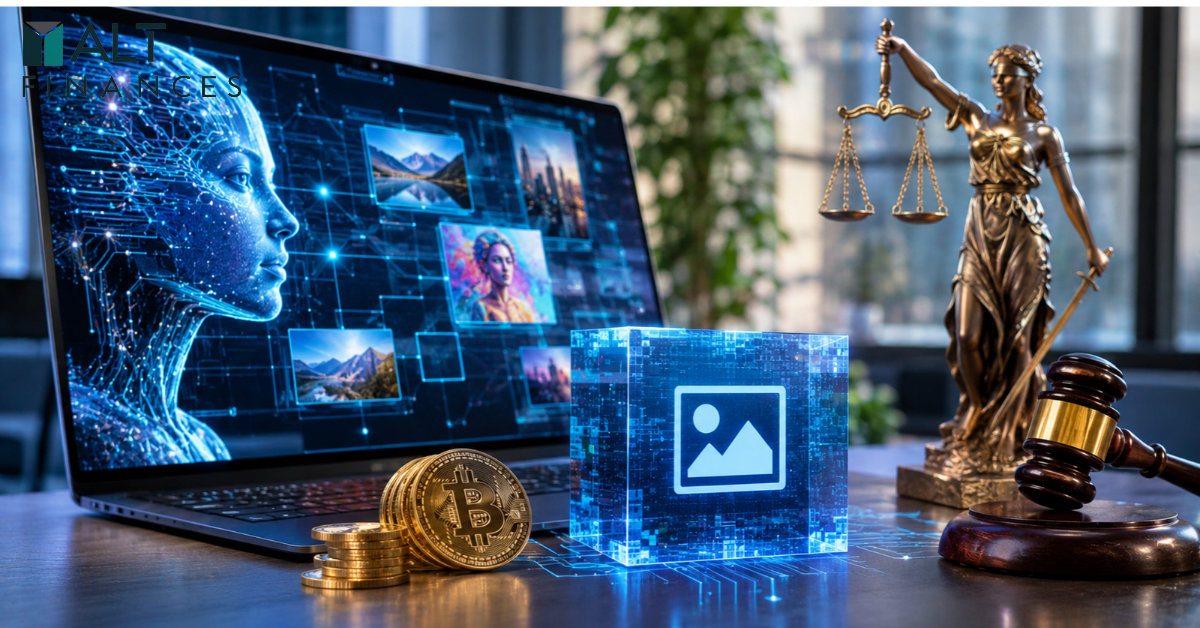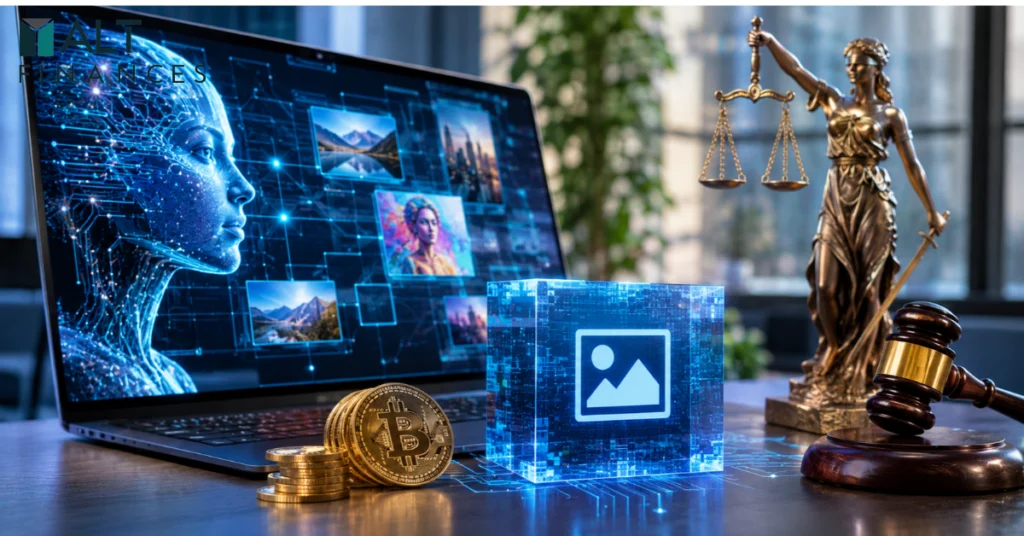
Generative artificial intelligence can now produce images, music, written content, product designs and virtual objects in minutes. Blockchain technology, meanwhile, allows digital items to be represented by tokens that can be transferred and recorded on a public ledger. Together, these technologies are creating new commercial possibilities and a difficult question: who actually owns an AI-generated digital asset?
The answer is not always the person who entered the prompt, the company that developed the AI model or the individual who purchased the resulting NFT. Copyright, contractual usage rights, ownership of a blockchain token and the ability to commercially exploit a digital creation are separate matters.
For creators, technology companies and investors, understanding those distinctions is becoming essential. A token can document a transaction, but it cannot automatically establish that the seller owns the underlying intellectual property.
Who Owns AI-Generated Content?
Copyright law traditionally protects original creative expression produced by human authors. Generative AI complicates this principle because the final output may combine human instructions, model-generated material and subsequent human editing.
In the United States, the Copyright Office maintains that copyright protection requires sufficient human authorship. Its guidance explains that simply entering prompts into an AI system does not, by itself, establish copyright ownership. Human-created elements, creative selection or arrangement, and meaningful modifications may qualify for protection when they meet the applicable originality requirements.
Consider an artist who generates several images using an AI platform, selects one, substantially edits its composition and incorporates it into an original illustrated book. The human-authored elements may qualify for copyright protection, even if some material was generated by AI. The purely machine-generated elements may not receive the same protection.
Platform terms add another layer. An AI provider may grant users commercial usage rights, impose restrictions or establish conditions for generated outputs. Such contractual permissions can matter commercially, but they do not necessarily create copyright where the law recognises none. Nor can a platform grant rights to third-party material it does not own.
This distinction is important for businesses selling AI-generated images, music, designs and digital collectibles. A commercial-use licence from a platform is not necessarily proof of exclusive ownership.
Copyright Challenges Across Jurisdictions
Legal treatment differs between countries, making cross-border digital asset transactions more complicated.
United States
The Copyright Office applies the human-authorship requirement. AI-assisted works can qualify where a person contributes sufficient original expression, but a prompt alone is generally insufficient. The Office also examines separate questions involving copyrighted material used to train AI systems and digital replicas.
European Union
Copyright protection generally requires an identifiable human author and an original intellectual creation reflecting that person’s own creative choices. AI-generated content does not automatically receive copyright simply because a user requested it. The EU’s separate AI Act transparency requirements are also relevant. Article 50 obligations began applying on 2 August 2026, including requirements concerning the marking of certain AI-generated or manipulated content and the disclosure of specified deepfakes and public-interest text.
United Kingdom
UK law has a distinctive provision for certain computer-generated works without a human author. Under section 9(3) of the Copyright, Designs and Patents Act 1988, the person who made the necessary arrangements for creation may be treated as the author. The protection is subject to specific statutory conditions and is not identical to the US or EU approach. In March 2026, the UK government published a report and impact assessment revisiting the treatment of AI training, computer-generated works and digital replicas. The future of this provision remains a policy question rather than a settled reform.
These differences matter to companies selling digital assets internationally. An output treated one way under one country’s law may have a different level of protection or commercial certainty elsewhere.
How Blockchain and Tokenization Change Digital Ownership
Blockchain can provide a shared, time-stamped record of transactions involving digital assets. Through tokenization, a digital item can be associated with a unique token, often using a non-fungible token (NFT) standard.
This can help record:
The wallet that initially minted a token.
Transfers between wallets.
Transaction dates and token history.
Links to associated digital files or metadata.
Licence information or other terms attached to the token, where properly implemented.
For example, an AI artist could create a digital illustration, mint an NFT linked to that work and sell the token through a marketplace. The blockchain can record the minting and subsequent transfers, helping buyers trace the token’s transaction history.
However, the record has limits. A blockchain may establish that a particular wallet minted or transferred a token, but it does not independently prove that the wallet holder created the artwork, owns its copyright or had permission to mint it.
The underlying image may also be stored outside the blockchain. If its hosting location changes or becomes unavailable, the token may continue to exist even if the associated content cannot be accessed.
Owning a Token Is Not the Same as Owning Copyright
This is one of the most important distinctions in the emerging market for AI-generated digital assets.
Buying an NFT generally gives the buyer control of the token, subject to the blockchain protocol and applicable terms. It does not automatically transfer copyright in the image, music or design represented by that token.
A buyer might own an NFT depicting an AI-generated character but have no right to reproduce the character commercially, create merchandise, adapt the artwork or license it to another business.
Those rights depend on the copyright position and the terms of the sale or licence. A smart contract may automate payments or transfers, but it cannot independently establish that the seller has valid intellectual property rights.
For a transaction to be commercially reliable, buyers should examine the licence, identify the rights holder, establish whether the asset contains third-party material and check whether the seller has authority to transfer the promised rights.
Investment and Commercial Opportunities
Despite the legal uncertainty, the combination of AI and tokenization creates several potential business models.
Digital art and collectibles: Creators can sell AI-assisted artwork, limited digital editions and virtual collectibles. Their value depends on demand, originality, provenance and the rights attached to each item.
Music and entertainment licensing: AI-assisted music, sound effects and visual content may be distributed through licensing platforms. Businesses need clear agreements covering ownership, commercial use, attribution and any third-party rights.
Virtual goods: Games, digital environments and online platforms may use tokenized assets to represent items such as clothing, accessories and virtual property. Whether these tokens can be transferred or used outside a particular platform depends on technical compatibility and contractual terms.
Tokenized intellectual property: In principle, blockchain can support the transfer or tracking of interests connected to patents, copyright licences, designs or other intellectual property. But the legal rights must be clearly defined outside the token itself.
For investors, this creates potential exposure to digital marketplaces, licensing infrastructure, rights-management technology and blockchain-based provenance systems. It does not mean that every AI-generated NFT is an investable asset. Commercial value still depends on enforceable rights, customer demand and the quality of the underlying product.
AltFinances has also explored related developments in AI-powered on-chain analytics, which can help market participants examine blockchain activity, and AI crypto agents, which illustrate how AI is becoming integrated into digital asset ecosystems.
The Risks for Creators, Businesses and Investors
The market faces several significant risks.
Unclear copyright ownership: Buyers may acquire tokens linked to content that has no clearly identifiable copyright owner or whose seller lacks the necessary rights.
Training-data disputes: AI models may be trained on copyrighted material. Whether particular training practices infringe copyright depends on the applicable law, facts and relevant licences or exceptions. Disputes can create uncertainty for developers and businesses relying on generated outputs.
Unauthorized use and imitation: AI-generated content may reproduce protected expression or closely resemble existing creative works. A token does not remove the possibility of infringement claims.
Digital replicas: AI tools can generate convincing images, voices and videos resembling real individuals. Commercial use may raise privacy, publicity, consent and personality-rights issues, depending on the jurisdiction.
Fraud and misleading provenance: A seller may mint a token linked to someone else’s artwork or make unsupported claims about authorship. Blockchain records can preserve the transaction history without validating those claims.
Weak licensing and royalties: Smart contracts can automate certain payments, but royalty enforcement may vary between marketplaces and platforms. A token’s code cannot guarantee that every secondary-market transaction will honour a commercial agreement.
The European Commission’s Code of Practice on Transparency of AI-Generated Content provides a practical framework for marking and labelling certain AI-generated or manipulated material under the EU AI Act. Transparency can help buyers and audiences understand how content was produced, although labelling alone does not resolve copyright ownership.
Shaping Europe’s digital future+1
Conclusion: Can Clearer Rules Create a More Reliable Digital Asset Market?
AI-generated digital assets could become an important part of the digital economy, particularly as businesses look for new ways to create, license and distribute images, music, designs and virtual goods. Blockchain can strengthen transaction records and make provenance easier to examine, but it cannot replace copyright law or establish ownership by itself.
The market’s development will depend on clearer licensing arrangements, reliable records of human and AI contributions, stronger safeguards against unauthorized use and greater consistency across jurisdictions.
For investors, the most credible opportunities may lie not only in buying digital collectibles but also in the infrastructure supporting them: rights management, licensing, verification and compliant marketplaces. The long-term value of this market will depend on whether buyers can establish what they are purchasing, which rights they receive and whether those rights can actually be enforced.
Ultimately, AI-generated digital assets need both technological provenance and legally recognised rights. Without that combination, tokenization may make digital items easier to trade without making their ownership any more certain.
FAQs
1. Who owns the copyright to AI-generated digital assets?
It depends on the jurisdiction and the level of human creative contribution. In the United States and generally in the EU, purely AI-generated material without sufficient human authorship may not qualify for copyright protection. The UK has a separate statutory provision for certain computer-generated works.
2. Can AI-generated images, music and artwork be copyrighted?
AI-assisted works can qualify when a human contributes sufficient original creative expression. Entirely machine-generated material may receive different or no copyright protection, depending on the jurisdiction and applicable law.
3. Does buying an NFT give you copyright ownership of the digital artwork?
No, not automatically. Buying an NFT generally transfers control of the token, not the copyright in the associated artwork. Copyright or commercial rights must be transferred or licensed through an appropriate agreement.
4. How does blockchain establish the provenance of digital assets?
Blockchain records transactions, wallet addresses, timestamps and token transfers. These records can help trace a token’s history, but they do not independently verify the creator’s identity or establish that the original seller owned the intellectual property.
5. Can AI-generated content be legally tokenized and sold?
Generally, it can be tokenized and offered for sale, subject to applicable laws and platform rules. However, the seller must consider copyright, licensing, third-party material and other rights that may affect the transaction.
6. What intellectual property risks should investors consider when buying tokenized assets?
Investors should examine the seller’s authority, copyright status, licensing terms, possible infringement claims, third-party content and the reliability of the asset’s provenance records.
7. How could future copyright laws change the market for AI-generated digital assets?
Future laws and regulatory guidance may clarify human authorship, AI training permissions, licensing, digital replicas and transparency requirements. Greater legal certainty could support commercial licensing and institutional participation, although different jurisdictions may continue to apply different rules.

Marcie Bilawsky
Marcie Bilawsky is a Financial Writer & Research Contributor at AltFinances, covering investing, alternative assets, wealth management, and global financial markets. Her work focuses on making complex financial trends, investment themes, and emerging market opportunities easier to understand through research-driven analysis.