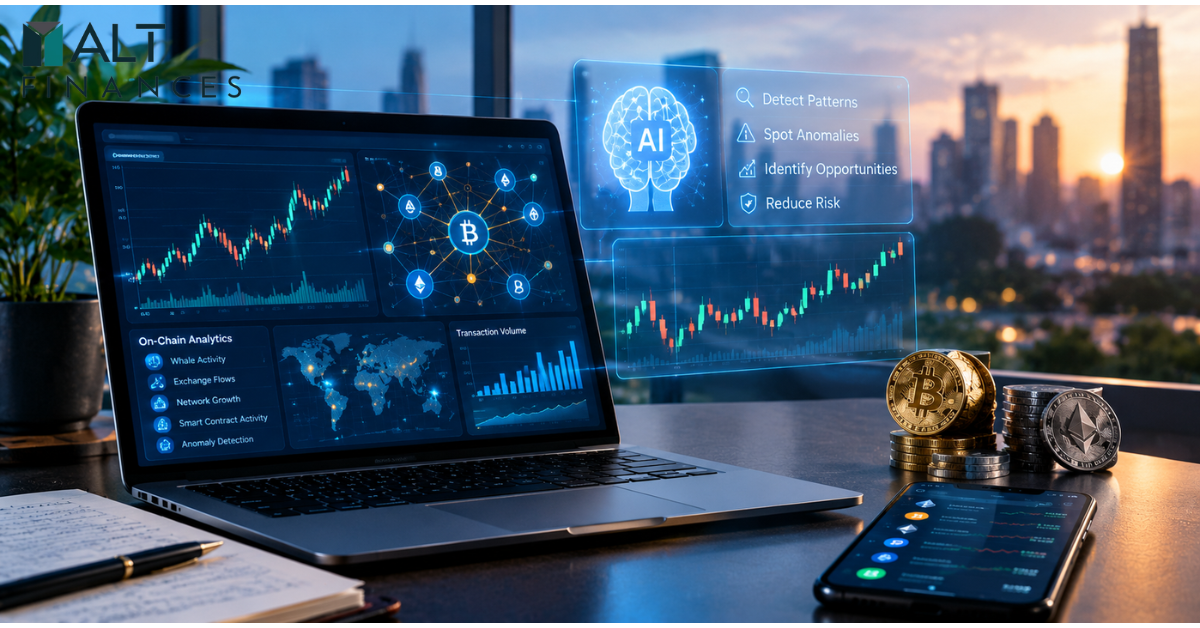
Cryptocurrency markets generate a vast stream of publicly visible blockchain data. Every confirmed transaction, token transfer, and interaction with a smart contract can contribute to a picture of how a network is being used and how digital assets are moving.
For investors, however, the challenge is not simply finding data. It is interpreting it correctly.
AI-powered on-chain analytics combines blockchain data with machine-learning techniques and automated analysis to help identify patterns, anomalies, and changes in activity. These tools can help investors investigate wallet movements, exchange flows, token distribution, and network behavior.
They do not provide a reliable shortcut to predicting prices. Blockchain signals can be incomplete, misinterpreted, or overwhelmed by broader market forces. Their value lies in supporting a more disciplined research process.
What Is On-Chain Analytics?
On-chain analytics examines activity recorded directly on a blockchain. Depending on the network, data may include:
- Transactions and transfers
- Wallet balances and token holdings
- Smart-contract interactions
- Network fees and transaction activity
- Token issuance and distribution
- Funds moving to or from known exchange addresses
Because public blockchains record transactions, analysts can often study activity without relying solely on information published by a token issuer or exchange.
But a wallet address does not automatically reveal the identity or intention of its owner. One person may control many addresses, while a single exchange address may represent the holdings of thousands of customers.
This distinction matters when interpreting activity. A large transfer may reflect an internal exchange movement, custody change, collateral deposit, or ordinary operational activity not necessarily a market buy or sell.
How AI Enhances Blockchain Analysis
AI can help process blockchain datasets that are too large or complex to review manually.
Pattern recognition
Machine-learning models can identify recurring patterns in transactions, wallet behavior, and network activity. Analysts may use them to compare current behavior with historical periods or to flag changes that deserve investigation.
Anomaly detection
Automated systems can identify unusual activity, such as a sudden increase in transfers from a group of wallets or a sharp departure from typical transaction patterns.
An anomaly is not automatically suspicious or bullish. It is a signal to investigate the underlying cause.
Automated monitoring
AI-powered systems can monitor selected addresses, tokens, or protocols and alert users when predefined conditions occur. This can reduce the time spent reviewing dashboards and manually checking activity.
Entity and wallet analysis
Some analytics platforms use clustering and labeling techniques to associate addresses with entities such as exchanges, funds, protocols, or other services. These labels help analysts interpret flows but they may be incomplete or incorrect.
Key Signals Investors Track
Exchange inflows and outflows
Exchange inflows measure assets moving into known exchange wallets. Outflows measure assets moving away from them.
Large inflows may indicate that holders are positioning assets for trading or selling. But assets can also move for custody, collateral, or internal operational reasons.
Likewise, exchange outflows may reflect withdrawals into self-custody, staking, or other uses. They do not necessarily indicate long-term accumulation.
The strongest analysis compares flows over time and across multiple sources rather than relying on a single large transaction.
Whale movements
“Whales” are holders with substantial balances or the capacity to move large amounts of an asset.
Tracking whale activity can help investors observe changes in concentration or large transfers. But the term “whale” can be misleading: an address may belong to an exchange, custodian, protocol, or intermediary rather than an individual investor.
A large transfer should be treated as an event to interpret not as proof that a market move is imminent.
Active addresses and network activity
Active-address metrics can provide a rough indication of participation in a blockchain. Transaction counts, fees, and smart-contract interactions may help assess whether network usage is changing.
However, activity can be inflated by automated transactions, incentives, bots, or low-value transfers. Address growth alone does not prove that a network has gained durable users or economic value.
Token distribution and holder behavior
Analytics platforms can track token concentration, changes in balances, and movement between holder groups.
These indicators may help investors evaluate whether supply is becoming more concentrated or whether particular groups are changing their holdings.
Still, wallet labels and holder classifications can be uncertain. Analysts should check how a metric is calculated before drawing conclusions.
Platforms and Practical Applications
Several established platforms provide blockchain data and analytics, though their focus and capabilities differ.
Glassnode offers on-chain and market metrics, including exchange flows, supply dynamics, and holder behavior. Its data can help investors study market cycles and changes in asset activity.
Dune allows users to query and visualize blockchain datasets. It is useful for custom research, protocol dashboards, and tracking activity across supported networks.
Chainalysis focuses on blockchain intelligence, including transaction tracing, entity analysis, and risk-related investigations. Its tools are particularly relevant to compliance and investigative work.
Coin Metrics provides crypto network and market data that can support research, comparisons, and analysis of blockchain fundamentals.
In 2026, the field is increasingly integrating AI into research workflows. Chainalysis announced blockchain intelligence agents in March 2026 to support investigations, alert enrichment, monitoring, and automated workflows. Dune also offers AI-assisted query tools for analyzing blockchain data.
These developments can make analysis faster, but the quality of the output still depends on data coverage, methodology, and the analyst’s ability to verify the result.
Turning Signals Into Investment Insights
On-chain analysis is most useful when combined with other forms of research.
For example, an investor examining a token might:
- Review exchange flows and large wallet movements.
- Check whether network activity and fees are rising or falling.
- Compare the data with liquidity, trading volume, and market volatility.
- Review the token’s supply schedule, governance, and protocol economics.
- Investigate whether the observed activity has a plausible explanation.
Consider a hypothetical situation in which a token experiences a rise in active addresses while exchange balances decline.
One interpretation could be that more participants are using the network and moving tokens away from exchanges. But alternative explanations may include incentives, automated activity, wallet migration, or changes in exchange custody.
The signal becomes more useful only when corroborated by independent information.
Investors evaluating blockchain-related infrastructure can also explore AltFinances’ analysis of the AI compute marketplace, where blockchain networks connect computing resources with users.
Risks and Limitations
False signals
AI models can identify patterns that have no meaningful relationship to future prices. A signal that worked in one market environment may fail in another.
Wallet-labeling errors
If an address is incorrectly labeled, the interpretation of its activity may also be wrong. Even reputable platforms can have gaps in entity attribution.
Manipulated or artificial activity
Bots, wash trading, incentive programs, and Sybil activity can inflate metrics such as transactions or active addresses.
Privacy and transparency
Public blockchain data does not mean every transaction can be attributed to a real person. Analysts should avoid treating wallet identity as certain without strong evidence. Investors should also account for AI-powered crypto scams and blockchain security risks, since manipulated activity and fraudulent transactions can complicate the interpretation of blockchain signals.
Price prediction limits
On-chain activity is only one component of crypto markets. Prices can also be affected by interest rates, regulation, liquidity, derivatives positioning, macroeconomic events, and investor sentiment.
AI cannot eliminate uncertainty or guarantee accurate market forecasts.
The Future of AI-Driven Blockchain Intelligence
The next stage of blockchain analytics is likely to involve more automated monitoring, natural-language research, and workflows that combine on-chain data with market and financial information.
AI agents may help analysts investigate wallet activity, generate dashboards, summarize transaction histories, and monitor selected signals. But automated systems will need transparent sources, reliable data, and safeguards against incorrect interpretations.
As autonomous software becomes a potential participant in digital commerce, investors are also considering AI agents and their potential impact on crypto networks, including how these systems may interact with blockchain infrastructure.
As analytics tools become easier to use, a key challenge will be separating genuine economic activity from activity that is simply easy to generate on a blockchain.
Conclusion: Use Blockchain Signals as Evidence, Not Predictions
AI-powered on-chain analytics can help investors understand how digital assets move, how blockchain networks are used, and where activity is changing.
The most useful signals exchange flows, wallet movements, holder behavior, and network activity require context. They are not direct measures of investor intent and cannot reliably predict future prices on their own.
For crypto investors, the goal should be to use on-chain data as one layer of a broader research process, combining it with market liquidity, fundamentals, risk management, and independent verification.
AI can help investors read blockchain signals faster. Sound judgment is still required to decide what those signals mean.
Frequently Asked Questions
What is AI-powered on-chain analytics?
It uses AI and automated analysis to examine blockchain data, identify patterns, detect anomalies, and support research into digital asset activity.
How can investors use blockchain data to identify market trends?
Investors can review exchange flows, transaction activity, wallet behavior, and token distribution over time, then compare those signals with market and fundamental data.
What do large whale transactions indicate?
They indicate that a substantial amount of an asset has moved. The transaction’s meaning depends on the wallets involved and the reason for the transfer.
How do exchange inflows and outflows affect crypto analysis?
They can help investors monitor assets moving to or from exchanges, but they do not independently establish whether holders intend to buy, sell, or simply move assets.
Which platforms provide on-chain analytics?
Glassnode, Dune, Chainalysis, and Coin Metrics provide different types of blockchain data and intelligence. The best fit depends on the research question.
Can AI predict cryptocurrency prices using blockchain data?
AI can identify patterns and help analyze signals, but blockchain data alone cannot reliably predict prices or guarantee investment outcomes.
What are the main risks of relying on on-chain signals?
Risks include false signals, inaccurate wallet labels, manipulated activity, incomplete data, model limitations, and failure to account for broader market conditions.

Marcie Bilawsky
Marcie Bilawsky is a Financial Writer & Research Contributor at AltFinances, covering investing, alternative assets, wealth management, and global financial markets. Her work focuses on making complex financial trends, investment themes, and emerging market opportunities easier to understand through research-driven analysis.