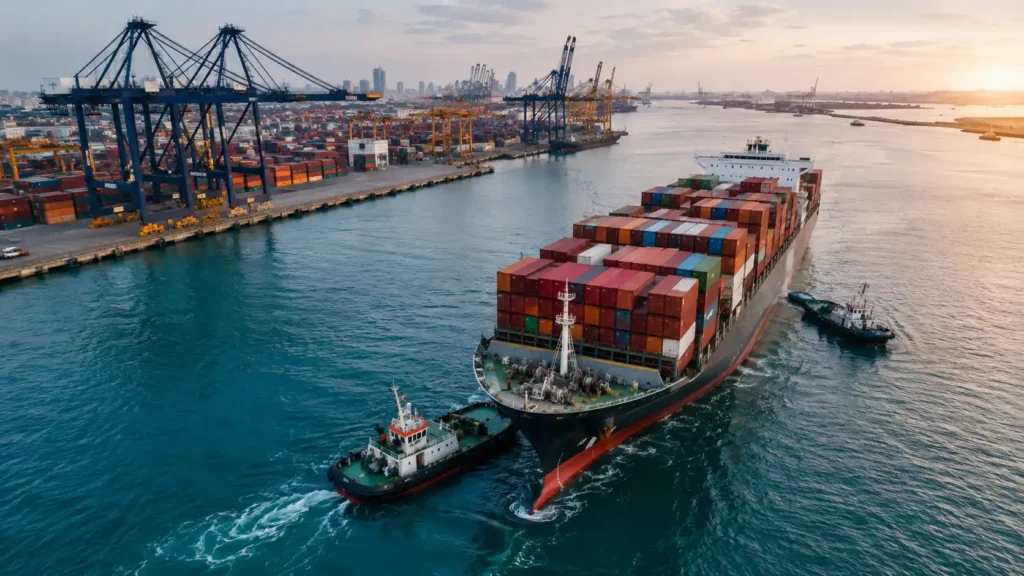
Globalization is entering a new phase. For decades, investors evaluated economies through interest rates, inflation, corporate earnings, and commodity prices. Today, however, the resilience of the infrastructure that keeps global commerce moving has become an increasingly important investment consideration. Shipping routes investment has become an increasingly important consideration because the reliability of maritime trade now influences everything from manufacturing costs and energy security to inflation, industrial competitiveness, and long-term capital allocation.
As businesses diversify production networks and governments strengthen economic resilience, shipping routes investment is evolving from a logistics concern into a strategic investment theme. Institutional investors are paying closer attention to global shipping routes, ports, energy corridors, and logistics infrastructure because disruptions can ripple across industries, reshape supply chains, and alter investment opportunities far beyond the transportation sector.
Rather than viewing shipping lanes as simple transportation networks, investors increasingly recognize them as critical economic assets. Strategic waterways such as the Suez Canal, Panama Canal, and emerging Arctic shipping routes now influence global trade patterns, infrastructure spending, and geopolitical competition in ways that extend well beyond maritime commerce.
Why Shipping Routes Have Become Strategic Assets?
Modern economies depend on uninterrupted maritime trade. According to the United Nations Conference on Trade and Development (UNCTAD), more than 80% of global merchandise trade by volume is transported by sea, making global shipping routes one of the world’s most essential economic infrastructures.
That reality has transformed shipping lanes into strategic assets.
Today, shipping corridors determine how efficiently manufacturers receive components, how quickly retailers replenish inventories, and how reliably energy producers deliver oil, liquefied natural gas (LNG), and refined fuels to international markets. Consequently, disruptions in these corridors can influence inflation, corporate profitability, and economic growth.
Shipping routes investment therefore extends beyond owning shipping companies. It encompasses investment analysis focused on the infrastructure supporting maritime trade, including:
- Global shipping routes
- Commercial ports
- Container terminals
- Logistics infrastructure
- Rail and inland freight connections
- Energy transportation networks
- Digital supply-chain technologies
Institutional investors increasingly evaluate these assets because they underpin long-term economic productivity rather than short-term market cycles.
Furthermore, geopolitical competition has elevated maritime logistics from an operational issue to a national strategic priority. Countries continue investing in ports, trade corridors, and transportation infrastructure not only to improve commerce but also to strengthen economic security and regional influence.
Why this matters to investors?
Understanding shipping routes provides investors with an additional macroeconomic indicator. Infrastructure resilience, rather than simply trade volume, increasingly affects long-term capital allocation decisions, especially within infrastructure investing and alternative investments.
How Shipping Routes Influence Investment Decisions?
Supply chains no longer operate solely according to efficiency. Increasingly, resilience, redundancy, and geopolitical stability influence corporate strategy and institutional portfolio construction.
Several strategic corridors illustrate this shift.
Suez Canal
The Suez Canal remains one of the world’s most significant trade routes because it connects Europe with Asia while dramatically reducing shipping distances compared with routes around southern Africa.
For investors, its importance extends well beyond shipping companies.
The canal directly influences:
- Global manufacturing supply chains
- Energy transportation
- Container shipping
- Freight costs
- Inventory management
- Inflation expectations
Whenever congestion or operational challenges emerge, companies often face higher logistics costs that eventually flow into consumer prices.
Panama Canal
The Panama Canal continues to serve as a critical gateway linking Atlantic and Pacific trade.
However, long-term operational capacity increasingly depends on environmental factors, particularly freshwater availability required for lock operations.
Periods of reduced canal capacity have demonstrated how climate conditions can affect global logistics infrastructure, encouraging businesses to diversify transportation strategies and governments to expand investment in alternative trade routes.
Arctic Shipping Routes
Although still developing, Arctic shipping routes represent one of the most closely watched long-term geopolitical developments.
Changing climate conditions could increase seasonal accessibility along some Arctic routes between Europe and Asia. Nevertheless, commercial viability depends upon infrastructure investment, environmental regulation, insurance costs, and geopolitical cooperation.
Rather than assuming rapid adoption, institutional investors generally monitor Arctic development as a long-duration infrastructure theme rather than an immediate commercial opportunity.
Before comparing these corridors, it is useful to examine how each presents different investment characteristics.
Strategic Trade Corridors
| Strategic Trade Corridor | Economic Importance | Key Investment Risk |
|---|---|---|
| Suez Canal | Europe–Asia trade and energy transport | Geopolitical disruptions and congestion |
| Panama Canal | Atlantic–Pacific commerce | Climate-related water constraints |
| Arctic Shipping Routes | Potential reduction in transit times | Infrastructure limitations and regulatory uncertainty |
| Regional Land-Sea Corridors | Supply-chain diversification | Political and financing risks |
The comparison highlights an important point: investors no longer evaluate shipping routes solely by cargo volume. Instead, they increasingly assess resilience, infrastructure quality, environmental exposure, and geopolitical stability.
As a result, infrastructure investing increasingly incorporates logistics corridors alongside airports, utilities, and digital infrastructure.
Why this matters to investors?
Strategic trade corridors influence transportation costs, commodity pricing, and industrial competitiveness. Investors who understand these structural relationships often gain a broader perspective on long-term economic trends rather than reacting only to short-term geopolitical headlines.
Opportunities, Risks, and Global Trade Realignment
Global supply chains are becoming more diversified.
Instead of concentrating production in a limited number of locations, multinational companies increasingly pursue regional manufacturing strategies that improve resilience while reducing dependence on individual trade corridors.
This structural adjustment creates significant investment opportunities across logistics infrastructure, ports, warehouses, industrial real estate, and transportation technology.
However, investors must also recognize several important risks.
Geopolitical tensions continue to reshape trade relationships, while industrial policy encourages domestic manufacturing across many advanced economies. Additionally, infrastructure projects often require years of planning, regulatory approvals, and substantial capital commitments before generating economic returns.
Climate change introduces another layer of complexity. Rising sea levels, severe weather events, droughts, and changing environmental conditions increasingly influence port operations, inland waterways, and transportation networks.
At the same time, insurance costs continue to evolve as insurers reassess environmental and geopolitical risks..
For institutional investors, successful shipping routes investment therefore depends not simply on identifying infrastructure assets but on evaluating how resilient those assets remain under multiple long-term economic scenarios.
Why this matters to investors?
Supply-chain resilience has become a competitive advantage. Consequently, investors increasingly allocate capital toward infrastructure capable of supporting diversified global trade while recognizing that regulatory changes, geopolitical developments, and environmental risks remain central to long-term investment performance.

Comparing Strategic Infrastructure Investments
Global trade is supported by far more than shipping lanes alone. Modern supply chains rely on an interconnected network of physical and digital infrastructure that enables goods, energy, and information to move efficiently across borders. For institutional investors, evaluating these complementary assets is just as important as monitoring maritime trade itself.
The table below compares several infrastructure themes that increasingly feature in long-term portfolio construction.
Comparing Strategic Infrastructure Investments
| Infrastructure Theme | Investment Opportunity | Primary Challenge |
|---|---|---|
| Global Shipping Routes | Growth in international trade and supply-chain resilience | Geopolitical disruptions |
| Ports & Logistics Infrastructure | Rising cargo volumes and regional manufacturing | High capital requirements |
| Energy Transportation Corridors | Growing energy security and LNG demand | Regulatory and political uncertainty |
| Digital Supply Chain Infrastructure | Automation, visibility, and logistics optimization | Cybersecurity and rapid technological change |
Each theme addresses a different aspect of global commerce. Shipping routes facilitate international trade, while ports and logistics hubs improve operational efficiency. Energy transportation corridors support global energy markets, whereas digital infrastructure enables real-time supply-chain management through AI, cloud computing, and advanced analytics.
No single infrastructure category is sufficient on its own. Instead, many institutional investors seek diversified exposure across complementary assets that support the long-term evolution of global trade.
Why this matters to investors?
Infrastructure investing increasingly extends beyond roads and bridges. Investors now evaluate integrated transportation networks, logistics technology, and energy infrastructure as interconnected components of economic resilience. Diversification across these assets may reduce concentration risk, but outcomes still depend on execution, regulation, and broader macroeconomic conditions.
The Future of Global Trade Infrastructure
Global trade is unlikely to become less important, but its structure is changing.
Rather than optimizing exclusively for cost efficiency, businesses increasingly prioritize resilience, flexibility, and geographic diversification. Governments are also investing heavily in transportation infrastructure, domestic manufacturing, and strategic trade corridors to strengthen economic security.
Consequently, shipping routes investment is becoming part of a much broader investment narrative centered on industrial policy, infrastructure modernization, and regional supply-chain development.
Several long-term trends are expected to shape future investment decisions:
- Continued modernization of ports and logistics infrastructure
- Expansion of digital supply-chain technologies
- Greater investment in grid and energy infrastructure supporting industrial growth
- Increased regionalization of manufacturing
- Development of alternative transportation corridors
- Higher spending on climate adaptation and resilient infrastructure
Artificial intelligence may also transform global logistics by improving route optimization, inventory management, predictive maintenance, and cargo visibility. Meanwhile, automation continues to improve efficiency across ports, warehouses, and freight operations. As AI expands worldwide, investment in energy infrastructure is becoming just as important as investment in transportation corridors.
Nevertheless, uncertainty remains. Future outcomes will depend on geopolitical relationships, environmental conditions, trade policies, financing costs, and technological innovation rather than any single structural trend.
Why this matters to investors?
Long-term infrastructure themes often evolve over decades rather than quarters. Investors focusing on structural economic transformation may increasingly monitor logistics infrastructure alongside traditional macroeconomic indicators when evaluating future capital allocation opportunities.
Unique Insight
One of the most significant changes in institutional investing is that logistics infrastructure is no longer viewed merely as a supporting industry; it has become a strategic indicator of economic competitiveness.
The growing importance of shipping routes investment reflects this transformation. Institutional investors increasingly recognize that resilient trade corridors influence manufacturing capacity, inflation dynamics, commodity markets, and industrial development. Rather than simply tracking freight volumes, sophisticated investors analyze how infrastructure quality, geopolitical stability, and supply-chain flexibility affect long-term economic productivity.
In many respects, global shipping routes now function as economic arteries that determine where capital flows, where businesses expand, and where future industrial growth is likely to occur. That perspective represents a major shift from viewing transportation infrastructure as a passive utility to recognizing it as a strategic investment variable within modern portfolio construction.
Conclusion
The evolution of shipping routes investment demonstrates how infrastructure, geopolitics, and global commerce have become increasingly interconnected. Strategic waterways such as the Suez Canal, Panama Canal, and emerging Arctic routes now influence far more than shipping; they shape supply chains, energy security, corporate strategy, and institutional capital allocation.
For investors, the key lesson is not to predict individual geopolitical events but to understand the structural forces reshaping global trade. Infrastructure modernization, supply-chain diversification, digital logistics, and regional manufacturing are likely to remain defining themes over the coming decade. Many investors now see logistics infrastructure as part of a broader alternative investments allocation.
At the same time, no infrastructure investment is without risk. Regulatory developments, climate change, financing costs, geopolitical tensions, and operational challenges will continue to influence outcomes. Investors who evaluate shipping routes within the broader context of infrastructure resilience and long-term economic transformation may be better positioned to understand where future opportunities and risks are emerging across global markets.
Frequently Asked Questions
What is shipping routes investment?
Shipping routes investment refers to analyzing how strategic maritime trade corridors, logistics infrastructure, and transportation networks influence long-term investment opportunities, economic growth, and capital allocation.
Why are shipping routes important to investors?
They affect supply-chain efficiency, energy transportation, inflation, corporate profitability, and global trade, making them an increasingly important macroeconomic indicator.
How do the Suez and Panama Canals affect global trade?
Both canals shorten shipping distances, reduce transportation costs, and facilitate international commerce. Operational disruptions can increase freight costs and impact supply chains worldwide.
Why are Arctic shipping routes attracting attention?
They may provide shorter trade routes between Asia and Europe over time. However, commercial development depends on infrastructure investment, environmental conditions, regulation, and geopolitical cooperation.
How do shipping routes influence energy security?
Major shipping corridors transport significant volumes of oil, LNG, and refined fuels. Reliable transportation supports stable global energy markets.
What risks threaten global shipping routes?
Geopolitical tensions, climate-related disruptions, infrastructure bottlenecks, cyber threats, insurance costs, and regulatory changes all present significant challenges.
How do geopolitical tensions affect maritime trade?
They can alter trade flows, increase shipping costs, delay deliveries, and encourage companies to diversify production and logistics networks.
Why are institutional investors monitoring logistics infrastructure?
Because resilient logistics infrastructure supports long-term economic growth, industrial competitiveness, and more efficient global supply chains.
How does supply-chain resilience affect investment decisions?
Businesses increasingly value reliability alongside efficiency, creating investment opportunities in infrastructure, logistics technology, ports, and regional manufacturing.
Why is shipping routes investment becoming an important long-term investment theme?
As global trade becomes more complex, shipping routes investment helps investors understand how infrastructure resilience, geopolitical dynamics, and supply-chain modernization influence future economic growth and portfolio strategy.

Contributing Writer for Alt Finances with experience in luxury events, travel, fashion, and the arts. Active investor through her family office across real estate, energy, and private equity. University of Miami – BBA.