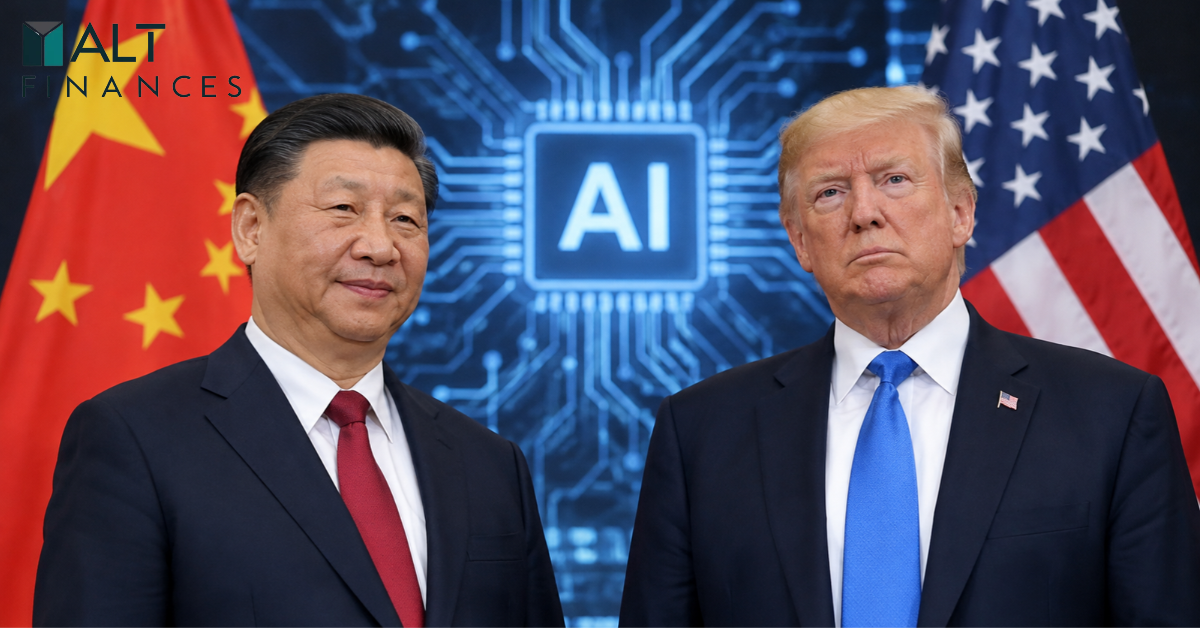
US-China AI competition is shifting from a contest over the best model to a contest over chips, data centres, electricity and supply chains. For investors, that means opportunity across AI infrastructure alongside rising policy and geopolitical risk.
A change in vocabulary can signal a change in strategy. In September 2026, a US executive order told federal agencies to use the term superintelligence in place of AI in non-statutory communications. A World Economic Forum analysis published on November 26, 2026 argues that this shift matters for markets and diplomacy alike. This article uses that analysis and other recent sources to explain US-China AI competition, how the race for superintelligence is steering capital and what investors should watch next. It follows our coverage of Jensen Huang Reinstated as Nvidia CEO, where Nvidia’s new national-security governance steps already pointed to this trend.
Why US-China AI Competition Is Changing
The WEF authors stress that the order did not mean machines had reached superintelligence. Its importance is that it turned a contested possibility into an organizing idea for government, industry and national strategy. Governments act on what may soon be possible, so the narrative can change competition before the technology does.
They point to three forces behind the shift:
- Measurable capability gains. Stanford’s 2026 AI Index Report found that leading systems improved quickly, with success on one real-world software test rising from around 60% to nearly 100% within a year.
- A large investment case. Rising data-centre electricity demand turns compute into an energy and infrastructure challenge, and sustaining spending at that scale needs a compelling strategic goal.
- Securitization. America’s 2025 AI Action Plan already describes technological leadership as a national security imperative.
The Scorecard: How Close Is the AI Race?
The gap is narrower in models than in infrastructure.
- Models: The AI Index found US and Chinese models traded the lead after early 2025, and the top US model led by only 2.7% in March 2026. The Lowy Institute’s Asia Power Snapshot, published November 8, estimates a US lead of six to nine months that is narrowing.
- Compute: Lowy says US data centres hold nearly 40 times China’s processing power and US AI chips 31 times. Stanford data cited by WEF shows the US hosted 5,427 data centres, more than 10 times any other country.
- China’s strengths: Lowy says China dominates critical minerals and open AI models, which account for 78% of US and Chinese model downloads, though it calls China’s overall AI reach overstated. China’s industry ministry reports more than 6,000 AI enterprises and 1,590 exaflops of intelligent computing capacity by 2025.
These figures come from different sources and methods, so treat them as indicators rather than a final scoreboard.
Semiconductor Competition and Export Controls
Chips sit at the center of the rivalry, and the rules keep tightening.
- US measures: In January 2026 the House passed the Remote Access Security Act to extend export controls to cloud access to restricted chips. In May the Commerce Department moved to block advanced chip sales to overseas subsidiaries of Chinese companies. In November the US issued a rule on remote access to American superintelligence technology through data centres in third countries.
- Enforcement: In March 2026 prosecutors charged a Super Micro co-founder with conspiring to divert servers containing Nvidia chips, alleging roughly $2.5 billion of technology was sent to China. Charges are allegations until proven. In October, Malaysian customs seized servers holding about $12 million of AI chips.
- China’s response: In October 2026 China proposed adding 40 technologies to its export restrictions, 23 of them AI-related, and its rare-earth rules extend licensing to certain foreign-made goods containing Chinese materials. Reports also said Beijing criticized the new US chip rule as economic coercion.
- Corporate impact: In November 2026 Nvidia created a board-level National Security and Export Control Oversight Committee, which WEF cites as a sign that companies now read chip sales and compliance through a national security lens.
AI Infrastructure Investment: Chips, Data Centres and Power
WEF argues that a narrowing performance gap combined with concentrated infrastructure makes chips, cloud access and electricity look strategically decisive. That encourages more investment, more technology controls, new energy partnerships and technological decoupling.
For investors, AI infrastructure investment now spans a chain of linked sectors:
- Chips and equipment, where export rules can change demand quickly.
- Data centres and cloud, where location and remote-access rules matter.
- Power and grid, because electricity demand from data centres is rising rapidly.
- Critical minerals, where China holds supply-chain leverage.
Some investors reach these themes through private funds. If that is you, read Evergreen Funds in 2027: Trends and What to Watch for the liquidity and valuation questions to ask first.
The Superintelligence Dialogue: Diplomacy Alongside Rivalry
Competition has not ended talks. After a September summit, the White House said the two countries established a US-China Super Intelligence Dialogue and an incident channel. On November 10, Treasury Secretary Scott Bessent said the sides would exchange best practices for testing advanced models and alert each other to serious incidents, while making no commitment to limit AI development. He described the US goal as de-risking rather than decoupling.
The November 18-19 APEC summit in Shenzhen ended with a leaders’ declaration, but one report noted no agreement on who should govern AI. CNN reported a rift inside the administration: many officials favor cutting China off from the most advanced chips, while President Trump sounded opposed to steps that could stifle AI progress.
The WEF authors warn that the bigger danger may be a perceived AI gap rather than a real one, much like Cold War fears of a missile gap. They suggest sustained senior dialogue, bounded transparency on frontier-model evaluations and clearer purposes for export controls.
What US-China AI Competition Means for Investors
This is analysis, not advice.
Potential opportunities
- Continued spending on compute, data centres, power and grid upgrades.
- Growth in compliance, security and supply-chain tools as controls expand.
- Falling AI prices from competition. DeepSeek cut its API prices in September 2026 with a new smaller model, according to People’s Daily.
Key risks
- Policy shocks: New export rules or retaliation can hit revenue overnight.
- China exposure: Companies with large China sales or Chinese suppliers face two-sided risk.
- Concentration: A few firms and one narrative can drive large market swings.
- Escalation risk: Miscalculation over a perceived AI breakthrough could disrupt markets.
Geopolitical headlines can also amplify market volatility, so position sizing matters as much as picking themes.
Your Watchlist for US-China AI Competition
- Follow-up talks under the Super Intelligence Dialogue and details of the incident channel.
- Enforcement and response to the November remote-access rule and Beijing’s reaction.
- China’s proposed export list and any final restrictions on AI technologies.
- Power and grid limits on data-centre buildouts.
- Model benchmarks to see whether the lead keeps narrowing.
- Chip smuggling cases and any new trade-truce signals between Washington and Beijing.
Bottom Line
US-China AI competition is now about infrastructure, controls and expectations as much as algorithms. The investment case remains large, but so do the risks from policy, supply chains and miscalculation. Investors should diversify across the AI stack, check exposure to China, follow official announcements and avoid trading on single headlines.
Frequently Asked Questions
What is US-China AI competition?
It is the rivalry between the two countries to lead in AI models, chips, data centres, energy and standards. Both governments link AI leadership to economic strength and national security.
Who is ahead in the AI race?
The US leads in top models and computing power, with estimates of a six-to-nine-month model lead, but the margin is narrowing. China leads in critical minerals and open model downloads. Sources use different methods, so estimates vary.
Why are semiconductors so important?
Advanced chips train and run the most capable AI systems. That is why Washington restricts their export and why Beijing is looking at its own controls.
How does US-China AI competition affect investors?
It can raise demand for AI infrastructure while adding risks from export controls, retaliation, supply-chain disruption and market concentration.
What is the US-China Super Intelligence Dialogue?
It is a bilateral channel announced after a September 2026 summit to discuss risks and benefits, share model-testing practices and alert each other to serious incidents. It does not limit AI development.
This article is for general information only and is not financial, investment or legal advice. Figures reflect public reports as of November 27, 2026 and may change. Allegations mentioned are not established facts.

Contributing Writer for Alt Finances with experience in luxury events, travel, fashion, and the arts. Active investor through her family office across real estate, energy, and private equity. University of Miami – BBA.