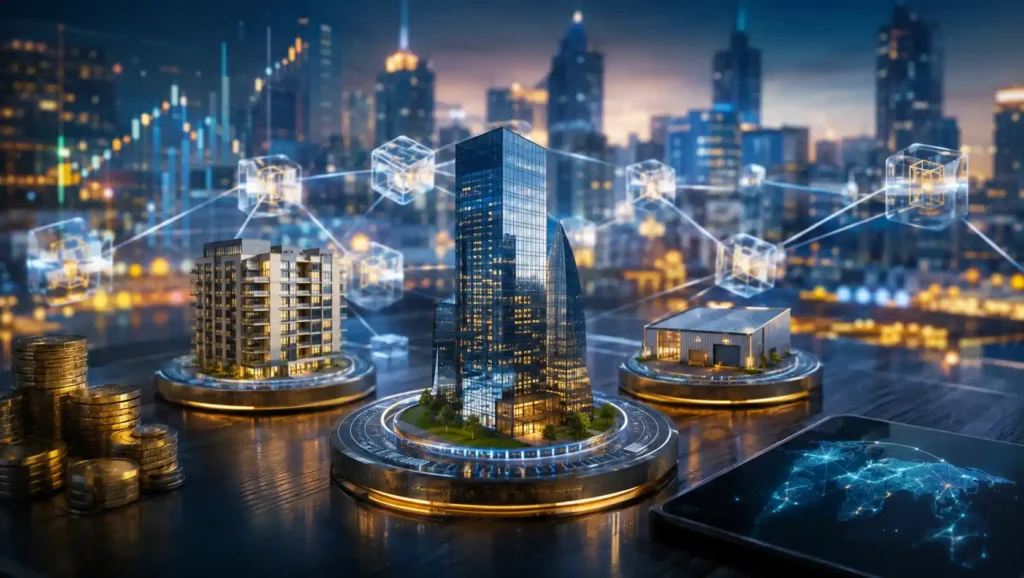
For decades, capital markets have relied on traditional intermediaries, paper-based ownership records, and limited trading windows to manage everything from commercial real estate to private credit. Today, however, real-world asset tokenization is emerging as one of the most closely watched innovations in modern finance. By converting ownership rights into blockchain-based digital tokens, this approach has the potential to make historically illiquid assets easier to transfer, divide, and access while improving transparency and operational efficiency.
The concept has attracted growing interest from institutional investors, asset managers, and financial infrastructure providers rather than only cryptocurrency enthusiasts. Major organizations including BlackRock, Franklin Templeton, and several global financial institutions have launched or tested tokenized investment products, while research from Boston Consulting Group (BCG), McKinsey & Company, the World Economic Forum (WEF), and the Bank for International Settlements (BIS) suggests that tokenization could become an important component of future capital markets.
Some industry observers describe this trend as “The Great Securitization Revival“ While the phrase is intentionally provocative, it reflects a broader discussion about how blockchain technology may modernize ownership and capital formation. At the same time, widespread adoption is far from guaranteed. Regulatory clarity, legal recognition, cybersecurity, liquidity, investor confidence, and robust market infrastructure will ultimately determine whether tokenized real-world assets become a mainstream feature of global finance or remain limited to specialized markets.
Why Real-World Asset Tokenization Is Accelerating?
At its core, real-world asset tokenization refers to the process of representing ownership interests in physical or financial assets as digital tokens recorded on a blockchain. Instead of relying solely on conventional databases or paper certificates, tokenized assets use distributed ledger technology to document ownership, facilitate transfers, and automate certain administrative processes through programmable smart contracts.
Unlike cryptocurrencies that derive value primarily from market demand, tokenized real-world assets represent claims on existing assets such as commercial buildings, private credit portfolios, infrastructure projects, government bonds, investment funds, or fine art collections.
Several structural trends explain why RWA tokenization has gained momentum.
Blockchain Infrastructure Is Becoming More Mature
Over the past decade, blockchain networks have evolved significantly. Enterprise-grade infrastructure now offers improved scalability, security, and interoperability compared with earlier public blockchain systems. Financial institutions increasingly view blockchain as operational infrastructure rather than merely a speculative technology.
Modern digital asset platforms can potentially reduce settlement times, automate compliance workflows, and improve recordkeeping while maintaining transparent audit trails.
Rather than replacing existing financial markets overnight, blockchain is increasingly being integrated into traditional financial infrastructure.
On-Chain Securitization Modernizes Capital Formation
Traditional securitization transformed finance by packaging assets into tradeable securities. Tokenization extends this concept by enabling ownership interests themselves to exist digitally.
This emerging model often called on-chain securitization could simplify issuance, ownership tracking, dividend distributions, and secondary transfers without eliminating regulatory oversight.
Instead of relying on multiple disconnected systems, blockchain enables a shared ledger where authorized participants can verify transactions more efficiently.
Industry experts emphasize that tokenization should be viewed as an evolution of capital market infrastructure rather than a replacement for financial regulation.
Fractional Ownership Expands Investment Accessibility
Historically, many alternative investments required substantial capital commitments.
Commercial office buildings, infrastructure funds, private equity vehicles, or museum-quality artwork often remained accessible only to institutional investors or high-net-worth individuals.
Fractional ownership changes this dynamic by dividing an asset into numerous digital shares.
For example, instead of purchasing an entire commercial property, investors may eventually acquire smaller ownership interests through regulated tokenized structures, depending on local securities laws.
Likewise, fractional real estate investing could broaden access to income-producing assets that were previously beyond the reach of many investors.
However, accessibility alone does not eliminate investment risk. Investors must still evaluate valuation methods, liquidity, governance, legal protections, and underlying asset quality before allocating capital.
Institutional Participation Is Changing the Conversation
Perhaps the biggest shift is not technological but institutional.
Large asset managers, banks, custodians, and financial infrastructure providers are increasingly exploring digital securities, tokenized funds, and blockchain settlement systems.
BlackRock’s tokenized money market fund initiative and Franklin Templeton’s blockchain-enabled fund platform illustrate how established financial institutions are experimenting with tokenization within regulated frameworks.
Meanwhile, central banks, regulators, and organizations including the BIS and IMF continue studying how digital asset infrastructure could coexist with existing financial systems.
This growing institutional involvement suggests that tokenization is increasingly viewed as a capital markets initiative rather than solely a blockchain innovation.
Why This Matters to Investors?
For investors, the significance of real-world asset tokenization lies less in short-term market excitement and more in its potential to modernize how capital moves through private markets. If regulatory frameworks mature and market infrastructure develops as expected, tokenization could improve operational efficiency, expand access to selected alternative investments, and reduce administrative friction. However, long-term success will depend on legal certainty, institutional adoption, and sustainable market liquidity not technology alone.
Which Assets Are Being Tokenized?
While headlines often focus on cryptocurrencies, much of the current innovation involves bringing traditional assets onto blockchain infrastructure.
Financial institutions are evaluating which asset classes benefit most from digital ownership structures, particularly those characterized by limited liquidity, lengthy settlement processes, or complex ownership administration.
Several categories stand out.
Commercial Real Estate
Commercial real estate remains one of the most discussed applications for tokenization.
Office buildings, apartment complexes, logistics facilities, hotels, and mixed-use developments often require significant capital and involve lengthy transaction processes.
Tokenization may improve capital efficiency by enabling fractional ownership, simplifying ownership transfers, and potentially expanding access to qualified investors.
Although property management, legal ownership, and regulatory compliance remain unchanged, blockchain can streamline how ownership interests are issued and transferred.
Private Credit
Private credit has grown rapidly as companies seek financing outside traditional banking channels.
Many private debt instruments are relatively illiquid and difficult to trade.
Tokenization could improve transparency, facilitate ownership transfers, and create more efficient secondary markets, although liquidity will ultimately depend on investor participation and regulatory frameworks.
Infrastructure Assets
Infrastructure projects including renewable energy facilities, transportation networks, utilities, and telecommunications assets typically involve long investment horizons and substantial capital commitments.
Tokenized ownership structures may allow institutional and qualified investors to diversify exposure while improving administrative efficiency.
Infrastructure tokenization could become particularly attractive for pension funds, sovereign wealth funds, and family offices seeking stable long-term cash flows.
Fine Art and Collectibles
High-value artwork, rare collectibles, luxury watches, and vintage automobiles represent another growing category.
Fine art investing has traditionally required considerable expertise, significant capital, and long holding periods.
Digital asset tokenization could simplify ownership documentation while enabling regulated fractional participation in selected investment vehicles.
However, valuation transparency, authentication, insurance, custody, and investor protection remain essential considerations.
Tokenized Asset Classes
| Tokenized Asset | Primary Benefit | Key Challenge |
|---|---|---|
| Commercial Real Estate | Fractional ownership and broader investor access | Complex property regulations and liquidity |
| Private Credit | Improved transferability and operational efficiency | Credit risk and secondary market depth |
| Infrastructure Assets | Access to long-term income-producing investments | Regulatory approvals and long investment horizons |
| Fine Art & Collectibles | Fractional participation in high-value assets | Valuation, authenticity, and custody requirements |
| Private Equity Funds | Simplified ownership administration | Legal structuring and transfer restrictions |
The table highlights a common theme: every asset class offers meaningful opportunities through tokenization, but each also presents distinct operational, legal, and market challenges. Tokenization does not eliminate the underlying risks of an investment; rather, it changes how ownership can be recorded, transferred, and potentially accessed.
As financial institutions continue to test blockchain-based infrastructure, the most successful applications are likely to emerge in markets where improved efficiency, transparency, and broader participation provide clear economic value without compromising investor protection.
Why This Matters to Investors?
Investors should view tokenized assets through the lens of portfolio construction rather than technological novelty. Commercial real estate, private credit, infrastructure, and fine art each serve different investment objectives, risk profiles, and return expectations. Tokenization may make these alternative investments more accessible and operationally efficient, but careful due diligence remains essential. The long-term opportunity lies in expanding access to private markets while maintaining the governance, transparency, and regulatory safeguards that institutional investors expect.
Opportunities and Challenges
The momentum behind real-world asset tokenization stems from its potential to modernize how capital is raised, managed, and transferred. Yet the industry’s future will depend on solving practical challenges rather than simply advancing blockchain technology.
Regulatory Clarity
Regulation remains the single most important factor influencing the future of RWA tokenization. Unlike cryptocurrencies, tokenized real-world assets often represent ownership interests in securities, funds, or physical assets, placing them under existing financial regulations.
Authorities in jurisdictions such as the European Union, Singapore, the United Arab Emirates, and the United States are developing or refining frameworks for digital securities and tokenized financial products. However, regulatory approaches continue to evolve, creating uncertainty for issuers and investors alike.
Market Liquidity
One of tokenization’s most discussed advantages is the possibility of improved liquidity. Fractional ownership may increase the number of potential buyers and sellers, particularly for traditionally illiquid alternative investments.
However, tokenization alone does not create liquidity. Active secondary markets, sufficient trading volume, transparent pricing, and broad investor participation remain essential. Without these elements, a tokenized asset may still be difficult to sell.
Custody and Cybersecurity
Institutional investors place significant emphasis on secure custody solutions. Digital wallets, private key management, and cyber resilience must meet the same standards expected in traditional financial markets.
As tokenized assets grow in value, cybersecurity will become increasingly important. Strong governance, regulated custodians, and comprehensive risk management frameworks will play a central role in building investor confidence.
Valuation and Transparency
Private market assets often lack the continuous pricing available in public markets. Commercial real estate, infrastructure projects, and private credit portfolios may be valued periodically rather than daily.
Blockchain improves recordkeeping and ownership transparency, but it does not determine an asset’s fair market value. Reliable valuation methodologies and independent verification remain essential.
Interoperability
Today’s blockchain ecosystem consists of multiple networks, standards, and technology providers. For digital asset tokenization to reach scale, these systems must communicate effectively with each other and with traditional financial infrastructure.
Greater interoperability could reduce operational friction and improve cross-border investment opportunities while preserving regulatory oversight.
Why This Matters to Investors?
For investors, the opportunity lies in long-term capital market modernization not short-term speculation. The strongest projects are likely to be those built on trusted legal structures, institutional-grade infrastructure, and transparent governance. At the same time, regulatory uncertainty, cybersecurity risks, and uneven market liquidity mean investors should approach tokenized assets with the same discipline applied to any other investment.
Comparing Tokenized Asset Classes
Different asset classes present different opportunities for tokenization. Their investment characteristics remain largely unchanged, but blockchain infrastructure may improve accessibility, operational efficiency, and ownership transfer.
| Asset Class | Tokenization Opportunity | Primary Risk |
|---|---|---|
| Commercial Real Estate | Fractional ownership and broader capital access | Property market cycles and regulatory complexity |
| Private Credit | More efficient transfers and potential secondary trading | Credit defaults and limited liquidity |
| Fine Art | Broader participation in high-value collectibles | Subjective valuation and authenticity |
| Infrastructure Assets | Digital ownership of long-duration cash-flow assets | Political, regulatory, and project execution risks |
Commercial Real Estate
Commercial property remains one of the most promising applications for tokenization because ownership can potentially be divided among multiple investors without changing the underlying asset.
Investment objective: Income generation and long-term appreciation.
Liquidity potential: Higher than traditional ownership if regulated secondary markets develop.
Growth drivers: Urban development, institutional demand, and global real estate investment.
Regulatory complexity: High due to property, securities, and tax laws.
Ideal investor: Long-term investors seeking diversified income-producing assets.
Private Credit
Private credit has expanded significantly over the past decade as businesses seek alternatives to bank lending.
Tokenization may improve administrative efficiency while supporting more transparent ownership transfers.
Investment objective: Yield generation.
Liquidity potential: Moderate, depending on market development.
Growth drivers: Expanding private lending markets.
Risk profile: Credit quality remains the primary consideration.
Ideal investor: Investors comfortable evaluating credit risk over longer investment horizons.
Fine Art
Fine art investing has traditionally been accessible only to wealthy collectors and specialist funds.
Fractional ownership may broaden participation while preserving professional asset management.
Investment objective: Portfolio diversification and long-term appreciation.
Liquidity potential: Limited compared with public securities.
Growth drivers: Global demand for rare collectibles.
Regulatory considerations: Authentication, provenance, and investor protection.
Ideal investor: Diversified investors seeking exposure to alternative assets.
Infrastructure Assets
Infrastructure investments generally produce long-term, predictable cash flows but require significant capital commitments.
Tokenization may simplify ownership administration and broaden investment participation over time.
Investment objective: Stable long-term income.
Liquidity potential: Moderate if regulated trading venues expand.
Growth drivers: Energy transition, transportation, and digital infrastructure.
Operational complexity: High due to project management and regulatory oversight.
Ideal investor: Pension funds, family offices, insurers, and patient long-term investors.
Why This Matters to Investors
Each asset class serves a different role within a diversified portfolio. Tokenization may improve access and operational efficiency, but it does not alter the fundamental characteristics of the underlying investment. Successful capital allocation will continue to depend on asset quality, cash flows, valuation, and risk management rather than blockchain technology itself.
The Future of Tokenized Capital Markets
Many analysts believe the next phase of financial innovation will focus less on cryptocurrencies and more on integrating blockchain into existing financial infrastructure.
Institutional investors are increasingly exploring digital securities, programmable settlement, tokenized money market funds, and blockchain-enabled private markets. Rather than replacing traditional finance, tokenization appears more likely to complement it by improving operational efficiency and reducing administrative complexity.
Cross-border investing could also become more streamlined if tokenized assets operate within interoperable regulatory frameworks. Faster settlement, transparent ownership records, and automated compliance processes may reduce costs while improving market accessibility.
At the same time, capital market modernization will require cooperation among regulators, custodians, exchanges, technology providers, and financial institutions. Legal recognition of tokenized ownership, standardized technical protocols, and investor protections will be essential before widespread adoption can occur.
Why This Matters to Investors?
Investors should monitor tokenization as a long-term structural trend rather than a short-term market cycle. The greatest opportunities may emerge from stronger financial infrastructure, more efficient private markets, and broader access to alternative investments not from speculation surrounding blockchain technology itself.
Conclusion
The growing interest in real-world asset tokenization reflects a broader effort to modernize global capital markets rather than simply introduce another blockchain application. By enabling fractional ownership, improving operational efficiency, and expanding access to selected alternative investments, tokenization offers a compelling framework for rethinking how assets are issued, owned, and transferred.
Yet its future should be viewed with measured optimism. Regulatory clarity, robust cybersecurity, interoperable infrastructure, market liquidity, and institutional participation will determine whether tokenized real-world assets become a foundational element of modern finance. For long-term investors, executives, and wealth managers, the opportunity lies not in chasing technological hype but in understanding how digital infrastructure could gradually reshape private markets and capital allocation over the next decade.
Frequently Asked Questions
What is real-world asset tokenization?
Real-world asset tokenization is the process of representing ownership rights in physical or financial assets as blockchain-based digital tokens that can be transferred within regulated frameworks.
What are tokenized real-world assets?
They are digital representations of assets such as commercial real estate, private credit, infrastructure projects, investment funds, fine art, or other private market investments.
How does fractional ownership work?
Fractional ownership divides an asset into smaller ownership interests, allowing multiple investors to participate without purchasing the entire asset.
What is on-chain securitization?
On-chain securitization applies blockchain technology to the issuance, management, and transfer of asset-backed investments while operating within applicable legal and regulatory requirements.
Which assets can be tokenized?
Commercial real estate, private credit, infrastructure, fine art, collectibles, investment funds, government bonds, and selected private equity interests are among the assets currently being explored.
Why are institutional investors interested in RWA tokenization?
Institutional investors see potential benefits including operational efficiency, improved transparency, reduced settlement times, and broader access to private market opportunities.
What are the risks of tokenized assets?
Risks include regulatory uncertainty, cybersecurity threats, limited secondary market liquidity, valuation challenges, operational risks, and the performance of the underlying asset.
How does blockchain improve private markets?
Blockchain can improve recordkeeping, ownership transparency, settlement efficiency, and administrative processes while supporting programmable financial infrastructure.
Can retail investors access tokenized assets?
Access depends on local regulations, the specific investment structure, investor eligibility requirements, and whether regulated investment platforms offer participation.
Why is real-world asset tokenization considered a long-term financial trend?
Many analysts view real-world asset tokenization as part of the broader evolution of private markets, digital securities, and capital market infrastructure. Its long-term potential depends on regulation, institutional adoption, trusted infrastructure, and investor confidence rather than technology alone.

Administrator at Alt Finances, leading editorial strategy and contributing in-depth coverage of investing, wealth management, alternative assets, and global financial markets. Through research-driven articles and analysis, he helps readers understand the ideas, industries, and market forces shaping modern finance.