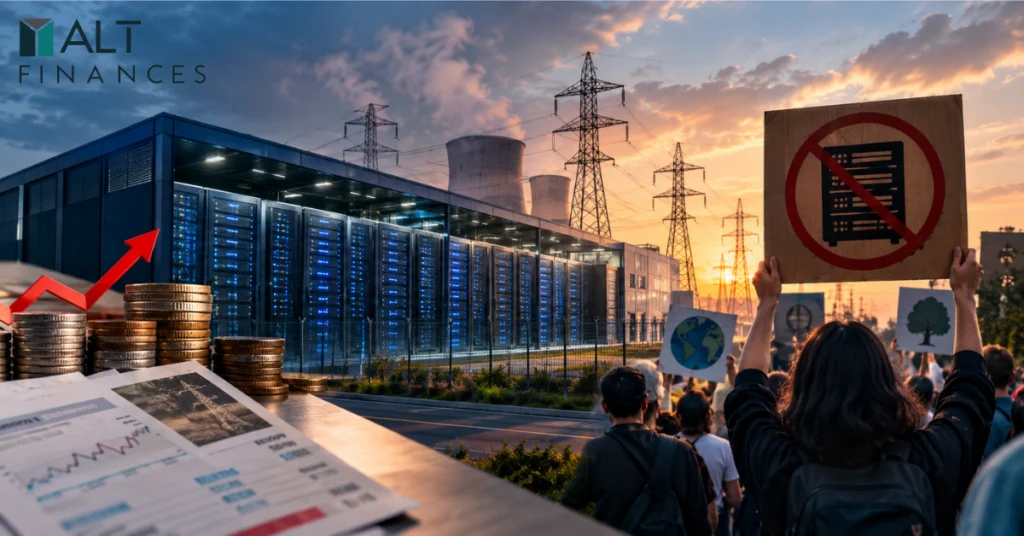
The race to build artificial intelligence infrastructure is colliding with a practical constraint: data centers cannot operate without reliable electricity, suitable land and permission to build. As developers compete to expand computing capacity, grid limitations, rising infrastructure requirements and community opposition are becoming important factors in determining which projects can proceed and whether their expected returns justify the capital committed.
The financial stakes are substantial. The International Energy Agency reported in 2026 that electricity consumption by data centers increased 17% in 2025, while consumption by AI-focused data centers grew even faster. The agency also reported that capital expenditure by five major technology companies exceeded $400 billion in 2025 and was expected to rise further in 2026. These figures illustrate the scale of the build-out, but spending and projected demand do not guarantee profitable projects.
For infrastructure investors, the question is changing. It is no longer enough to identify strong demand for AI computing. Investors must determine whether individual projects can secure power, obtain approvals, manage costs and attract customers on terms that support sustainable returns.
Why AI Data Centers Are Facing Growing Resistance
Large data centers can bring construction spending, employment, tax revenue and investment in supporting infrastructure. However, those benefits are not distributed equally, and their scale depends on the project.
Communities have raised concerns about electricity demand, water consumption, noise, land use and the effect of industrial-scale facilities on residential areas. Residents may also question whether promised economic benefits justify the local infrastructure requirements.
The resistance is not confined to the United States. In October 2026, Reuters reported growing opposition to data-center development in India, including concerns about land conversion, electricity use and the effects on nearby communities. The reporting illustrates how the physical requirements of AI infrastructure are becoming a local political issue as well as a technology investment story.
A prominent US example is the Digital Gateway proposal in Virginia. In July 2026, Blackstone-owned QTS terminated the planned project and withdrew its associated filings after years of local opposition and litigation. The decision demonstrates that even a project backed by substantial capital can face execution risks that demand more than a favorable demand forecast.
Neither example means opposition will stop data-center expansion everywhere. They show that the local conditions surrounding a project can materially affect its feasibility.
The Rising Cost of Powering AI Infrastructure
Electricity is both an operating expense and a constraint on development. A site may offer attractive land and proximity to customers, but its commercial value is limited if sufficient power cannot be delivered when the facility is scheduled to open.
The IEA’s 2026 analysis of electricity demand from data centers highlights the rapid growth in consumption and the infrastructure challenge involved in meeting it. New generation alone is not always enough: transmission lines, substations, distribution equipment and grid connections must also be available.
Developers may need to fund or contribute to grid upgrades, arrange long-term electricity contracts, secure backup power and invest in cooling systems. Each requirement affects the amount of capital committed before a facility generates revenue.
These expenses also influence operating margins. A project that secures electricity at a predictable cost may have a different financial profile from one exposed to volatile prices, expensive backup arrangements or uncertain connection dates.
Investors should distinguish a power supply agreement from physical deliverability. A contract may establish commercial terms, but the project still needs the infrastructure and approvals necessary to receive the electricity.
How Grid Constraints Are Reshaping Data Center Locations
Power availability is increasingly important in site selection. Locations with established grid infrastructure, credible connection schedules and access to suitable generation may be more attractive than sites where electricity delivery remains uncertain.
That does not mean every project should move to the region with the cheapest power. Investors must also consider transmission capacity, customer proximity, construction costs, water availability, permitting requirements and the reliability of the energy supply.
Developers have several options, including utility-supplied electricity, renewable power purchase agreements, energy storage and on-site generation. Each involves trade-offs. Renewable contracts can support energy procurement strategies, but their commercial value depends on contract terms and how supply aligns with the facility’s demand. Storage and backup generation can improve resilience but introduce additional costs and operational considerations.
The investment case therefore depends on the complete energy arrangement rather than a headline electricity price.
ALT Finance’s analysis of data centers as investment assets examines the sector’s appeal as digital infrastructure. The same characteristics that make these facilities strategically important also make their power requirements, construction schedules and customer commitments essential to underwriting.
Public Opposition, Permitting and Project Delays
Planning approvals are not administrative details to be handled after financing. They are part of the project’s commercial foundation.
Community hearings, environmental reviews, litigation and changes in local policy can delay construction or require developers to redesign projects. Delays can increase financing costs, postpone revenue and leave equipment orders or customer commitments out of alignment with the construction schedule.
The Virginia Digital Gateway case illustrates this risk. QTS’s decision to terminate the project followed years of opposition and legal challenges, despite earlier local approval. For investors, the lesson is not that every contested project will be cancelled, but that approval risk must be evaluated throughout development.
Developers can reduce some uncertainty through earlier community engagement, transparent disclosure of expected electricity and water requirements, and clear explanations of local benefits. These measures cannot guarantee support, but they may reveal objections early enough to change the project design or operating plan.
Who Bears the Cost of Expanding AI Infrastructure?
One of the most consequential questions is how the cost of additional electricity infrastructure is allocated.
Depending on local tariffs, interconnection agreements and regulatory decisions, data-center operators may pay directly for certain facilities or upgrades. Utilities may also invest in network capacity, with the allocation of costs between large customers and other ratepayers determined by the applicable rules.
This matters because a project can be commercially attractive to its developer while raising questions about affordability for households and smaller businesses. Conversely, a data center can contribute tax revenue and support investment in local infrastructure. The balance varies by jurisdiction, project design and contractual arrangement.
Investors should therefore examine utility filings, connection agreements and applicable regulatory decisions rather than assume that all grid costs will be borne by the developer or passed automatically to consumers.
What the Backlash Means for Infrastructure Investors
For infrastructure funds, lenders, utilities and private-equity investors, the backlash changes how projects should be assessed. Strong demand for computing is only one part of the investment thesis.
Four questions deserve particular attention:
- Is power deliverable? Verify grid connection milestones, capacity commitments and the schedule for required upgrades.
- Are approvals sufficiently secure? Examine outstanding permits, litigation, environmental requirements and the history of local opposition.
- Are revenues credible? Assess customer commitments, lease terms, utilization assumptions and the financial strength of counterparties.
- Can the project absorb delays? Stress-test construction costs, interest expense, electricity prices and the consequences of a later opening date.
These checks help distinguish announced capacity from projects that can realistically be completed and operated. They also help investors assess whether projected returns compensate for the risks.
The wider infrastructure capital surge creates opportunities across digital infrastructure, power networks and other essential assets. However, scarcity alone does not guarantee attractive returns. A constrained power market may support demand for infrastructure while simultaneously making individual developments more expensive and difficult to deliver.
Frequently Asked Questions
Why are communities opposing AI data centers?
Common concerns include electricity demand, water use, noise, land conversion, environmental effects and whether local economic benefits justify the infrastructure required.
Can data centers increase electricity prices?
They can contribute to additional demand and infrastructure requirements, but the effect on consumer bills depends on local supply, grid investment, tariffs, cost-allocation rules and regulatory decisions.
How do power constraints affect investment returns?
Insufficient or delayed power can postpone operations, increase financing costs and reduce the period during which a facility generates revenue.
What should investors examine before financing a data center?
They should verify power delivery, permits, construction budgets, customer contracts, operating assumptions and the project’s ability to withstand delays or higher costs.
Conclusion
AI data center investment is becoming an infrastructure challenge shaped by electricity supply, grid capacity, permitting, community acceptance and financing. Demand for computing may remain strong, but it cannot compensate automatically for a project that cannot obtain power or complete construction on viable terms.
For investors, the strongest opportunities will depend on disciplined underwriting and independent verification. The objective is not simply to finance more capacity. It is to identify projects capable of delivering reliable computing services at sustainable costs while addressing the needs of the communities in which they operate.
Disclaimer: This article is for informational purposes only and does not constitute individualized financial or investment advice.

Administrator at Alt Finances, leading editorial strategy and contributing in-depth coverage of investing, wealth management, alternative assets, and global financial markets. Through research-driven articles and analysis, he helps readers understand the ideas, industries, and market forces shaping modern finance.