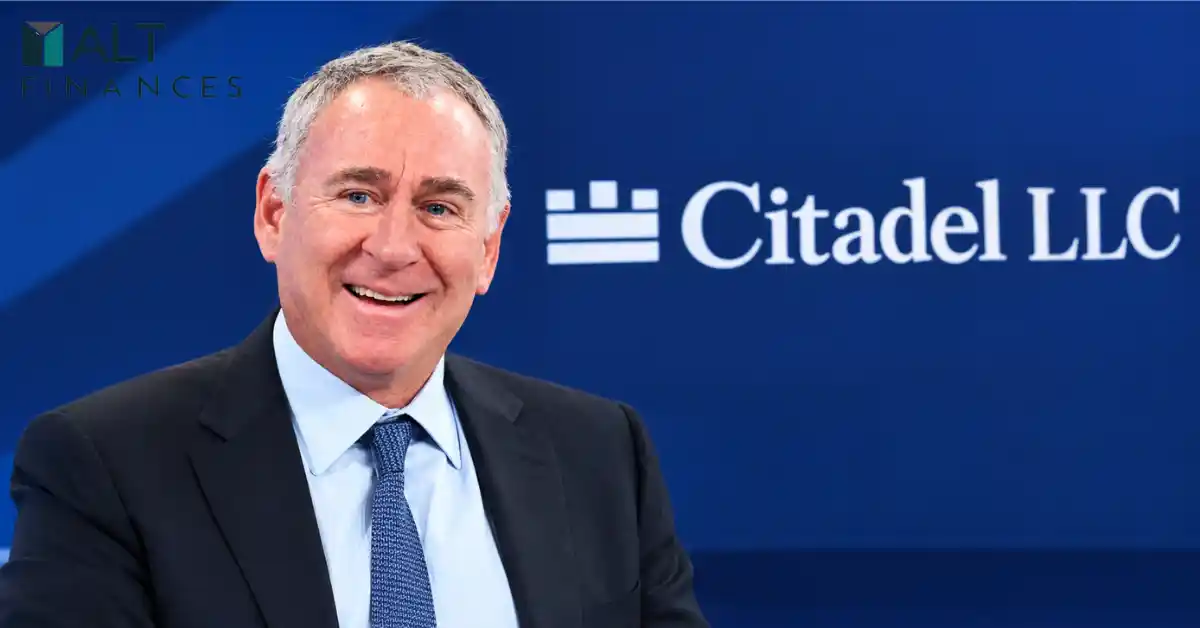
Ken Griffin’s important contribution to market making was not simply building a large trading firm; it was treating liquidity provision as a technology, data and risk-management problem that could be industrialized at enormous scale.
That approach helped transform market making from a largely relationship-driven financial activity into a highly automated business built around quantitative research, electronic execution and continuous risk management.
The distinction between Citadel and Citadel Securities is important. Citadel is Griffin’s investment-management firm, while Citadel Securities is the separate market-making business founded in 2002. Citadel Securities provides liquidity across equities, options, fixed income and foreign exchange, serving both retail and institutional markets.
Today, the firm’s model illustrates how technology can turn a traditionally specialized trading function into a form of financial infrastructure.
From Trading Floor to Electronic Market Making
When Citadel Securities was established, electronic trading was changing the economics of financial markets. Exchanges were becoming increasingly automated, while advances in computing and data processing made it possible to evaluate and execute orders at speeds that were difficult to achieve through manual processes.
Griffin’s strategy was to build around that transition.
The firm’s own account of its origins describes an early focus on electronic market making, using technology and quantitative methods to automate processes that had historically depended more heavily on manual intervention.
The result was not simply faster trading. It changed the operating model.
Instead of relying primarily on individual traders to assess every transaction, automated systems could continuously process market data, calculate prices and manage large numbers of orders.
That required investment in software engineering, mathematics, market research and risk controls alongside traditional trading expertise.
The Core Economics of Market Making
Market making is fundamentally about providing liquidity.
A market maker continuously offers to buy and sell securities. The difference between those prices is the bid-ask spread. When a market maker successfully manages the risks associated with buying and selling, the spread can compensate it for providing immediacy and absorbing short-term inventory risk.
But the spread is not guaranteed profit.
A market maker can receive an order just before the market moves against its position. It can accumulate an unwanted inventory position or face rapidly changing volatility. Technology failures, connectivity problems and extreme market conditions can create additional risks.
This makes risk management central to the business.
For a large electronic market maker, the objective is therefore not simply to execute more transactions. It is to price risk accurately, manage inventory efficiently and remain connected to multiple sources of liquidity.
Why Technology Became the Foundation
Citadel Securities’ model relies heavily on automated pricing, quantitative research, data processing and electronic execution.
The firm’s current platform spans multiple asset classes and markets. Its own description emphasizes the integration of financial, mathematical and engineering expertise with predictive models and systems designed to scale.
That scale can create an important feedback loop.
More trading activity produces more market data. More data can support research and model development. Better systems can improve pricing and execution, potentially allowing the firm to compete for additional liquidity and client flow.
The process is continuous rather than static.
Market conditions change, exchanges change their rules, securities behave differently and competitors develop their own technology. A market-making platform therefore requires constant investment rather than a one-time technological advantage.
Citadel Securities has itself described efforts to simplify and rebuild elements of its trading infrastructure as it expands into new businesses. A 2024 report on the firm’s technology strategy described a broad reassessment of its core systems.
Scale Changed the Business Model
Scale is particularly important in market making because the economics of individual transactions can be small while the aggregate volume is enormous.
Citadel Securities currently reports that more than 23% of U.S. equity market volume is executed through its platform and that it handles approximately 35% of U.S.-listed retail volume. These are company-reported figures rather than independent market-share estimates.
Its 2026 market-structure research also identifies the firm as the largest U.S. retail market maker and reports approximately 35% of U.S.-listed retail volume.
The significance of those figures is not simply the size of the numbers.
Large volumes can allow infrastructure costs, research capabilities and technology investments to be spread across a much broader trading base. Diversification across clients, securities and markets can also reduce dependence on any single source of activity.
However, scale does not remove risk. It increases the importance of reliable systems, capital capacity and controls because a technological or operational failure can affect a very large volume of transactions.
From Equities to a Multi-Asset Platform
Citadel Securities has expanded considerably beyond its original electronic-equities focus.
Its current business covers equities, options, fixed income and foreign exchange, with the firm reporting liquidity provision across more than 50 fixed-income and currency markets.
Options add another layer of quantitative complexity because pricing depends on factors such as volatility, time, interest rates and the relationships between securities.
Fixed income and foreign exchange introduce different market structures and liquidity conditions.
The broader strategy is therefore not simply to replicate one trading model in another asset class. Each market has different participants, regulations, pricing conventions and risk characteristics.
Diversification can nevertheless strengthen the overall platform by expanding client relationships and creating additional opportunities to deploy technology, research and balance-sheet capacity.
Why Human Relationships Still Matter
The rise of electronic market making might suggest that financial markets are moving toward a completely automated model. Citadel Securities’ recent expansion suggests something more complicated.
In 2026, the firm expanded its High Touch Equities business, adding human client coverage alongside its electronic infrastructure. The company said it had executed hundreds of block trades and expanded relationships with major venture-capital and private-equity firms.
That development is significant because large institutional trades can require more than automated execution.
A pension fund, asset manager or private-equity firm executing a large transaction may need market intelligence, customized execution and direct communication with trading professionals.
The emerging model is therefore hybrid: automation handles scale and speed, while experienced professionals handle complex relationships and transactions.
The Investor View: Technology Plus Risk Management
The economics of modern market making can be summarized through several interconnected components:
| Component | Role in the Model |
|---|---|
| Technology | Automated pricing and electronic execution |
| Quantitative research | Models, analytics and predictive tools |
| Scale | Large volumes and diversified trading activity |
| Liquidity | Continuous buying and selling |
| Risk management | Inventory, volatility and exposure controls |
| Talent | Mathematics, engineering, trading and financial expertise |
| Client coverage | Institutional and high-touch relationships |
The important point is that no single component explains the business.
Technology without risk controls can amplify losses. Scale without reliable infrastructure can create operational vulnerabilities. Quantitative models still depend on assumptions and data. Client relationships remain important even when most execution is electronic.
The business is therefore better understood as an integrated system.
The Risks and Limits of the Model
Modern market making remains exposed to several risks.
Market volatility can change prices faster than models or systems can respond. Inventory risk arises when a firm temporarily holds securities that move against it. Technology risk includes outages, software errors, connectivity failures and cybersecurity threats.
There are also regulatory risks.
Electronic market making operates within detailed rules governing exchanges, execution quality, market structure and customer order handling. Citadel Securities continues to participate actively in debates over U.S. market-structure regulation, including proposals affecting equity-trading rules.
Competition is another constraint. Other market makers, banks, exchanges and technology-driven trading firms continue to invest in pricing systems and quantitative capabilities.
The model also depends on trading activity. Lower volumes or changing market structures can affect the economics of liquidity provision.
Griffin’s broader views on technology and markets remain relevant to this evolution. In a July 2026 Goldman Sachs interview, he discussed AI, data centers, geopolitics and the way technology could reshape financial and corporate businesses.
Market Making Became Financial Infrastructure
The deeper significance of Ken Griffin Citadel market making is the way liquidity itself has become increasingly technology-driven.
Citadel Securities does not simply execute individual trades. It operates systems designed to continuously price securities, connect buyers and sellers, manage inventory and distribute liquidity across markets.
That makes the business resemble infrastructure as much as traditional trading.
The firm’s market-making and liquidity platform now spans multiple asset classes and client types, while its investment in quantitative research, engineering and high-touch coverage shows how the model continues to evolve.
The key competitive factors are consequently broader than trading skill alone: technology, talent, data, scale, capital, risk management and distribution all interact.
Conclusion
Ken Griffin’s role in modern market making is best understood through the business architecture he helped create rather than through biography alone.
Citadel Securities took an established financial function and built it around electronic execution, quantitative research and scalable technology. It then expanded that model from equities into options, fixed income and foreign exchange while maintaining relationships with both retail and institutional clients.
The 2026 expansion of high-touch equities adds another dimension, showing that automation has not eliminated the need for human judgment and client relationships.
The broader lesson is that financial infrastructure increasingly depends on the integration of technology and capital-market expertise. Citadel Securities is one example of how that integration can reshape the economics of liquidity provision.
For investors and finance professionals, the more important question is not simply how much trading a market maker handles. It is how effectively technology, scale, risk management and capital can work together as market structure continues to evolve.
For a broader view of Griffin’s current thinking on technology and markets, his 2026 Goldman Sachs interview provides additional context.
FAQs
Who is Ken Griffin?
Ken Griffin is the founder and CEO of Citadel and the founder of Citadel Securities. The two businesses are separate entities with different activities.
What does Citadel Securities do?
Citadel Securities is a global market-making firm that provides liquidity across equities, options, fixed income and foreign exchange.
How does a market maker make money?
Market makers generally seek to earn compensation for providing liquidity, including through bid-ask spreads, while managing inventory and market risk.
Why is technology important to modern market making?
Technology allows market makers to process large amounts of data, price securities, execute orders and manage risk across many markets at high speed.
How is Citadel Securities different from Citadel?
Citadel is an investment-management business, while Citadel Securities is a separate market-making firm. Both were founded by Ken Griffin.
Investment disclaimer: This article is provided for informational and educational purposes only. It does not constitute investment, financial, tax or legal advice and should not be interpreted as a recommendation regarding any security, company or investment strategy.

Administrator at Alt Finances, leading editorial strategy and contributing in-depth coverage of investing, wealth management, alternative assets, and global financial markets. Through research-driven articles and analysis, he helps readers understand the ideas, industries, and market forces shaping modern finance.