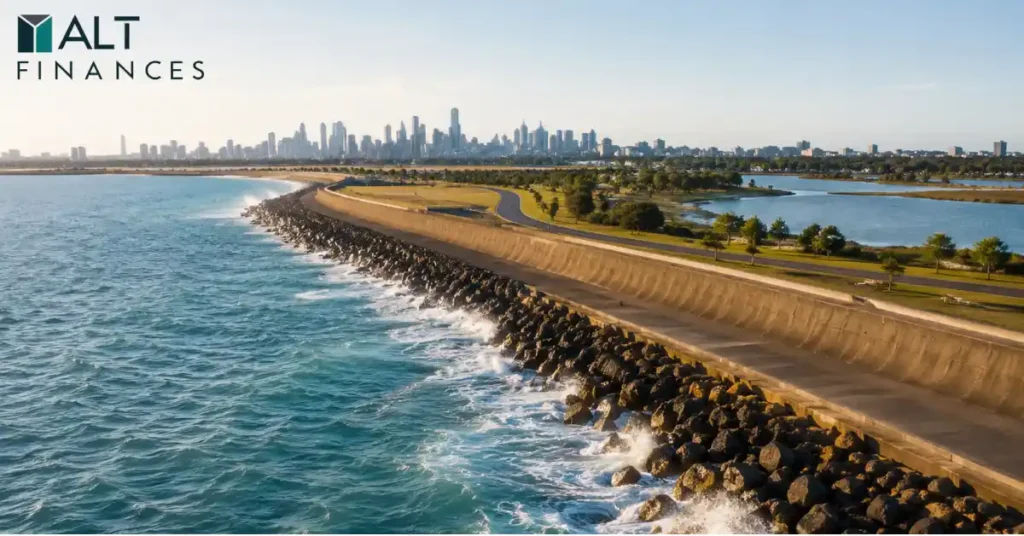
The most expensive infrastructure problem is often the one that has not happened yet: a city that must strengthen its drainage system, a utility that needs to harden its grid, or a coastal community that must protect valuable assets before the next major storm. That is turning climate adaptation infrastructure into a capital-allocation question, not simply an environmental one. As physical climate risk grows, governments, insurers and businesses face a difficult choice: spend heavily before damage occurs or accept potentially larger costs afterward.
The investment challenge is becoming more visible because the financing requirement extends well beyond public budgets. UNEP estimates that developing countries will need more than $310 billion annually for adaptation by 2035 under its modelled-cost estimate, while international public adaptation finance was only $26 billion in 2023. UNEP also identifies potential for substantially greater private-sector participation when policy support and blended-finance structures make projects investable.
The question for investors, therefore, is not whether resilience spending will increase. It is which parts of that spending can generate sufficiently reliable economic value to attract long-term capital.
Why Climate Adaptation Is Becoming an Infrastructure Problem
Physical climate risk increasingly intersects with the existing infrastructure stock. Floods can disrupt transport and utilities; extreme heat can strain electricity systems; wildfires can threaten communities and industrial assets; and coastal exposure can raise the cost of protecting property and infrastructure.
However, the investment case is more complicated than simply forecasting more extreme weather. Exposure matters too. Population growth, urbanisation, higher property values and greater infrastructure concentration can increase the amount of capital sitting in vulnerable locations.
Swiss Re estimates that the global natural-catastrophe protection gap reached $424 billion in 2025, while almost three-quarters of global exposure remained uninsured. The insurer also argues that adaptation can reduce catastrophe losses and support continued insurability.
That creates a powerful economic feedback loop:
Physical Risk → Potential Damage → Higher Economic Losses → Greater Protection Need → Adaptation Spending
For investors, the implication is important. Resilience is moving from a policy objective toward a potential infrastructure investment theme. Yet the existence of a large need does not itself create an investable asset. Revenue structures, regulation and government participation determine where capital can actually earn a return.
Table 1
| Adaptation Challenge | Infrastructure Response | Primary Capital Source |
|---|---|---|
| Flood exposure | Flood barriers, drainage and retention systems | Public capital + PPPs |
| Coastal risk | Coastal defenses and resilient infrastructure | Government + infrastructure capital |
| Water stress | Water supply, treatment and storage | Utilities + private infrastructure |
| Grid vulnerability | Grid hardening and modernization | Utilities + infrastructure investors |
| Extreme heat | Cooling and resilient urban infrastructure | Public + private capital |
| Wildfire exposure | Resilient utilities and prevention infrastructure | Utilities + public funding |
| Climate-exposed transport | Bridges, roads and resilient transit | Public infrastructure + PPPs |
The comparison reveals the central investment problem: the projects with the greatest social value do not necessarily have the clearest private cash flows. Investors therefore need to distinguish between resilience infrastructure that can operate as a commercial asset and infrastructure whose benefits primarily accrue to society.
Who Pays When Governments Cannot Pay Alone?
Governments remain central because adaptation frequently produces benefits that are difficult to monetize. A flood-control system may protect thousands of households without generating a conventional toll or subscription revenue stream.
That makes public budgets, municipal finance and development banks essential. However, fiscal constraints can limit how quickly governments can build. Development institutions can help bridge that gap through loans, guarantees, technical assistance and blended-finance structures.
Public-private partnerships can become particularly important when governments can provide land, procurement commitments, guarantees or regulated revenue frameworks while private investors provide construction and operating capital.
For family offices and institutional investors, this creates an important distinction: the opportunity may not be to finance an entire climate project independently. It may instead be to participate in a structure where public-sector support reduces specific risks and allows private infrastructure capital to enter.
Why Adaptation Is Harder to Finance Than Mitigation
Climate mitigation projects often have a relatively recognizable economic model. Electricity generation can sell power; renewable projects can receive contracted revenues; infrastructure can charge users.
Adaptation is different.
A seawall does not necessarily produce a direct income stream. Neither does a stronger drainage system or a wildfire buffer. Their value comes from avoided losses.
That creates a valuation challenge. Investors must determine whether avoided insurance claims, reduced business interruption, higher property values, lower maintenance costs or government payments can be converted into sufficiently predictable cash flows.
Consequently, climate finance needs more than capital. It needs structures that translate resilience benefits into investable economics.
For long-term infrastructure investing, that could mean availability payments, regulated utility revenues, insurance-linked incentives, government guarantees, development-bank participation or long-term contracts.
The Investment Case for Resilience Infrastructure
The strongest opportunities may emerge where adaptation overlaps with infrastructure that already has a commercial revenue model.
Water infrastructure is one example. Treatment, distribution, storage and recycling assets can serve essential demand while also addressing increasing water stress.
Grid modernization provides another. Hardening transmission and distribution networks can improve reliability while supporting broader electrification.
Resilient real estate can also create an investment angle where stronger buildings, drainage, cooling systems and location-specific resilience measures protect asset values and potentially reduce insurance costs.
Transport infrastructure presents a similar opportunity. Roads, ports, bridges and rail networks require resilience investment because disruptions can impose costs far beyond the physical asset itself.
Nature-based solutions add another layer. Wetlands, mangroves and restored ecosystems can sometimes provide flood protection alongside environmental benefits. However, their investment models remain more complex than conventional infrastructure.
The key is not to label every resilience project an investment opportunity. It is to identify assets where resilience creates measurable economic value.
Insurance Could Become a Catalyst for Adaptation
Insurance may become one of the most important bridges between physical resilience and investment economics.
The logic is straightforward: stronger infrastructure can potentially reduce damage, which can reduce claims, business interruption and financial volatility. In turn, lower risk can support insurance availability and affordability.
Swiss Re’s 2026 research highlights this relationship, noting that adaptation investments can reduce catastrophe losses and help maintain insurability. It cites examples where defenses materially reduce expected losses.
The broader protection gap reinforces the issue. Swiss Re reported that natural catastrophes generated approximately $220 billion of economic losses in 2025, compared with $107 billion of insured losses.
That difference represents more than an insurance statistic. Uninsured losses ultimately fall on households, companies, governments and financial systems.
Resilience therefore has a potential second-order financial benefit:
Adaptation → Lower Loss Severity → Better Insurability → Lower Economic Disruption
For investors, that creates an emerging intersection between infrastructure, insurance and alternative investments. However, the value still needs to be captured through a credible commercial structure.
Where Private Capital Can and Cannot Go
The most interesting question is not whether private investors will finance adaptation. They already participate in infrastructure, utilities, real estate and other assets that can incorporate resilience spending.
The question is where private capital can achieve acceptable risk-adjusted economics without relying on unrealistic assumptions.
Table 2
| Investment Area | Potential Opportunity | Key Risk |
|---|---|---|
| Water infrastructure | Essential-service revenues + resilience demand | Regulation and capital intensity |
| Grid modernization | Long-term utility investment | Regulatory and execution risk |
| Resilient real estate | Asset protection + potential insurance benefits | Valuation and location risk |
| Coastal infrastructure | Protection of high-value assets | Public funding dependence |
| Climate-resilient transport | Essential infrastructure + public contracts | Political and construction risk |
| Nature-based solutions | Resilience + environmental benefits | Monetization uncertainty |
| Disaster-risk technology | Data, modelling and monitoring | Technology and adoption risk |
This is where climate adaptation infrastructure becomes particularly interesting for alternative-investment investors. The strongest opportunities may sit at the intersection of several existing investment categories rather than inside a standalone “climate” bucket.
A water utility can be infrastructure. A resilient building can be real estate. Grid hardening can be an infrastructure-capital opportunity. Climate-risk analytics can be a technology investment.
That flexibility expands the potential opportunity set but it also makes due diligence essential.
The Limits of the Private-Market Opportunity
There is a temptation to assume that the enormous adaptation requirement automatically represents an enormous investment opportunity.
It does not.
Some projects will remain fundamentally public goods. Others may require subsidies, guarantees or concessional financing. Still others may face political constraints that make private ownership inappropriate.
Investors should therefore examine five questions:
- Who pays?
- How predictable is the revenue?
- Who absorbs construction and political risk?
- Does resilience create measurable economic savings?
- Can the project maintain those economics over decades?
The answer to those questions may matter more than the size of the climate problem itself.
Unique Insight: Resilience Could Become a New Infrastructure Value Driver
The deeper investment thesis is not simply that climate change requires more infrastructure.
It is that adaptation could change how existing infrastructure is valued.
Historically, investors often evaluated infrastructure through familiar variables: demand, regulation, operating costs, leverage and expected cash flow. Increasingly, physical climate risk can become another valuation variable.
Two otherwise similar assets may have very different long-term economics if one is protected against flooding, heat, water stress or extreme weather while the other is exposed.
That creates a new chain:
Climate Risk → Adaptation Need → Capital Spending → Asset Resilience → Economic Protection → Investment Value
This does not mean resilient assets will automatically outperform. Adaptation spending can be expensive, poorly designed or difficult to monetize.
Instead, the emerging opportunity lies in identifying assets where:
Climate Risk + Clear Revenue + Insurance Value + Government Support + Long-Term Demand
produce a credible investment case.
That is the real frontier for climate adaptation infrastructure.
The Future of Climate Adaptation Infrastructure
The next phase of climate finance may be less about creating entirely new investment categories and more about redirecting existing pools of infrastructure capital toward assets that can withstand physical risk.
Governments will remain essential. Development banks can help make difficult projects financeable. Insurers can create incentives for risk reduction. Infrastructure funds and private capital can participate where reliable revenue exists.
At the same time, investors will need to resist the assumption that every adaptation project represents an attractive alternative investment.
The most durable opportunities are likely to emerge where resilience solves a genuine economic problem and produces a credible mechanism for investors to capture part of that value.
Ultimately, the question is not simply how much climate adaptation infrastructure the world needs. It is who will pay for it and which parts of that enormous requirement can become investable, durable assets.
Conclusion
Climate adaptation infrastructure is becoming a test of capital allocation as much as a response to physical climate risk. The need is large, but the investment opportunity is not uniform.
The winners may not be the projects with the biggest climate headlines. They may be the assets where resilience improves a measurable economic outcome: protecting utility revenues, reducing insurance losses, preserving property values, maintaining transport networks or securing essential water supplies.
That makes the central question increasingly financial:
Who will pay for climate resilience and where can public and private capital work together to turn adaptation from an unavoidable cost into investable infrastructure?
Frequently Asked Questions
What is climate adaptation infrastructure?
Climate adaptation infrastructure includes physical assets designed to reduce vulnerability to physical climate risks, including flood protection, resilient water systems, grid modernization, coastal defenses and disaster-resistant transport.
Why is climate adaptation infrastructure becoming an investment theme?
Because governments, businesses and infrastructure owners face growing costs from physical risks. Where resilience projects have identifiable revenues or measurable economic benefits, they may attract long-term infrastructure capital.
Who pays for climate adaptation?
Governments remain major funders, but development banks, municipalities, insurers, infrastructure investors and private capital can also participate through mechanisms such as PPPs, project finance and blended finance.
How is climate adaptation different from climate mitigation?
Mitigation aims to reduce greenhouse-gas emissions, while adaptation focuses on reducing vulnerability to physical climate risks and their economic consequences.
Can private investors finance climate adaptation?
Yes, particularly where projects have predictable revenues or contractual support. However, many adaptation projects generate broad public benefits and may still require substantial government or development-bank financing.
How does insurance support climate resilience?
Resilience can potentially reduce damage and claims, helping protect insurability. Swiss Re’s research links adaptation with efforts to narrow natural-catastrophe protection gaps.
What are the biggest risks of investing in adaptation infrastructure?
Key risks include construction costs, regulation, political intervention, uncertain revenues, high capital requirements, changing risk assumptions and difficulty monetizing avoided losses.
Why is climate adaptation difficult to finance?
Many projects create large social benefits without generating direct commercial revenues. As a result, investors may require public guarantees, contracts, subsidies or other mechanisms to make projects financially viable.

Marcie Bilawsky
Marcie Bilawsky is a Financial Writer & Research Contributor at AltFinances, covering investing, alternative assets, wealth management, and global financial markets. Her work focuses on making complex financial trends, investment themes, and emerging market opportunities easier to understand through research-driven analysis.