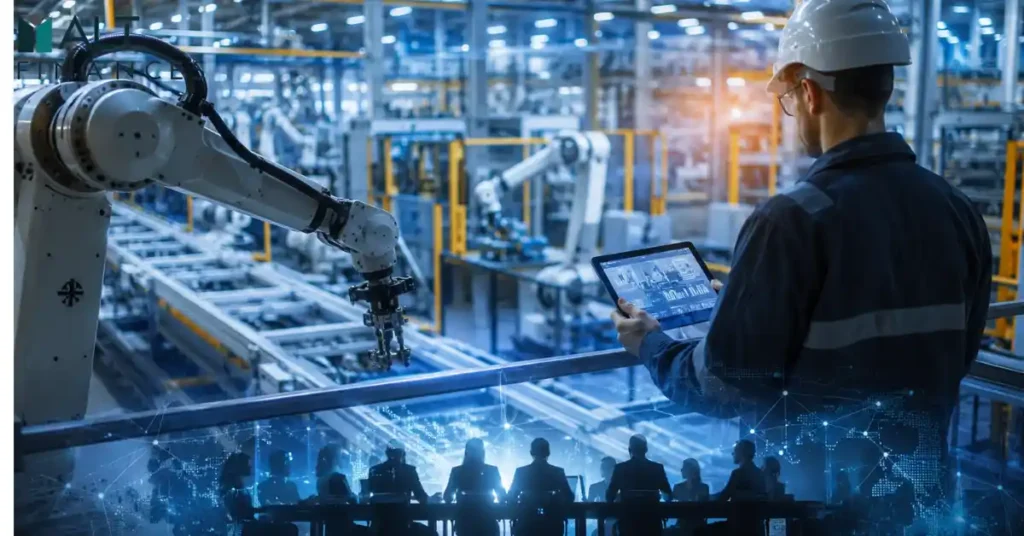
What happens when businesses can increasingly substitute capital and machines for human labor and who captures the resulting productivity gains? That question sits at the center of the labor economics of physical AI, as robots and autonomous machines move beyond narrowly defined industrial tasks and into a wider range of physical activities.
Unlike software automation, physical AI requires companies to commit capital to machines, sensors, chips, energy, maintenance, integration and workforce training. The economic calculation therefore extends beyond whether a machine can perform a task. Companies must determine whether the expected productivity improvement and labor savings justify the investment required to deploy it.
That creates a broader economic chain: labor scarcity → automation investment → capital costs → productivity gains → wage effects → corporate margins → consumer prices → distribution of economic gains.
The crucial question for investors is consequently not simply who sells the robots. It is who ultimately captures the economic value created by them.
Why the Labor Economics of Physical AI Matters
Physical AI changes the economics of automation because machines have to operate in the physical world. A software system can often be deployed through existing digital infrastructure. A robot requires hardware, sensors, computing, power, physical space, maintenance and integration with existing operations.
The basic economic equation becomes:
Capital + Machines + Labor → Output
The objective is not necessarily to eliminate labor. It may instead be to increase the amount or consistency of output generated by a given workforce.
Recent evidence supports a more nuanced view than the simple idea that robots automatically destroy employment. The International Federation of Robotics‘ 2026 position paper emphasizes displacement, productivity and reinstatement effects, noting that robots can automate particular tasks while also supporting new tasks, productivity and competitiveness.
For investors, this distinction matters because the economic value of physical AI depends on how effectively additional capital is converted into additional productive capacity.
| Automation Effect | Potential Economic Impact | Who May Benefit |
|---|---|---|
| Task automation | Lower labor requirements for specific activities | Companies, consumers |
| Higher productivity | More output from existing resources | Companies, workers, investors |
| Labor substitution | Changes in workforce composition | Capital owners, some employers |
| Human-machine collaboration | Higher productivity for complementary workers | Skilled workers, companies |
| Lower production costs | Potentially lower prices or higher margins | Consumers, companies, shareholders |
| New technical roles | Demand for integration, maintenance and supervision | Skilled workers, service providers |
The outcome depends on productivity, competition, labor-market conditions, bargaining power and ownership of the capital deployed.
Who Pays for Automation?
Automation begins with a capital-allocation decision.
Companies purchasing physical AI may have to fund robotics chips, sensors, software, integration, employee training, maintenance and supporting infrastructure. Those costs can make automation unattractive if the expected economic benefit is insufficient or takes too long to materialize.
The investment equation is therefore:
Automation Cost → Labor Cost Saved → Productivity Gain → Payback Period → Return on Capital
The companies most likely to pursue automation are not necessarily those seeking to eliminate the most workers. Labor shortages, production bottlenecks, safety concerns and the need for consistent output can also influence adoption.
That is increasingly relevant in aging economies. The IFR identifies demographic change and labor shortages as important drivers of robotics adoption, while the OECD continues to identify structural labor shortages despite relatively resilient employment conditions across its member economies.
Investors therefore need to distinguish between automation demand created by labor scarcity and automation demand created purely by technological enthusiasm.
The cost can also extend beyond the company. Workers may bear transition costs through retraining or changes in job responsibilities. Governments may face pressure to support education and workforce adjustment. Society may ultimately finance part of the transition through infrastructure and skills systems.
Who Captures the Productivity Gains?
The more difficult question is what happens after the machine is installed.
Suppose automation increases output while reducing the labor required for a particular process. The resulting economic surplus can move in several directions.
Higher wages could reward workers whose skills become more valuable.
Lower prices could transfer some productivity gains to consumers.
Higher margins could benefit companies and shareholders.
Higher investment could support expansion and additional employment.
Higher tax revenues could benefit governments.
There is no economic rule requiring the entire productivity gain to flow toward one group.
This is why the labor economics of physical AI is ultimately a question of distribution as much as automation.
The bargaining power of workers, intensity of competition between companies, ownership structure and ability to pass cost reductions into prices can all influence the final outcome.
Recent ILO research reinforces the importance of distributional differences. Its 2026 research on industrial robotics in China found that the effects of adoption varied across skill groups and were associated with changes in wage and working-hour disparities.
That does not establish a universal outcome for physical AI. It demonstrates instead why automation effects should be analyzed by sector, skill level and labor-market structure rather than treated as a single economy-wide result.
Labor Shortages Could Accelerate Physical AI
One of the strongest economic incentives for physical AI may be the scarcity of workers rather than the availability of robots.
The logic is straightforward:
Demographic change → Labor scarcity → Automation investment → Productivity
Where companies cannot easily recruit or retain workers for repetitive, dangerous or physically demanding tasks, automation can become a capacity-management tool.
The IFR’s 2026 robotics research explicitly identifies labor shortages and demographic change as important reasons for automation, while its 2026 trends analysis describes robots as potential complements to human workers in labor-constrained environments.
But adoption will not be identical everywhere. A labor-abundant economy may face a weaker economic case for replacing inexpensive labor with capital-intensive machinery. A labor-scarce economy may reach the opposite conclusion.
That difference could become important for investors evaluating where robotics adoption has the strongest economic rationale.
Physical AI Will Reshape More Than Factory Floors
Physical AI is often associated with manufacturing, but the economic question extends to any industry where physical tasks represent a meaningful share of operating costs.
| Sector | Physical AI Opportunity | Key Labor/Investment Risk |
| Manufacturing | Automated production, inspection and material handling | High integration and capital requirements |
| Warehousing | Autonomous movement, sorting and picking | Workforce transition |
| Logistics | Autonomous handling and transportation | Regulation and infrastructure |
| Construction | Robotic assistance and autonomous equipment | Complex physical environments |
| Agriculture | Automated harvesting, monitoring and machinery | Reliability and deployment economics |
| Healthcare | Robotic assistance and logistics | Safety, regulation and workforce acceptance |
| Retail | Automated inventory and fulfillment | Adoption costs and customer experience |
| Hospitality | Service and back-of-house automation | Human interaction requirements |
| Industrial services | Inspection, maintenance and hazardous-task automation | Specialized integration |
The economic opportunity is therefore broader than robot manufacturers. Semiconductor suppliers, sensor companies, automation providers, infrastructure businesses and companies deploying automation can all participate in the ecosystem.
But participation does not guarantee value capture.
The Distribution Problem: Productivity Gains vs. Worker Displacement
The most important distinction is between job displacement and task transformation.
A machine can automate one task without eliminating an entire occupation. Workers may shift toward supervision, maintenance, quality control, customer interaction or other activities that remain complementary to machines.
The IFR’s latest evidence emphasizes precisely this distinction, arguing that robots typically substitute for tasks rather than entire occupations and that productivity gains can support additional economic activity.
At the same time, transition costs are real. Workers whose tasks become less valuable may need new skills, while workers with complementary technical capabilities may see stronger demand.
The ILO’s 2026 work on AI in manufacturing similarly frames the issue around productivity, employment, skills, working conditions and a just transition rather than assuming a single employment outcome.
The distribution of gains could therefore depend heavily on whether workers can move into complementary roles and whether productivity improvements translate into higher wages, lower prices, greater investment or corporate profits.
What Physical AI Means for Investors
For investors, the central distinction is:
Who sells the automation?
versus
Who captures the productivity gains?
Robotics manufacturers, semiconductor companies, sensor suppliers and industrial automation providers may benefit from increased spending on physical AI. But the companies deploying those technologies may capture a larger economic benefit if automation materially improves productivity or strengthens competitive positioning.
The investment case therefore requires more than tracking robot installations.
Investors should consider:
- capital expenditure requirements;
- expected productivity improvements;
- labor-cost exposure;
- integration complexity;
- pricing power;
- competitive intensity;
- workforce requirements;
- maintenance costs;
- regulatory constraints; and
- the ability to convert technological adoption into durable economic returns.
The labor economics of physical AI consequently sits at the intersection of technology and capital allocation. A rapidly adopted technology can still produce disappointing investment outcomes if deployment costs consume much of the resulting productivity benefit.
Unique Insight: Ownership May Matter More Than Adoption
The deepest labor economics of physical AI question is not:
“Will robots take jobs?”
It is:
“Who owns the machines, who pays for their deployment, and how is the productivity surplus distributed?”
The economic model could increasingly shift from:
Human Labor → Output
toward:
Human Labor + AI Machines → Higher Output
But higher output does not determine who receives the resulting value.
The surplus could become higher wages, lower prices, higher corporate profits, higher investment or some combination of these.
That makes physical AI more than a technology story. It is a question of capital ownership, labor bargaining power, productivity and economic distribution.
Conclusion
Physical AI could become an important productivity technology, but its economic consequences will depend on how companies deploy it and how the resulting gains are distributed.
Automation requires capital.
Labor scarcity creates incentives.
Productivity creates economic value.
Ownership and bargaining power influence who captures it.
The labor economics of physical AI therefore cannot be reduced to a forecast of how many jobs robots might replace. The more consequential question for investors is whether automation produces enough additional economic value to justify its capital requirements and where that value ultimately flows.
The key investment question is not simply:
How many robots will be deployed?
It is:
Which companies, workers, consumers and investors will capture the economic gains created by the machines?
Frequently Asked Questions
What is the labor economics of physical AI?
The labor economics of physical AI examines how AI-enabled machines affect labor demand, productivity, wages, capital investment and the distribution of economic gains between workers, companies, consumers and investors.
How does physical AI affect labor markets?
It can automate specific tasks while also creating demand for complementary skills. The employment effect depends on adoption, productivity, labor-market conditions and how companies reorganize work. The evidence does not support treating all automation as equivalent to job elimination.
Who pays for automation?
Companies generally bear the direct capital costs of purchasing and integrating automation, while workers, governments and society can face additional transition, training and infrastructure costs.
Who captures the productivity gains from automation?
Potential beneficiaries include companies through higher margins, workers through higher wages or complementary employment, consumers through lower prices, investors through capital returns, and governments through additional tax revenues. The distribution is not predetermined.
Will physical AI replace workers?
It may replace some tasks, but that does not necessarily mean entire occupations disappear. The economic effect can also include task transformation, new roles and productivity-driven expansion.
How can robots affect wages?
The effect can vary by skill, sector and labor-market conditions. Workers whose skills complement automation may benefit, while workers performing highly automatable tasks may face greater adjustment pressure.
Why do labor shortages accelerate automation?
When companies struggle to recruit workers, the economic value of machines that supplement or substitute for scarce labor can increase. Demographic change is therefore becoming an important consideration in automation decisions.
Which industries are most likely to adopt physical AI?
Manufacturing and logistics are established areas for robotics, while construction, agriculture, healthcare, retail, transportation and industrial services may offer additional opportunities as technologies mature.
What does physical AI mean for investors?
Investors need to distinguish between companies that sell automation and companies that capture the economic benefits of deploying it. Capital intensity, productivity, margins, competitive advantage and deployment risk are central considerations.
Could automation increase inequality?
It could, particularly if productivity gains disproportionately accrue to capital owners or highly skilled workers. However, lower prices, higher wages, new employment and broader investment could distribute some gains more widely. The outcome depends on market and policy conditions.
How does physical AI affect corporate margins?
Automation can potentially reduce certain operating costs or increase output, but the effect on margins depends on the cost of the technology, financing, maintenance, integration, productivity improvement and competitive pricing pressure.
Why is productivity important to the economics of automation?
Productivity determines whether additional capital expenditure creates sufficient economic value to justify deployment. A technology can be widely adopted without producing the same level of economic return for every company or investor.

Administrator at Alt Finances, leading editorial strategy and contributing in-depth coverage of investing, wealth management, alternative assets, and global financial markets. Through research-driven articles and analysis, he helps readers understand the ideas, industries, and market forces shaping modern finance.