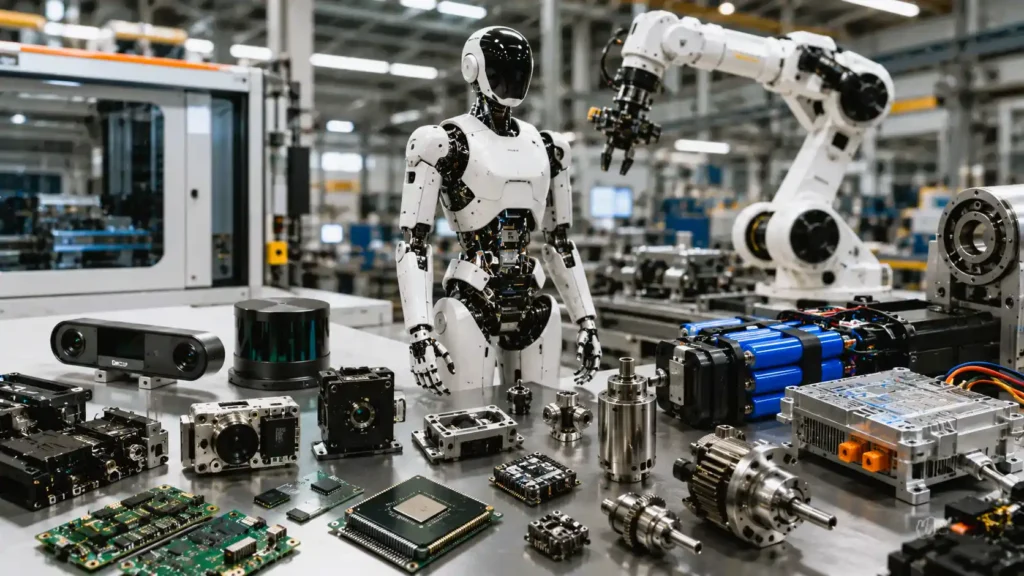
The history of transformative technologies is full of companies that attracted the public’s attention while less visible suppliers captured value from the expansion around them. Railroads created demand for steel and locomotives; computing created enormous markets for semiconductors and networking equipment. Robotics may follow a similar pattern. The robotics supply chain could ultimately matter as much to investors as the machines themselves.
That distinction becomes increasingly important as robotics moves from specialized industrial automation toward AI-powered machines capable of operating across a wider range of environments. The investment opportunity may therefore extend from robotics suppliers and components to semiconductors, sensors, actuators, batteries, software, manufacturing equipment and AI infrastructure. For investors, the question is not simply which robot maker wins, but which companies become economically indispensable as the ecosystem expands.
Why the Robot Maker Is Only One Part of the Investment Story
A finished robot is the visible endpoint of a much larger industrial system.
Behind a robotic arm or humanoid machine sits a chain that can include processors, memory, cameras, force sensors, motors, gearboxes, batteries, power electronics, precision bearings, software and manufacturing systems. As robots become more sophisticated, that chain becomes even more complex because physical machines increasingly depend on artificial intelligence to perceive their surroundings, make decisions and execute movements.
The broader structure can be viewed as:
AI Compute → Semiconductors → Sensors → Actuators → Motors → Batteries → Mechanical Components → Software → Integration → Robots → Deployment
That creates an important distinction for robotics investment. A robot manufacturer competes directly for customers and market share. A critical supplier, by contrast, may sell components or infrastructure to several competing platforms.
That does not guarantee superior returns. Suppliers can face intense competition, customer concentration, falling component prices or rapid technological substitution. A strategically important component can therefore be a poor investment if its manufacturer lacks pricing power or earns weak margins.
Still, the distinction is important. IFR recorded 542,000 industrial robot installations globally in 2024, more than double the number a decade earlier, while Asia accounted for 74% of new installations. The underlying automation ecosystem is already substantial before the potential expansion of humanoid robots and physical-AI systems.
Investor takeaway: The strongest robotics opportunities may not necessarily sit with the most recognizable robot brands. Investors should examine who supplies multiple platforms, controls scarce technology or possesses meaningful switching costs.
The Semiconductor Layer: Intelligence Requires Compute
Robots increasingly resemble mobile computing systems with mechanical bodies.
Their ability to interpret visual information, process sensor data, plan movements and execute increasingly complex tasks depends on processors, memory, connectivity and AI accelerators. The basic sequence is:
Compute → Perception → Decision-Making → Control
This makes robotics semiconductors an important layer of the investment thesis.
Industrial robots historically relied heavily on deterministic control systems. Physical AI introduces a more computationally intensive architecture in which machine-learning models can contribute to perception and decision-making. That creates potential demand for both centralized and edge computing.
The economics, however, depend on how much compute a robot actually requires. If increasingly capable models can operate efficiently on smaller or specialized processors, demand may shift toward more efficient edge hardware rather than simply producing a linear increase in expensive compute requirements.
For investors, this creates a more nuanced semiconductor opportunity. The relevant question is not simply whether AI grows, but which computing architectures become necessary for machines operating continuously in physical environments.
Investor takeaway: Robotics could broaden the addressable market for AI chips, but investors must distinguish genuine robotics exposure from companies benefiting only indirectly from the broader AI cycle.
Sensors: Giving Machines Physical Awareness
Intelligence without perception has limited value in the physical world.
Robots operating inside controlled factories can rely on highly structured environments. Machines working alongside humans, navigating warehouses or handling irregular objects face a far harder problem. They need cameras, depth sensors, LiDAR, radar, inertial measurement systems, force sensors and increasingly sophisticated tactile technologies.
The transition toward physical AI could therefore increase the economic importance of perception.
As robots encounter less predictable environments, sensing becomes a bottleneck between software intelligence and physical action. A machine may have a powerful model, but poor perception can still produce unreliable behavior.
The robotics supply chain consequently includes a growing collection of sensing technologies rather than a single universal sensor.
| Robotics Supply-Chain Layer | Why It Matters | Potential Investment Driver |
|---|---|---|
| AI compute | Processes perception and decision-making | Growing machine intelligence requirements |
| Sensors | Provide environmental and physical information | Greater deployment in unstructured environments |
| Actuators and motors | Convert decisions into physical movement | More sophisticated manipulation |
| Batteries and power systems | Determine operating time and mobility | Higher robot utilization |
| Precision components | Enable reliable mechanical movement | Increasing performance requirements |
| Software and AI | Coordinates perception, planning and control | Greater autonomy and flexibility |
The critical issue is differentiation. Sensor categories can become commoditized when competing suppliers offer sufficiently similar performance. Conversely, a component with superior accuracy, reliability or integration can retain greater pricing power.
Investor takeaway: Sensor demand may expand with robotics deployment, but the opportunity depends on technological differentiation, manufacturing scale and the ability to avoid commoditization.
Actuators, Motors and Precision Components
Software may decide what a robot should do, but actuators determine whether it can actually do it.
Motors, gearboxes, actuators, bearings and precision mechanical components form the physical foundation of robotic movement. For humanoid systems, the challenge becomes even greater because machines must coordinate multiple joints while managing weight, heat, energy consumption and durability.
McKinsey‘s recent analysis of humanoid supply chains illustrates the importance of this hardware layer: actuators represent a particularly large portion of the estimated bill of materials, while sensing, compute, structural components and batteries account for much of the remainder. These figures are estimates rather than universal industry standards, but they illustrate how much economic value can sit below the visible robot itself.
This creates a potentially attractive feature for component suppliers: one successful technology can sometimes be incorporated into multiple robot architectures.
Yet precision manufacturing also requires capital, engineering expertise and quality control. A supplier cannot automatically convert technical importance into superior economics.
Investor takeaway: Actuators and precision components could become important bottlenecks, but investors should examine margins, customer concentration, production capacity and technological durability before treating a component as an attractive investment.
Batteries and Power Systems
Mobility introduces an economic constraint that stationary industrial automation largely avoids: energy.
A mobile robot needs enough energy density to operate productively without spending excessive time charging. Battery cycles, thermal management, power electronics and charging infrastructure therefore influence more than hardware design. They influence robot utilization.
A robot that spends significant time charging may have less productive capacity than its headline specifications suggest. Improvements in battery technology, power efficiency or charging systems could consequently increase the economic value of the entire robot.
The same principle applies to thermal management. More powerful processors and actuators generate heat, creating another engineering trade-off between performance, energy consumption, reliability and operating time.
Investor takeaway: Batteries are not simply an energy-storage story. In robotics, power efficiency can directly influence utilization and therefore the economics of deployment.
Software and AI Infrastructure
The robotics supply chain is increasingly digital as well as physical.
Foundation models, computer vision, simulation, reinforcement learning, synthetic data, edge AI and cloud infrastructure can all contribute to robot development. Simulation can reduce the need to learn every behavior directly in the physical world, while AI models can potentially reduce programming requirements for certain tasks.
Software also changes the economics of the industry because improvements can potentially be distributed across an installed fleet rather than manufactured into every new machine.
McKinsey has highlighted how software, simulation and improved networking have reduced engineering complexity and made robotic systems easier to integrate and maintain.
This creates a second investment layer: companies supplying the intelligence infrastructure around robots may capture value even when they do not manufacture the machines.
Investor takeaway: Robotics investment increasingly requires analyzing the convergence of industrial automation and AI infrastructure rather than treating hardware and software as separate markets.
Manufacturing Capacity Could Become a Strategic Asset
Technology only becomes economically valuable when it can be manufactured at scale.
Mass robotics adoption requires precision manufacturing, automated assembly, semiconductor fabrication, component production, testing and calibration. Production capacity can become a competitive advantage when demand rises faster than suppliers can expand.
The same dynamic can create vulnerability. Concentrated production of critical components can expose the industry to geopolitical restrictions, trade disruptions or shortages.
The geographical concentration of robotics itself highlights the issue. Asia accounted for nearly three-quarters of global industrial robot installations in 2024, according to IFR. China alone represented 54% of deployments.
As governments increasingly treat semiconductors, batteries, advanced machinery and automation capabilities as strategic assets, industrial policy could influence the economics of the robotics ecosystem.
Investor takeaway: Manufacturing capacity may become an investment advantage in its own right, particularly where production expertise, supply security and technological know-how create barriers to entry.
Where Investors May Find the Bottlenecks
The most interesting part of the supply chain may be where three characteristics intersect:
High Demand + Limited Supply + High Switching Costs
That combination can create pricing power.
However, bottlenecks rarely remain permanent. Attractive economics invite new capacity, new competitors and technological alternatives. The cycle can therefore move from:
Demand Surge → Capacity Constraint → Pricing Power
to:
New Capacity → Competition → Lower Prices → Margin Compression
This is why the robotics supply chain should be analyzed dynamically rather than as a static list of components.
| Component or Infrastructure | Potential Advantage | Key Investment Risk |
|---|---|---|
| AI chips | Rising computational requirements | Rapid technological change |
| Sensors | Growing perception requirements | Commoditization |
| Actuators | Critical to physical movement | Customer concentration |
| Batteries | Higher utilization and mobility | Commodity exposure |
| Precision machinery | Manufacturing complexity | Capital intensity |
| Industrial software | Recurring digital value | Platform competition |
| Robotics factories | Scaling production capacity | Overcapacity |
| Power electronics | Energy-efficiency improvements | Technology substitution |
For investors, the central question becomes whether a bottleneck is structural or temporary.
A supplier with proprietary technology, high switching costs and scarce manufacturing capacity may have stronger economics than one benefiting merely from short-term shortages.
Investor takeaway: Bottleneck investing requires discipline. Scarcity can create pricing power, but temporary shortages can disappear faster than investors expect.
The Risks Behind the Robotics Supply Chain
The most obvious risk is customer concentration.
A supplier may appear strategically important while depending heavily on a handful of robotics manufacturers. If one platform loses market share, the supplier can suffer even when overall robotics adoption remains strong.
Commoditization presents another threat. Components that command premium prices during an early technology cycle can become standardized once multiple manufacturers achieve comparable performance.
There is also geopolitical risk. Robotics depends on a network of semiconductors, precision machinery, batteries and advanced components produced across multiple jurisdictions. Trade restrictions or disruptions can therefore affect both supply and cost.
Technological obsolescence may prove even more important. A company can dominate one generation of robotics hardware only to discover that a new architecture makes its component less necessary.
Finally, valuation matters. A company can have excellent robotics exposure and still represent a poor investment if expectations already price in years of aggressive growth.
Investor takeaway: Strategic importance and investment attractiveness are not the same thing. The best analysis combines technological relevance with valuation, margins, competitive positioning and capital requirements.
The Strategic Importance of Robotics Infrastructure
The broader robotics ecosystem is increasingly connected to industrial policy.
Governments and corporations have strategic reasons to secure access to AI chips, semiconductor manufacturing, batteries, precision machinery and robotics production. Reshoring and supply-chain resilience can therefore become part of the investment story alongside commercial demand.
That creates opportunities for companies building manufacturing capacity or supplying critical infrastructure. It can also create distortions. Subsidies, trade restrictions and national-security policies can change competitive economics independently of underlying demand.
For investors, the long-term question is whether robotics infrastructure becomes treated more like strategic industrial capacity than ordinary technology hardware.
Investor takeaway: Capital may increasingly flow toward the infrastructure required to make robotics scalable and resilient, but policy-driven investment carries its own regulatory and geopolitical risks.
Unique Insight: Look for the Companies Beneath the Robot
The deeper robotics investment question may not be:
“Which robot company wins?”
It may be:
“Which suppliers become unavoidable as the entire robotics industry scales?”
That distinction matters.
If multiple competing robot platforms require sophisticated compute, sensing, actuation, batteries or precision components, a successful supplier could potentially participate in industry-wide growth without correctly predicting which robot manufacturer ultimately dominates.
That is the strategic attraction of looking one or two layers below the finished machine.
But investors must separate:
Critical Component
from
Profitable Investment
A supplier can control an essential technology while facing low margins, aggressive customers, heavy capital expenditure or rapid technological substitution.
The best opportunities may therefore emerge where technological importance, pricing power, switching costs and financial discipline converge.
The central lesson of the robotics supply chain is that technological bottlenecks can matter more than technological headlines. The companies receiving the most attention may not necessarily capture the greatest economic value.
Conclusion
The robotics investment opportunity extends well beyond finished robots.
Compute matters. Sensors matter. Actuators matter. Power matters. Software matters. Manufacturing matters. Supply-chain positioning matters.
As industrial automation expands and physical AI moves toward more capable machines, the economic value created by robotics will spread across a complex network of suppliers and infrastructure providers. IFR’s data already shows the scale of the underlying industrial automation market, with more than half a million industrial robots installed globally in 2024.
The challenge for investors is therefore not simply identifying whether robotics adoption grows. It is determining which companies possess the technology, capacity, pricing power or strategic position to capture the economic value created by that growth.
The most compelling opportunities may ultimately sit beneath the robot itself—but only where technological importance translates into durable economics.
Frequently Asked Questions
What is the robotics supply chain?
The robotics supply chain encompasses the technologies and infrastructure required to build and operate robots, including semiconductors, sensors, actuators, motors, batteries, precision components, software, AI systems and manufacturing equipment.
Why should investors look beyond robot manufacturers?
Robot manufacturers compete for market share, while component suppliers may sell to several competing platforms. That can provide broader exposure to industry growth, although supplier economics depend on pricing power, margins and customer concentration.
Which components are most important to robotics?
AI chips, sensors, actuators, motors, batteries, precision components and software are among the most important layers. Their relative importance varies according to the robot’s design and application.
Why are semiconductors important to robotics?
Semiconductors provide the computing, memory, connectivity and control capabilities required for increasingly intelligent robots. Physical AI can increase the importance of both central and edge computing.
What role do sensors play in robotics?
Sensors allow machines to perceive their surroundings and physical interactions. Cameras, depth sensors, LiDAR, force sensors and tactile systems become particularly important when robots operate outside tightly controlled environments.
Why are actuators important for humanoid robots?
Actuators convert software decisions into physical movement. Their performance affects strength, speed, precision, energy consumption and reliability.
How do batteries affect robotics economics?
Battery capacity and efficiency influence operating time, charging requirements and utilization. For mobile robots, better power systems can increase productive operating hours.
What is physical AI?
Physical AI refers to AI systems designed to perceive, reason about and act within the physical world. Robotics is one of its most important applications.
Which robotics suppliers could benefit from industry growth?
Potential beneficiaries could include suppliers of AI compute, sensors, actuators, batteries, precision components, industrial software and manufacturing infrastructure. However, exposure alone does not guarantee attractive investment returns.
What are the biggest risks in robotics supply-chain investing?
Key risks include commoditization, customer concentration, technological obsolescence, geopolitical disruption, capital intensity, overcapacity and excessive valuations.
Could robotics suppliers outperform robot manufacturers?
They could benefit from selling into multiple platforms, but there is no automatic advantage. A supplier can have strong industry exposure while still facing weak margins or intense competitive pressure.
How does geopolitics affect the robotics supply chain?
Robotics depends on globally distributed semiconductor, battery, precision-manufacturing and component networks. Trade restrictions, export controls and efforts to reshore strategic manufacturing can therefore alter costs and competitive positions.

Administrator at Alt Finances, leading editorial strategy and contributing in-depth coverage of investing, wealth management, alternative assets, and global financial markets. Through research-driven articles and analysis, he helps readers understand the ideas, industries, and market forces shaping modern finance.