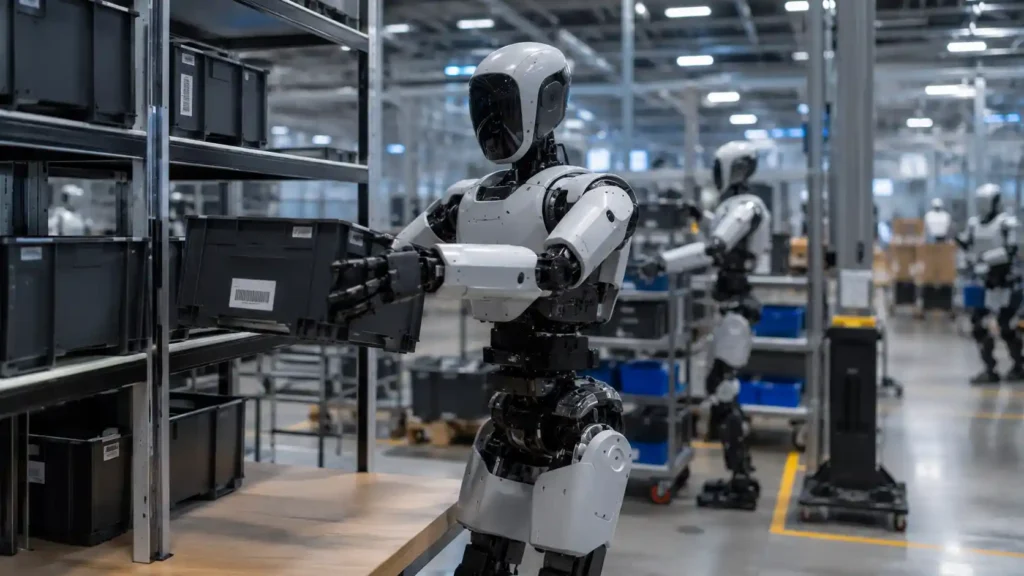
The economics of automation ultimately come down to a simple question: what does it cost to produce useful work? That question is becoming more consequential as advances in artificial intelligence give machines a broader range of physical capabilities. The emerging field of humanoid robots economics is therefore less about whether machines can walk like people and more about whether they can generate enough productive output to justify their total cost.
That distinction matters for humanoid robot profitability. A machine may be technically impressive yet economically unattractive if it requires expensive hardware, frequent maintenance, human supervision or long periods of downtime. Conversely, a sufficiently reliable general-purpose robot could become valuable precisely because it can operate in environments already designed for people. The International Federation of Robotics notes that humanoids are being developed around this potential advantage, while McKinsey identifies safety, uptime, dexterity and cost as the critical barriers to commercial scale.
The investment question, then, is not whether humanoids will exist. It is whether robotics productivity can rise faster than the cost of deploying the machines.
The Economic Case for General-Purpose Robots
Traditional industrial automation succeeds by doing a limited number of tasks extremely well. A robotic arm can weld, paint or assemble components at high speed because the factory is designed around its capabilities.
Humanoids propose a different model. Instead of redesigning the workplace around the robot, the robot is designed around the workplace.
That flexibility could matter enormously in brownfield factories, warehouses and logistics facilities where changing infrastructure is expensive. A humanoid capable of moving through existing aisles, manipulating familiar tools and performing several related tasks could reduce the need for extensive facility redesign.
However, flexibility is not automatically an economic advantage. General-purpose machines also require more sophisticated perception, mobility, control systems and AI. A specialized robot may remain cheaper and faster for a highly repetitive task.
That creates an important investment distinction: humanoids do not need to replace every industrial robot to succeed. They need to become economically superior where flexibility itself has value.
For investors, this means the addressable market should not be measured simply by the number of jobs humans perform. It should be measured by the number of workflows where general-purpose capability can produce a competitive return on capital.
The Real Cost of a Humanoid Robot
The sticker price of a robot is only the beginning of the calculation. The real economic comparison includes the entire cost of ownership.
McKinsey estimates that current prototype costs can range from roughly $150,000 to $500,000 per unit, while its analysis identifies actuation as the largest component of the bill of materials. It argues that substantial cost reductions will be necessary for humanoids to compete with human labor across mainstream sectors.
Goldman Sachs has separately estimated that manufacturing costs have already fallen materially and projected a potential humanoid robotics market of $38 billion by 2035. Such estimates should be treated as forecasts rather than evidence of guaranteed commercial adoption.
| Economic Variable | Why It Matters for Humanoid Robots | Profitability Impact |
|---|---|---|
| Hardware | Determines initial capital expenditure | Lower cost improves potential ROI |
| AI compute | Supports perception, planning and control | Higher costs can reduce margins |
| Batteries | Determines operating duration | Limited runtime reduces utilization |
| Maintenance | Covers mechanical and software failures | High downtime increases total cost |
| Human supervision | May remain necessary during deployment | Raises effective labor cost |
| Depreciation | Spreads hardware cost across useful life | Longer useful life improves economics |
| Insurance & safety | Determines liability and operating requirements | Can materially affect deployment costs |
| Financing | Determines how customers fund adoption | RaaS can lower upfront barriers |
The crucial point is that humanoid robots economics cannot be reduced to purchase price. A cheaper machine that fails frequently may have worse economics than a more expensive machine that operates reliably for thousands of hours.
Investors should therefore watch manufacturing yields, component costs, service revenue, uptime and customer payback periods not just headline robot prices.
Labor Economics: What Is a Robot Actually Replacing?
The relevant comparison is not simply:
Robot price vs. annual human salary.
Companies pay workers through wages, benefits, overtime and training. They also absorb recruitment costs, turnover, absenteeism and workplace-injury expenses. At the same time, workers bring flexibility that machines may struggle to replicate.
A humanoid robot could potentially operate for longer periods and perform standardized tasks consistently. Yet that advantage disappears if charging, software failures, maintenance or human intervention interrupt production.
The economic equation therefore becomes:
Total Cost of Ownership ÷ Productive Output
rather than:
Purchase Price ÷ Human Salary
This distinction explains why high-wage economies may become attractive early markets. Where labor costs are high and companies face persistent shortages, the economic threshold for automation can be easier to reach.
At the same time, specialized automation may remain the better investment where workflows are predictable and machines can perform individual tasks faster and more reliably.
For investors, the strongest opportunities may therefore emerge not where robots can technically work, but where labor economics and operational conditions make automation financially compelling.
Utilization May Determine Profitability
A robot operating eight hours a day has a very different economic profile from one that produces useful work across multiple shifts.
Utilization determines how quickly the initial capital investment is converted into productive output. That makes uptime one of the most important variables in humanoid robots economics.
McKinsey reports that many current humanoids operate for only two to four hours per charge, compared with typical eight-to-12-hour workplace shifts. Battery limitations therefore remain directly connected to commercial economics.
Charging infrastructure, battery swapping, maintenance, software failures and safety interruptions can all reduce productive hours.
The challenge becomes even greater in unpredictable environments. A warehouse may offer repeatable routes and tasks; a hospital or construction site introduces far greater variability.
Consequently, the first commercially successful deployments are likely to favor environments where robots can achieve high utilization without requiring human-level dexterity.
Where Humanoid Robots Could Become Profitable First
Early deployments already point toward manufacturing and logistics. McKinsey highlights automotive material movement, warehouse tote handling and industrial inspection as examples of relatively structured applications.
| Deployment Environment | Potential Advantage | Primary Economic Challenge |
|---|---|---|
| Manufacturing | Existing human-designed workflows | Safety and integration |
| Automotive | Repetitive material handling | Reliability |
| Warehousing | Repetitive movement and picking | Uptime and navigation |
| Logistics | Labor substitution in structured tasks | Utilization |
| Hazardous industry | Keeps people away from dangerous environments | Certification and maintenance |
| Construction | Access to human-designed sites | Highly variable conditions |
| Healthcare | Physical assistance and logistics | Safety and regulation |
| Retail | Stocking and repetitive movement | Low margins and task variability |
| Hospitality | Flexible physical assistance | High interaction requirements |
The most attractive early markets share several characteristics:
high labor costs + repetitive tasks + labor shortages + predictable workflows + high utilization.
That combination matters more than the novelty of the application itself.
The IFR’s broader robotics data reinforces this economic context: 542,000 industrial robots were installed globally in 2024, more than twice the level of a decade earlier. The established robotics industry demonstrates that automation adoption follows measurable productivity economics rather than technological excitement alone.
The Role of AI and Physical Intelligence
Artificial intelligence could change the economics by increasing the number of tasks one machine can perform.
Traditional robots often require extensive task-specific programming. Physical AI aims to allow robots to interpret environments, learn from demonstrations and adapt their behavior.
That creates a potential feedback loop:
More Deployments → More Data → Better Models → Greater Reliability → Higher Utilization → Better ROI
Yet the reverse is equally possible:
High Cost → Low Utilization → Weak ROI → Slow Adoption → Less Data → Slow Improvement
McKinsey identifies the need for richer embodied datasets, improved sensorimotor learning and better dexterity as major remaining challenges.
The economic significance is considerable. If AI allows one robot to perform ten economically useful tasks instead of one, the value of the hardware can rise without requiring proportional increases in physical complexity.
That is where physical AI could become more important than the robot itself.
Robot-as-a-Service and the Financing Question
Financing could become another major variable.
Under a conventional capital-expenditure model, a customer buys the machine and assumes the risks associated with depreciation, maintenance and technological obsolescence.
A robot-as-a-service model shifts more of that burden toward the provider. The customer pays recurring fees, potentially aligning costs more closely with actual usage.
This model could accelerate adoption among companies unwilling to make large upfront investments in immature technology. However, it also changes the economics for robotics providers. They must finance hardware, maintain fleets and absorb downtime while still earning attractive margins.
The success of RaaS will therefore depend on whether providers can predict utilization and maintenance costs accurately enough to price contracts profitably.
For investors, financing models may ultimately prove as important as hardware breakthroughs because they determine who carries technology and utilization risk.
The Investment Opportunity Across the Robotics Ecosystem
The robotics investment opportunity extends beyond humanoid manufacturers.
A scalable industry would require actuators, sensors, batteries, semiconductors, AI compute, industrial software, AI infrastructure, manufacturing capacity and maintenance networks.
That creates several potential value pools. However, higher robotics adoption does not automatically translate into higher returns for every supplier.
Component manufacturers could face commoditization. Robot makers could face intense competition. Software companies could benefit from recurring revenue but remain dependent on hardware adoption.
Investors therefore need to distinguish between technology exposure and economic value capture.
The companies most likely to sustain attractive economics may be those that control scarce components, proprietary software, critical data or customer relationships rather than simply assembling increasingly standardized machines.
Unique Insight: From Robotics Demonstration to Robotics Business
The most important question in humanoid robots economics is not:
“How capable is the robot?”
It is:
“How many dollars of economically useful work can the robot produce per dollar of total ownership cost?”
That distinction separates robotics demonstrations from robotics businesses.
The deeper thesis is:
Humanoid Robots Become an Economic Technology Only When Intelligence, Hardware and Utilization Converge
Three curves need to move in the right direction simultaneously:
Falling Robot Costs
Rising Machine Capability
Increasing Productive Utilization
If those curves converge, humanoids could become a genuine labor-capital substitute.
If hardware becomes cheap but reliability remains poor, the economics fail. If AI becomes powerful but robots cannot operate safely around people, deployment remains limited. If robots work well but spend too much time charging or waiting for tasks, capital productivity remains weak.
That is why investors should focus less on spectacular demonstrations and more on measurable commercial indicators: uptime, repeat orders, customer payback, maintenance costs, manufacturing scale and the conversion of pilots into recurring revenue.
Conclusion
The future of humanoid robotics will ultimately be determined by economics rather than spectacle.
Cost matters. Productivity matters. Reliability matters. Utilization matters. Labor economics matter. Scale matters.
The industry already has evidence that robotics can generate substantial industrial value. The IFR’s global installation data shows how deeply automation has entered manufacturing, while current humanoid developments suggest the next phase could involve machines capable of operating across multiple workflows.
But humanoids face a higher economic hurdle than a conventional robot because they promise greater flexibility while carrying greater technical complexity.
The central question is therefore not whether humanoid robots can perform human-like tasks.
It is whether they can perform enough valuable work, reliably enough, at a cost that makes deployment economically rational.
That is the real test of humanoid robots economics and ultimately the foundation on which the next major robotics investment cycle will be built.
Frequently Asked Questions
What are the economics of humanoid robots?
Humanoid robot economics examine whether the productive value generated by a machine can exceed its total ownership and operating costs, including hardware, energy, maintenance, software, supervision and financing.
Can humanoid robots become profitable?
Potentially, but profitability depends on cost reduction, reliability, utilization, productivity and the economics of the tasks being automated. Demonstrations alone do not establish commercial profitability.
Why could humanoid robots be more valuable than specialized robots?
Their potential advantage is flexibility. A humanoid could perform multiple tasks in environments already designed for people, reducing the need for expensive facility redesign.
What industries are most likely to adopt humanoid robots?
Manufacturing, automotive, warehousing, logistics and hazardous industrial environments appear better positioned for early adoption because they can offer structured workflows and potentially high utilization.
How do humanoid robots compare with human labor costs?
The comparison should include the full cost of human employment and the robot’s total cost of ownership. Wages alone do not provide an adequate basis for calculating ROI.
What is robot-as-a-service?
Robot-as-a-service allows businesses to access robotic systems through recurring payments rather than purchasing the machines outright. It can reduce upfront capital requirements while shifting more operational risk to the provider.
How does AI improve humanoid robot economics?
AI can allow robots to perform a broader range of tasks and adapt to changing environments. Better models could increase utilization and productivity, potentially improving the economics of each deployed machine.
What are the biggest risks to humanoid robot profitability?
The largest risks include high hardware costs, poor uptime, safety requirements, maintenance expenses, limited dexterity, expensive AI compute, low utilization and slower-than-expected customer adoption.
Could humanoid robots replace human workers?
They could automate some tasks currently performed by people, particularly repetitive or physically demanding work. However, the more likely near-term outcome is a combination of labor substitution and human-machine collaboration rather than wholesale replacement.
What companies are developing humanoid robots?
The field includes companies across the United States, China and Europe, with different approaches to hardware, AI and manufacturing. Investors should distinguish prototypes, pilots, commercial deployments and scaled production rather than treating all announced projects as equivalent. McKinsey estimates that only a small portion of the companies pursuing humanoids have reached scaled pilots or precommercial deployment.
Why is utilization important for humanoid robot profitability?
A robot generates economic value only while it performs useful work. Higher uptime spreads the capital cost across more productive hours, making utilization one of the central variables in determining humanoid robot profitability.

Administrator at Alt Finances, leading editorial strategy and contributing in-depth coverage of investing, wealth management, alternative assets, and global financial markets. Through research-driven articles and analysis, he helps readers understand the ideas, industries, and market forces shaping modern finance.