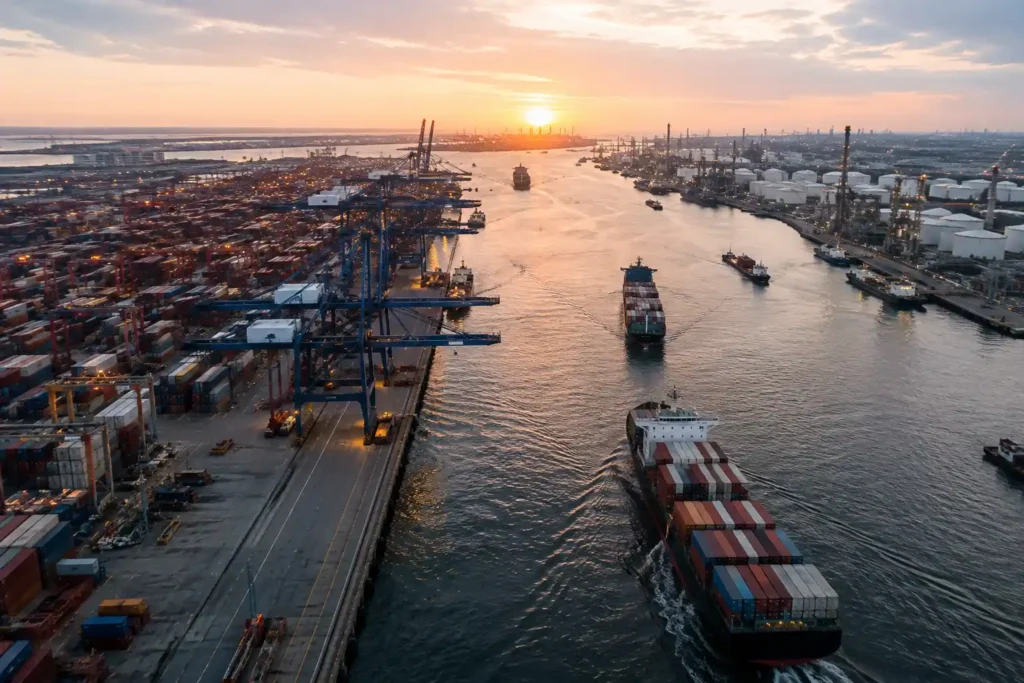
For investors, geography is becoming an increasingly important variable in deciding where capital should go. The location of a factory, energy source, mineral deposit, data center or logistics hub can now influence an asset’s strategic value almost as much as its financial characteristics. Global trade fragmentation is accelerating this shift, as governments and companies place greater weight on national security, supply-chain resilience and geopolitical alignment.
The result is not necessarily a retreat from international commerce. Recent OECD evidence shows that global value chains remained highly globalized in 2024, with trade linked to global value chains equivalent to around 17% of global GDP. Instead, companies are reorganizing how they participate in those networks, diversifying suppliers and relocating selected activities while maintaining international production and investment links.
For investors, that distinction matters. Capital is increasingly following resilience: new manufacturing capacity, alternative trade corridors, energy infrastructure, critical minerals, logistics networks and strategically positioned emerging markets. The investment question is therefore shifting from simply identifying the cheapest production base to understanding which locations can remain commercially viable when trade becomes more politically contested.
Why Global Trade Fragmentation Is Changing Capital Allocation
For decades, global supply chains were largely designed around efficiency. Companies could source components wherever costs were lowest, consolidate production in specialized locations and move goods through established trade routes. That model produced enormous efficiency, but it also created concentrated dependencies.
Tariffs, export controls, sanctions, investment restrictions and industrial-policy measures have changed the calculation. A company may now accept higher production costs if doing so reduces exposure to a single supplier, country or trade corridor. The premium for resilience can therefore translate directly into capital expenditure.
This is particularly visible in strategic industries. Semiconductor manufacturing, AI infrastructure, energy systems and critical minerals have become closely connected to national-security policy. Governments increasingly use subsidies, tax incentives, infrastructure spending and strategic partnerships to attract investment into these sectors.
That creates an unusual investment environment. Government policy is no longer simply shaping the operating environment around companies; in many strategic industries, it is actively influencing where companies build capacity.
The implications extend beyond public equities. Private equity, infrastructure funds, sovereign wealth funds and family offices increasingly have to evaluate geopolitical concentration alongside traditional measures such as valuation, cash flow and return on invested capital.
For investors, the central issue is not whether globalization disappears. It is whether the economics of globalization are being repriced.
The New Geography of Global Supply Chains
Supply-chain diversification is becoming one of the most important mechanisms through which capital is being redirected. Reshoring brings production closer to a company’s home market. Nearshoring moves production to geographically closer countries. Friendshoring places greater emphasis on political and strategic relationships.
None of these strategies necessarily means abandoning global value chains. The latest OECD research instead points to an evolution in which companies are adjusting physical supply chains while remaining deeply integrated through services, foreign investment and international production.
That creates opportunities for countries capable of becoming connector economies locations that link major markets through manufacturing, logistics, services or trade corridors. The IMF has identified evidence that some Asian economies have benefited from shifts in production and foreign direct investment associated with changing US-China trade patterns, although the gains and their durability vary considerably by country.
The investment consequences can be substantial. A new factory requires industrial land, power generation, transmission infrastructure, roads, ports, warehouses, telecommunications and financial services. Consequently, a single manufacturing relocation can create a much broader ecosystem of investment demand.
| Investment Theme | Primary Growth Driver | Key Risk |
|---|---|---|
| Semiconductors | Strategic manufacturing and technology security | Export controls and technological restrictions |
| AI infrastructure | Rising computing and data-center demand | Power constraints and high capital intensity |
| Energy | Security of supply and electrification | Commodity volatility and regulation |
| Critical minerals | Strategic resource competition | Price volatility and supply concentration |
| Manufacturing | Reshoring, nearshoring and diversification | Higher labor and production costs |
| Logistics | New trade routes and supply-chain redundancy | Weak utilization or geopolitical disruption |
| Infrastructure | Industrial relocation and new trade corridors | Large upfront capital requirements |
| Emerging markets | FDI and manufacturing relocation | Currency, political and policy risk |
The trade-off is important. Redundancy is expensive. Building a second supplier, alternative port route or additional production facility may reduce operational risk, but it can also lower asset utilization and increase working-capital requirements.
That means investors should distinguish between strategic resilience that creates durable economic value and duplication that simply adds costs.
The Investment Opportunities and Risks
The clearest opportunities are emerging around infrastructure that supports a more geographically diversified production system.
Manufacturing relocation can increase demand for industrial parks, power systems, transportation infrastructure and logistics facilities. Energy investment can benefit from governments seeking greater control over electricity and fuel supplies. Critical minerals can attract capital because batteries, semiconductors, defense technologies and renewable-energy systems depend on secure access to strategically important resources.
Logistics may become equally important. If companies diversify suppliers, trade corridors must become more flexible. Ports, railways, roads, warehouses and shipping services can therefore gain strategic relevance even when the underlying trade route is not the lowest-cost option.
Yet the investment case is not automatically positive. Higher production costs can pressure corporate margins. Duplicated infrastructure can reduce efficiency. Currency volatility can erode returns in emerging markets. Trade restrictions can strand assets built around a particular export market, while geopolitical escalation can abruptly alter the economics of an otherwise attractive project.
OECD modelling illustrates the broader tension: aggressive relocalization of supply chains could significantly reduce global trade and economic output, while not necessarily improving resilience. The implication is that diversification can be valuable, but isolation is not the same thing as resilience.
For investors, the most attractive assets may therefore be those that provide flexibility rather than simply localization.
Emerging Markets and the New Capital Map
Emerging markets are becoming important beneficiaries of supply-chain diversification, but the opportunity is highly selective.
Countries that combine competitive labor costs, improving infrastructure, access to major markets, political relationships and reliable energy can attract manufacturing investment as companies seek alternatives to concentrated production bases.
Southeast Asia is one example of this broader shift. India has also positioned itself to attract manufacturing and strategic investment. Mexico benefits from proximity to North American markets, while parts of the Middle East can leverage energy resources, logistics infrastructure and their position between major trade routes.
The Middle East deserves particular attention because infrastructure, energy and logistics can intersect with the changing architecture of global trade. Countries that invest in ports, industrial zones, transport corridors and energy systems can potentially capture investment not simply by offering low costs, but by offering strategic connectivity.
Africa presents a different opportunity. Its resource base, growing consumer markets and potential role in critical mineral supply chains could attract capital, but infrastructure gaps, financing constraints and political risk remain significant barriers.
UNCTAD’s latest investment data also highlights the uneven nature of the opportunity. Global foreign direct investment fell sharply in 2024, while investment prospects were weakened by trade tensions, geopolitical fragmentation and economic uncertainty. Developing economies continue to receive investment unevenly, with flows concentrated in a relatively small number of markets.
The lesson for investors is straightforward: being an emerging market is not itself an investment thesis. Strategic positioning must be supported by infrastructure, policy credibility and access to markets.
Comparing Regional Investment Shifts
The new capital map is unlikely to produce a single winner. Different regions offer different combinations of manufacturing capacity, resources, infrastructure and geopolitical alignment.
| Geographic Shift | Investment Opportunity | Primary Challenge |
| North America | Advanced manufacturing, semiconductors, energy and industrial technology | High costs and capital intensity |
| Latin America | Nearshoring, manufacturing, energy and minerals | Infrastructure and political risk |
| Southeast Asia | Electronics, manufacturing and supply-chain diversification | Competition between regional hubs |
| India | Manufacturing, technology and domestic-market expansion | Infrastructure and execution requirements |
| Middle East | Logistics, energy, industrial zones and trade corridors | Geopolitical exposure |
| Africa | Critical minerals, infrastructure and manufacturing | Financing, governance and infrastructure gaps |
| Central & Eastern Europe | Nearshoring and industrial supply chains | Regional security and energy exposure |
This is why geographic diversification may increasingly mean diversification across economic blocs and strategic alliances, rather than simply holding assets in several countries.
An investor with exposure to a manufacturing company, for example, may need to understand not only where that company operates, but where its critical components originate, which ports it depends on, where its energy comes from and whether its suppliers sit inside the same geopolitical sphere.
The Role of Institutional Investors
Institutional capital has a particularly important role in this transition because the assets required for supply-chain resilience are often long-duration investments.
Pension funds, sovereign wealth funds, insurance companies, infrastructure funds and private-equity firms can finance industrial facilities, logistics networks, energy infrastructure and digital systems that companies may be unwilling or unable to build entirely on their own.
Family offices can also participate through private markets, direct investments and specialist funds targeting infrastructure, energy transition, critical minerals or strategic manufacturing.
However, institutional investors face a more complicated due-diligence process. Traditional geographic diversification may no longer be sufficient. Investors increasingly need to map supply-chain dependencies, trade corridors, regulatory exposure and geopolitical relationships.
This creates a new form of investment analysis: geopolitical supply-chain due diligence.
The strongest assets may be those positioned at critical points in the global network ports connecting major markets, power infrastructure supporting industrial clusters, mineral projects with diversified customers, or technology infrastructure that remains commercially valuable across multiple geopolitical scenarios.
The Long-Term Economic Impact
The long-term consequence of global trade fragmentation may be a world economy that is somewhat less efficient but more resilient.
That trade-off has economic costs. More factories, warehouses, energy systems and transport routes mean more capital expenditure. Higher redundancy can increase prices and reduce productivity. Companies may also carry larger inventories and maintain more suppliers than they would under a purely efficiency-driven model.
Yet resilience itself has economic value. A supply chain that survives a geopolitical shock, export restriction or transport disruption can protect revenue and preserve market share even when competitors face shortages.
The investment opportunity therefore lies partly in financing this transition.
OECD research published in 2026 reinforces the point: global value chains have not disappeared, and imported inputs remain deeply embedded in world production. Instead, companies are changing the structure of their networks, with services and multinational investment becoming increasingly important.
This suggests that the future is unlikely to resemble either complete globalization or complete deglobalization. It will be a more complicated system of interconnected production networks with greater strategic redundancy.
Unique Insight: Globalization Is Being Repriced Rather Than Reversed
The most important investment insight from global trade fragmentation may be that globalization is not simply going backward.
The old model prioritized:
Lowest Cost → Maximum Efficiency
The emerging model increasingly prioritizes:
Resilience → Strategic Control → Supply Security → Geopolitical Alignment
That changes the value of physical and financial assets.
A factory located near a major market can become more valuable because it reduces geopolitical exposure. A port can gain strategic importance because it provides an alternative trade corridor. A power project can become more attractive because it supports domestic industrial capacity. A critical-mineral project can command strategic attention because supply security matters as much as commodity economics.
For institutional investors, this means the traditional investment question What does this asset earn? increasingly needs another question:
What strategic position does this asset occupy?
That question could become one of the defining principles of long-term capital allocation.
Conclusion
The era ahead is unlikely to be defined by the collapse of global trade. Instead, the global trade network is being reorganized around resilience, strategic security and political alignment.
For investors, global trade fragmentation therefore represents less a simple threat to international commerce than a major capital-reallocation theme. Manufacturing capacity, energy systems, critical minerals, logistics infrastructure, technology and emerging-market production hubs are all being reassessed through a geopolitical lens.
The opportunity is significant, but so are the risks. Governments can change policy, trade agreements can shift, currencies can move sharply and infrastructure built for one geopolitical environment can lose value when conditions change.
The most durable investment opportunities may ultimately come from assets that can serve multiple markets, withstand supply disruptions and remain strategically relevant across changing geopolitical relationships.
Globalization may not be disappearing. It is being repriced and the capital required to rebuild it around resilience could become one of the defining investment themes of the next decade.
Frequently Asked Questions
What is global trade fragmentation?
Global trade fragmentation refers to the increasing influence of geopolitical relationships, tariffs, sanctions, industrial policy and national-security priorities on international trade and investment decisions.
Why is global trade becoming more fragmented?
Governments and companies are responding to geopolitical tensions, supply disruptions, strategic competition and concentrated dependencies by diversifying suppliers and production locations.
How does trade fragmentation affect investors?
It can redirect capital toward infrastructure, manufacturing, energy, logistics, critical minerals and strategically positioned emerging markets while increasing geopolitical and operational risks.
Which industries benefit from global trade fragmentation?
Infrastructure, energy, logistics, critical minerals, semiconductor manufacturing, industrial technology and selected manufacturing hubs may benefit from increased investment in resilience.
How does nearshoring create investment opportunities?
Nearshoring can redirect manufacturing investment toward countries closer to major consumer markets, creating demand for factories, industrial infrastructure, logistics and energy.
What is friendshoring?
Friendshoring involves locating production and sourcing within countries considered strategically aligned or politically reliable. For investors, it can alter the geographic distribution of foreign direct investment.
How does trade fragmentation affect emerging markets?
Some emerging markets can attract manufacturing, infrastructure and foreign direct investment as companies diversify supply chains. However, currency, political, infrastructure and policy risks remain significant.
Why are critical minerals becoming more important to investors?
Critical minerals are essential inputs for technologies ranging from semiconductors and batteries to defense and energy systems. Secure access to these resources has therefore become a strategic economic priority.
How does industrial policy influence capital allocation?
Governments can influence investment through subsidies, tax incentives, infrastructure spending, trade policy and strategic regulations, changing the relative attractiveness of different locations and industries.
What are the biggest risks of global trade fragmentation?
Major risks include higher costs, inflation, duplicated infrastructure, supply shortages, currency volatility, trade restrictions, geopolitical escalation and weaker corporate margins.
How can institutional investors manage geopolitical supply-chain risk?
They can diversify across regions and economic blocs, analyze supplier dependencies, assess trade-corridor exposure and prioritize assets with flexible market access and resilient infrastructure.
Why are trade corridors becoming an investment theme?
As companies diversify supply chains, alternative ports, railways, shipping routes and logistics hubs become more valuable. Investment in these networks can support the physical infrastructure required for a more resilient global trading system.

Contributing Writer for Alt Finances with experience in luxury events, travel, fashion, and the arts. Active investor through her family office across real estate, energy, and private equity. University of Miami – BBA.