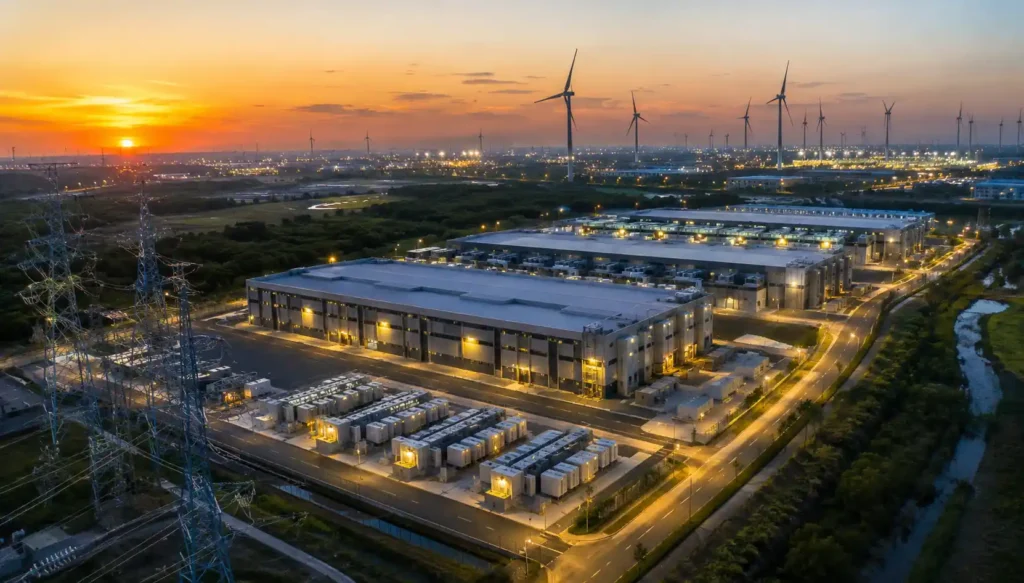
Artificial intelligence is often described as a software revolution, yet the industry’s biggest investment opportunity may lie elsewhere. Behind every AI model, enterprise application, and cloud platform sits a vast network of physical assets from hyperscale data centers and electricity grids to fiber networks and power infrastructure. Today, AI infrastructure investment has emerged as one of the defining long-term capital allocation themes as governments, technology companies, and institutional investors race to build the systems that will power the next generation of computing.
This shift represents a fundamental change in how investors view the AI economy. During the early stages of artificial intelligence adoption, market attention centered on software developers and semiconductor companies. Increasingly, however, sophisticated investors recognize that AI cannot scale without reliable energy, digital infrastructure, and massive computing capacity. That realization helps explain why firms such as BlackRock, Brookfield, and KKR are directing capital toward AI infrastructure, including AI data centers, transmission networks, renewable energy, and other long-duration assets. Rather than competing to build AI models, they are investing in the physical foundations that make artificial intelligence possible, creating a structural investment theme that could extend well beyond today’s technology cycle.
Why AI Infrastructure Has Become an Institutional Investment Theme
Artificial intelligence is transforming far more than enterprise software.
Every new AI application requires enormous computing power, continuous data processing, high-speed connectivity, and reliable electricity. As AI adoption accelerates across industries, demand for the physical infrastructure supporting those workloads is expanding at an equally rapid pace.
This has fundamentally changed the investment landscape.
Instead of viewing artificial intelligence solely through the lens of software innovation, institutional investors increasingly see AI as an infrastructure story.
The reasoning is straightforward.
Large language models, machine learning platforms, enterprise AI systems, and cloud-based applications operate inside massive hyperscale data centers. Those facilities require advanced networking equipment, cooling systems, backup power, land, and enormous quantities of electricity.
Consequently, the growth of AI is creating investment opportunities across multiple sectors simultaneously:
- Data centers
- Power generation
- Electricity transmission
- Renewable energy
- Fiber and digital infrastructure
- Utilities
- Grid modernization
Unlike traditional technology cycles, AI’s expansion depends on assets that often remain productive for decades.
That characteristic naturally attracts investors with long investment horizons.
Private capital, pension funds, sovereign wealth funds, infrastructure managers, and insurance companies increasingly favor assets capable of generating relatively stable cash flows while supporting long-term economic growth.
Research from organizations including the International Energy Agency (IEA), McKinsey & Company, and leading investment institutions continues to highlight the growing relationship between AI adoption and rising electricity demand. While forecasts differ regarding the pace of expansion, the overall direction remains consistent: more AI computing requires significantly greater infrastructure investment.
This trend extends beyond technology companies.
Utilities must strengthen transmission networks.
Energy producers are expanding generation capacity.
Developers continue constructing larger hyperscale campuses.
Digital infrastructure providers invest in fiber connectivity capable of handling increasing data traffic.
Together, these investments represent one of the largest capital expenditure cycles since the rapid global expansion of cloud computing.
Why BlackRock, Brookfield, and KKR Are Investing Big?
Few organizations understand long-duration infrastructure investing better than BlackRock, Brookfield, and KKR.
Although each firm follows its own investment strategy, all three have increasingly emphasized infrastructure assets that stand to benefit from expanding AI computing demand.
Importantly, they are not attempting to become artificial intelligence software companies.
Instead, they are financing the physical systems upon which AI depends.
BlackRock: Digital Infrastructure as a Long-Term Asset Class
BlackRock has consistently identified infrastructure as an important component of institutional portfolios. As demand for AI computing expands, digital infrastructure including data centers, networking assets, and energy-related investments has become increasingly relevant within broader infrastructure strategies.
For institutional investors seeking long-duration assets with structural growth drivers, AI infrastructure aligns naturally with themes such as digital transformation, rising data consumption, and long-term productivity growth.
Brookfield: Combining Energy and Digital Assets
Brookfield’s investment approach highlights another critical reality of the AI economy.
Data centers cannot operate without abundant, reliable electricity.
Consequently, investments in renewable energy, utilities, transmission infrastructure, and digital assets increasingly complement one another.
Rather than viewing energy and technology as separate sectors, Brookfield’s strategy reflects how closely connected they have become in supporting next-generation computing.
KKR: Financing the Infrastructure Behind AI
KKR has also expanded its focus on infrastructure investing, including digital connectivity, communications networks, energy systems, and other essential assets supporting economic growth.
Private equity infrastructure increasingly provides capital for projects requiring substantial upfront investment and long development timelines.
These characteristics align well with institutional investors seeking assets capable of producing value over many years rather than reacting to short-term market cycles.
Although these firms invest across different regions and asset classes, they share one important conclusion.
Artificial intelligence is creating demand not only for better software, but for more electricity, more computing capacity, stronger digital infrastructure, and larger capital commitments.
That is transforming AI infrastructure into an institutional investment theme rather than simply another technology trend.
Before examining the broader opportunities and risks, it helps to understand where investment demand is concentrating across the AI infrastructure ecosystem.
AI Infrastructure Investment Themes
| Infrastructure Asset | Primary Growth Driver | Key Challenge |
|---|---|---|
| Hyperscale Data Centers | Rising AI computing demand | High construction costs and permitting |
| Power Generation | Growing electricity consumption | Fuel availability and regulatory approvals |
| Electricity Grids | Grid modernization and transmission expansion | Aging infrastructure and long development timelines |
| Digital Infrastructure | Cloud connectivity, fiber, and networking | Rapid technology evolution |
The table demonstrates that AI infrastructure investment extends far beyond data centers alone. Every component of the ecosystem supports another. Computing capacity requires reliable electricity, electricity depends on modern transmission networks, and digital infrastructure connects everything together into a functioning AI economy.
Why this matters to investors?
For institutional investors, the opportunity is broader than owning technology companies. Long-term value may increasingly come from financing the physical assets that enable artificial intelligence at scale. Infrastructure ownership can provide diversified exposure to AI-driven economic growth while also presenting risks related to financing, regulation, execution, and technological change.
Opportunities, Risks, and Capital Allocation
The rapid expansion of artificial intelligence is triggering one of the largest infrastructure investment cycles in recent decades. Unlike many technology trends that rely primarily on software development, AI requires enormous amounts of physical capital. Building hyperscale data centers, expanding electricity generation, upgrading transmission networks, and strengthening digital infrastructure demand billions of dollars in long-term investment.
For institutional investors, this creates a distinct capital allocation opportunity.
Infrastructure assets often generate long-duration cash flows, making them attractive to pension funds, insurance companies, sovereign wealth funds, family offices, and infrastructure-focused private equity firms. As AI adoption accelerates, these investors increasingly view digital infrastructure alongside traditional infrastructure sectors such as transportation, utilities, and communications.
However, significant opportunities come with equally significant risks.
Energy availability has become one of the biggest constraints on AI expansion. Many regions already face pressure on electricity grids, while permitting new power generation facilities and transmission lines often takes years. Consequently, infrastructure development may struggle to keep pace with rapidly growing AI computing demand.
Financing costs also matter.
Large infrastructure projects require substantial upfront capital commitments. Higher interest rates can increase financing expenses, affecting project economics and investment returns. Investors must therefore evaluate capital structure, long-term demand, and funding strategies carefully.
Regulation presents another important consideration.
Governments continue developing policies covering energy markets, environmental approvals, cybersecurity standards, and digital infrastructure resilience. Regulatory changes can influence construction timelines, operating costs, and future investment decisions.
Technology evolution introduces additional uncertainty.
Although demand for AI computing appears strong, advances in chip efficiency, cooling technologies, or software optimization could alter future infrastructure requirements. Investors therefore need flexible strategies that account for both technological progress and changing market conditions.
Cybersecurity cannot be overlooked either.
As AI data centers and digital infrastructure become increasingly critical to economic activity, protecting these assets from cyber threats becomes an essential component of infrastructure management.
Why this matters to investors?
Infrastructure investing has always required patience, disciplined capital allocation, and careful risk management. AI infrastructure is no different. The most successful investments will likely combine strong long-term demand with prudent financing, effective execution, resilient operations, and adaptable business models.
Comparing AI Infrastructure Investment Themes
Although AI infrastructure is often discussed as a single investment opportunity, it actually consists of multiple interconnected asset classes with different risk profiles and growth drivers.
Some investors prefer direct exposure to AI data centers, while others focus on power generation, transmission networks, or broader digital infrastructure. Each segment plays a different role in supporting artificial intelligence.
Comparing AI Infrastructure Investment Opportunities
| Investor Focus Area | Investment Opportunity | Primary Risk |
|---|---|---|
| Data Centers | Rising demand for AI computing capacity | High capital intensity and utilization risk |
| Power Generation | Growing electricity demand from AI | Fuel costs, permitting, and environmental regulation |
| Electricity Grids | Grid modernization and transmission expansion | Long approval timelines and infrastructure bottlenecks |
| Digital Infrastructure | Fiber networks, connectivity, and cloud ecosystems | Rapid technological change and competitive pressure |
The comparison highlights an important reality.
No single asset powers the AI economy alone.
Instead, these investments form an integrated ecosystem. Data centers depend on electricity, power plants rely on transmission infrastructure, and cloud computing requires high-capacity digital networks. Weakness in any one area can slow the broader expansion of artificial intelligence.
This interconnected structure also creates opportunities for diversified infrastructure portfolios rather than concentrated investments in a single asset category.
Why this matters to investors?
Investors should evaluate AI infrastructure as a portfolio theme rather than an isolated asset class. Diversifying across energy, digital infrastructure, and computing facilities may help reduce concentration risk while providing exposure to multiple drivers of long-term AI adoption.
The Future of AI Infrastructure
Artificial intelligence is still in the early stages of its infrastructure buildout.
Governments, technology companies, utilities, and institutional investors continue expanding the physical capacity required to support increasingly sophisticated AI applications. At the same time, many countries are introducing sovereign AI initiatives designed to strengthen domestic computing capabilities and digital resilience.
Grid modernization is likely to become one of the defining investment priorities of the coming decade.
Without expanded electricity generation and stronger transmission networks, AI growth could face significant constraints regardless of advances in software or semiconductor technology.
Digital infrastructure will also continue evolving.
Higher network speeds, improved data storage, advanced cooling systems, and more efficient computing architectures will shape how future AI platforms operate. These developments may create additional opportunities across infrastructure, industrial technology, and private capital markets.
For firms such as BlackRock, Brookfield, and KKR, the long-term opportunity extends beyond financing individual projects.
Their investment strategies increasingly reflect a broader conviction that AI infrastructure represents an enduring structural theme rather than a temporary technology cycle. As artificial intelligence becomes embedded across industries, ownership of essential infrastructure assets may become increasingly valuable within institutional portfolios.
Why this matters to investors?
The future of AI may depend as much on physical infrastructure as on software innovation. Investors who understand how power systems, digital infrastructure, and long-term capital investment support AI adoption may be better positioned to evaluate opportunities across the broader AI economy rather than focusing solely on technology companies.
Unique Insight
The defining feature of AI infrastructure investment is that it shifts attention away from the companies creating artificial intelligence and toward the assets enabling it.
Every AI breakthrough ultimately depends on physical infrastructure electricity, computing facilities, cooling systems, fiber connectivity, and transmission networks. These assets often operate for decades, making them attractive to institutional investors seeking stable, long-term exposure to structural economic growth.
This perspective explains why firms like BlackRock, Brookfield, and KKR increasingly view AI infrastructure not as a technology trade, but as an extension of infrastructure investing itself. Rather than competing in software development, they are financing the essential systems that support the expanding AI economy. In that sense, the AI revolution is becoming as much an infrastructure story as it is a technology story.
Conclusion
As artificial intelligence becomes embedded across industries, the physical infrastructure supporting AI is emerging as one of the most important long-term investment themes. Data centers, power generation, electricity grids, and digital infrastructure are no longer simply supporting assets; they are becoming foundational components of the digital economy.
For investors, the key takeaway is clear. The future of artificial intelligence will not be shaped solely by software developers or chip manufacturers. It will also depend on the institutions financing the infrastructure that enables AI to scale. While opportunities remain significant, outcomes will ultimately depend on disciplined capital allocation, energy availability, regulatory developments, technological evolution, and effective project execution. Those factors will determine which infrastructure investments create durable value over the coming decades.
Frequently Asked Questions
What is AI infrastructure investment?
AI infrastructure investment refers to capital committed to the physical assets that enable artificial intelligence, including AI data centers, power generation, electricity grids, digital infrastructure, networking systems, and related facilities.
Why are BlackRock, Brookfield, and KKR investing in AI infrastructure?
These firms view AI infrastructure as a long-term investment opportunity driven by growing demand for computing capacity, digital infrastructure, reliable electricity, and other assets supporting large-scale AI deployment.
How do AI data centers increase electricity demand?
AI data centers require significant computing power and cooling systems, both of which consume substantial amounts of electricity, increasing demand for generation capacity and grid infrastructure.
What role does digital infrastructure play in AI?
Digital infrastructure including fiber networks, cloud platforms, and high-speed connectivity allows AI systems to process, transfer, and manage enormous volumes of data efficiently.
Why is power infrastructure important for artificial intelligence?
Reliable electricity is essential for operating AI data centers and supporting continuous computing workloads. Without sufficient power infrastructure, AI expansion becomes increasingly difficult.
How does grid modernization support AI growth?
Modern electricity grids improve transmission capacity, integrate new energy sources, and enhance reliability, enabling growing AI workloads to access stable power supplies.
What are the biggest risks of AI infrastructure investment?
Key risks include financing costs, permitting delays, energy availability, cybersecurity threats, regulatory uncertainty, execution challenges, and rapid technological change.
Why are institutional investors focusing on AI infrastructure?
Institutional investors often favor long-duration assets with structural growth drivers. AI infrastructure aligns with these objectives by supporting digital transformation and long-term economic development.
How does AI infrastructure differ from investing in AI software companies?
AI software companies develop applications and models, whereas AI infrastructure investments focus on the physical systems such as data centers, power networks, and digital connectivity that make those technologies possible.
Why is AI infrastructure investment considered a long-term investment theme?
Because AI infrastructure investment centers on essential physical assets with long operating lives, it reflects a structural shift in capital allocation rather than a short-term technology trend. Its success depends on AI adoption, energy availability, execution, regulation, and sustained demand over many years.

Ana Goldenberg is a Contributing Editor at Alt Finances with a career rooted in the high-stakes worlds of banking and private placements. From profiling global philanthropists to managing complex financial operations at Wells Fargo, she bridges the gap between editorial storytelling and disciplined financial expertise.