Rare watch collecting has evolved far beyond a niche hobby for enthusiasts. Within the world of luxury goods, it occupies a unique position where craftsmanship, history, and personal passion intersect with wealth preservation and alternative asset investing. Even as economic cycles shift and consumer trends change, exceptional timepieces continue to attract collectors who view them as far more than instruments for telling time.
The enduring appeal of luxury watches lies in their ability to combine mechanical artistry with emotional significance. A beautifully finished chronograph or a centuries-old perpetual calendar can embody engineering excellence, cultural heritage, and deeply personal memories all at once. For many watch collectors, ownership is not simply about financial gain. It is about stewardship, legacy, and participation in the long tradition of horology.
At the same time, growing global demand has elevated collectible watches into a recognized category of luxury collectibles. From vintage Rolex sports models to rare creations by independent watchmakers, investment watches increasingly attract both seasoned collectors and younger buyers seeking tangible assets that can retain meaning and value over time. Yet the finest collections are rarely built on speculation alone; they are shaped by curiosity, patience, and appreciation for rarity itself.
What Makes a Watch Truly Rare?
In horology, rarity extends far beyond low production numbers. A watch becomes genuinely rare when several factors converge to create lasting desirability.
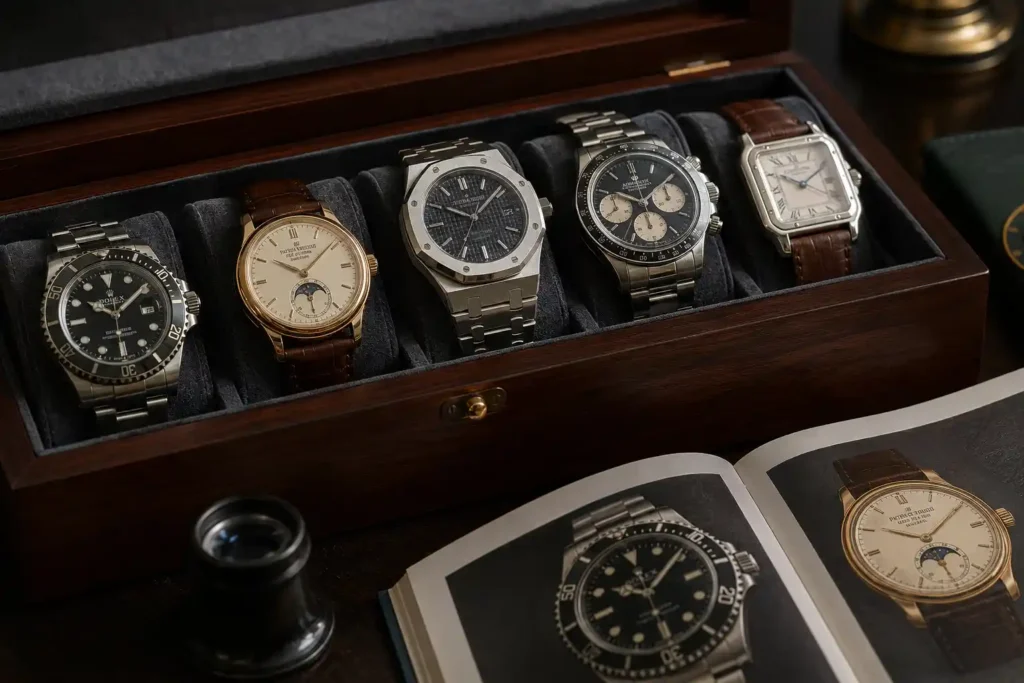
Limited production often plays an important role. Some references from brands such as Rolex, Patek Philippe, and Audemars Piguet were produced in small quantities or discontinued unexpectedly, creating scarcity that fuels long-term demand.
However, rarity can also emerge from provenance. A watch previously owned by a notable individual or connected to a significant historical event can command extraordinary interest at watch auctions. The market has repeatedly demonstrated that stories matter just as much as specifications.
Craftsmanship represents another defining element. Many independent watchmakers produce only a few dozen pieces each year, and each watch involves hundreds of hours of hand-finishing. Their scarcity is not manufactured; it is simply a consequence of artisanal production.
Other characteristics that often define rare watches include:
- Exceptional complications or unusual dial variations
- Limited edition watches with meaningful historical context
- Original documentation and service records
- Watches preserved in outstanding condition
- References that represent milestones in mechanical innovation
Ultimately, rarity is not merely about numbers. It is about significance. The watches that become legends are often those that capture a particular moment in design, engineering, or cultural history.
Why Collectors Think Beyond Investment Returns?
Although luxury watch investment has attracted increasing attention in recent years, many seasoned collectors reject the idea that watches should be treated solely as financial instruments.
Passion remains the foundation of most great collections. A collector may spend years searching for a particular vintage watch because it reminds them of a parent, represents a milestone achievement, or reflects an admiration for mechanical artistry.
Generational ownership also plays a central role. Unlike many luxury goods, high-end watches often become family heirlooms, carrying stories and memories across decades. The emotional return on ownership can prove just as meaningful as any potential financial appreciation.
Many collectors follow a simple philosophy:
- Buy what genuinely fascinates you.
- Study the history behind the reference.
- Focus on quality rather than quantity.
- Be prepared to hold pieces for many years.
This perspective explains why the watch market often behaves differently from purely speculative asset classes. Collectors frequently continue buying exceptional pieces even during uncertain economic periods because their motivations extend beyond short-term returns.
Scarcity, Heritage, and the Luxury Watch Market
The modern market for collectible watches has been shaped by a fascinating combination of scarcity and heritage. Iconic Swiss watches possess decades sometimes centuries of accumulated reputation that cannot easily be replicated.
Brands such as Rolex and Patek Philippe have cultivated identities rooted in reliability, innovation, and exclusivity. Their most desirable references often enjoy robust collector demand because they represent enduring symbols of excellence.
Meanwhile, independent manufacturers have added fresh energy to the market. Makers like F.P. Journe demonstrate how innovation and artisanal craftsmanship can create entirely new categories of collectibility.
The relationship between scarcity and collector value becomes clearer when different categories are compared.
| Watch Category | Primary Appeal | Long-Term Collector Value |
|---|---|---|
| Vintage Watches | Historical significance and rarity | Strong if condition and provenance are exceptional |
| Modern Limited Editions | Exclusivity and contemporary design | Variable depending on production numbers and demand |
| Independent Watchmakers | Artisanal craftsmanship and innovation | Increasingly strong among experienced collectors |
| Iconic Production Models | Brand recognition and liquidity | Stable due to broad global demand |
These categories illustrate that no single formula guarantees collectible success. Instead, long-term value emerges from the interaction of rarity, historical relevance, and sustained collector interest.
Furthermore, the growth of online communities and international watch events has expanded the global collector base. Enthusiasts in Asia, the Middle East, Europe, and North America now compete for the same exceptional pieces, reinforcing demand for truly scarce watches.
The Role of Auctions, Provenance, and Authentication
Auction houses have become influential institutions within the world of luxury collectibles. Sales organized by major firms frequently establish benchmark prices and introduce extraordinary watches to a global audience.
However, auctions do more than create headlines. They also reinforce the importance of provenance and authenticity.
Experienced buyers pay close attention to:
- Original paperwork and box sets
- Service history and maintenance records
- Dial originality and replacement parts
- Production dates and serial numbers
- Independent authentication reports
Condition remains particularly important. Two seemingly identical watches can command dramatically different prices if one retains original components and another has undergone extensive restoration.
Counterfeit risks have also increased alongside market growth. Consequently, authentication has become more sophisticated, with collectors relying on specialists, independent experts, and transparent documentation before completing significant purchases.
The emphasis on provenance reflects a broader trend in passion investing. Collectors increasingly seek objects with stories, histories, and verified origins. In many cases, a compelling narrative can elevate a watch from an attractive luxury item to an important cultural artifact.
Comparing Different Types of Collectible Watches
Not all collectible watches appeal to the same buyer. Different categories attract collectors with different priorities, risk tolerances, and aesthetic preferences.
| Watch Type | Signature Characteristics | Best Suited For |
| Vintage Watches | Historical references and rarity | Collectors seeking heritage and long-term appreciation |
| Modern Limited Editions | Exclusive production and contemporary appeal | Enthusiasts wanting rarity and modern design |
| Independent Watchmakers | Hand craftsmanship and innovation | Experienced collectors and connoisseurs |
| Iconic Production Models | Strong brand recognition and liquidity | New collectors and diversified investors |
Vintage watches often possess unmatched historical significance. Certain references have survived for decades in remarkably original condition, making them increasingly difficult to find. Consequently, collector demand remains exceptionally strong.
Modern limited editions occupy a more complex position. Some become highly sought-after, while others fade into obscurity. Their success often depends on genuine scarcity rather than marketing alone.
Independent watchmakers have become one of the most fascinating segments of the market. Their creations appeal to collectors who appreciate technical innovation and artisanal production. Increasing demand for independent watchmakers suggests that many buyers now value originality as much as heritage.
Iconic production models, meanwhile, offer accessibility and liquidity. References with decades of uninterrupted popularity often attract first-time collectors because they combine recognizability with relatively stable demand.
The diversity of these categories demonstrates that luxury watch investment is never one-dimensional. Different watches serve different purposes, and successful collectors typically understand exactly why a particular piece deserves a place within their collection.
The Future of Rare Watch Collecting
The future of Rare watch collecting appears remarkably dynamic. A new generation of collectors is entering the market with different priorities and broader access to information.
Digital marketplaces have increased transparency, allowing buyers to compare prices and research references with unprecedented ease. Meanwhile, authentication technologies continue to improve, strengthening confidence in secondary markets.
Several trends are shaping the next chapter of the industry:
- Growing participation from younger collectors.
- Greater appreciation for independent creators.
- Increasing emphasis on provenance and originality.
- Expanding global communities connected through digital platforms.
- Rising interest in tangible assets and wealth preservation.
At the same time, tastes are evolving. Younger enthusiasts often value design, storytelling, and authenticity more than traditional status symbols. As a result, the definition of collectibility may continue to broaden.
Nevertheless, one constant remains. Exceptional craftsmanship retains universal appeal. The finest mechanical watches represent hundreds of years of accumulated knowledge, and their ability to fascinate new generations seems unlikely to diminish.
Unique Insight: Why Rare Watches Endure Beyond Market Cycles?
Rare watch collecting continues to thrive because the finest timepieces satisfy emotional and intellectual desires that transcend financial considerations.
An extraordinary watch is a miniature work of engineering that can be worn every day. It represents human ingenuity, artistic expression, and historical continuity in a way few luxury objects can match.
Importantly, rarity often matters more than price. Some of the world’s most coveted watches were once considered relatively ordinary until collectors recognized their historical significance. This dynamic explains why provenance increasingly matters more than market hype.
Independent watchmakers have also reshaped the landscape by proving that innovation and craftsmanship can rival the appeal of established heritage brands. Their influence reflects a broader cultural shift toward authenticity and individuality.
Ultimately, exceptional watches function as wearable works of art. They preserve mechanical traditions in an increasingly digital world while creating emotional connections between generations. A treasured timepiece can commemorate achievements, mark personal milestones, and become part of a family’s history.
This combination of engineering, storytelling, and human connection explains why Rare watch collecting remains resilient despite economic uncertainty and changing luxury trends. The enduring attraction lies not only in potential value but also in the ability of remarkable watches to preserve craftsmanship and celebrate the timeless appeal of mechanical innovation.
Conclusion
The enduring appeal of Rare watch collecting lies in a rare combination of artistry, engineering, heritage, and human emotion. While luxury watches can sometimes function as alternative assets and instruments of wealth preservation, their true significance extends much further.
Collectors continue to pursue exceptional timepieces because they represent stories, achievements, and mechanical traditions that transcend changing market cycles. Whether one is drawn to vintage watches, independent watchmakers, or iconic Swiss watches, the finest examples remain powerful symbols of craftsmanship and enduring cultural value.
In an increasingly digital world, rare watches offer something profoundly tangible: objects that can be worn, admired, and ultimately passed from one generation to the next.
Frequently Asked Questions
What is rare watch collecting?
Rare watch collecting is the pursuit of acquiring exceptional timepieces that possess scarcity, historical significance, outstanding craftsmanship, or important provenance.
Which watch brands are most collectible?
Brands such as Rolex, Patek Philippe, Audemars Piguet, and several independent watchmakers consistently attract strong collector interest.
Are rare watches a good investment?
Some watches have appreciated significantly, but no watch guarantees future returns. Value depends on rarity, condition, authenticity, provenance, and market demand.
What makes a watch valuable to collectors?
Scarcity, originality, historical importance, exceptional craftsmanship, and documented provenance all contribute to collectible value.
Do vintage watches outperform modern watches?
Not necessarily. Certain vintage watches have performed exceptionally well, while some modern limited editions have also generated strong demand.
What role do auction houses play in watch collecting?
Auction houses help establish market values, provide transparency, and introduce important watches to global audiences.
How can buyers verify authenticity?
Collectors should rely on trusted dealers, independent experts, original documentation, and professional authentication services.
Why are independent watchmakers becoming more popular?
Collectors increasingly appreciate their innovation, artisanal craftsmanship, and limited production, which often creates genuine scarcity.
What risks should new collectors consider?
Counterfeits, overpaying during market peaks, poor documentation, and inadequate research remain significant risks.
Why does Rare watch collecting continue to attract long-term collectors?
Rare watch collecting attracts long-term collectors because it combines craftsmanship, history, emotional meaning, and the possibility of preserving value through tangible, culturally significant objects.

Administrator at Alt Finances, leading editorial strategy and contributing in-depth coverage of investing, wealth management, alternative assets, and global financial markets. Through research-driven articles and analysis, he helps readers understand the ideas, industries, and market forces shaping modern finance.