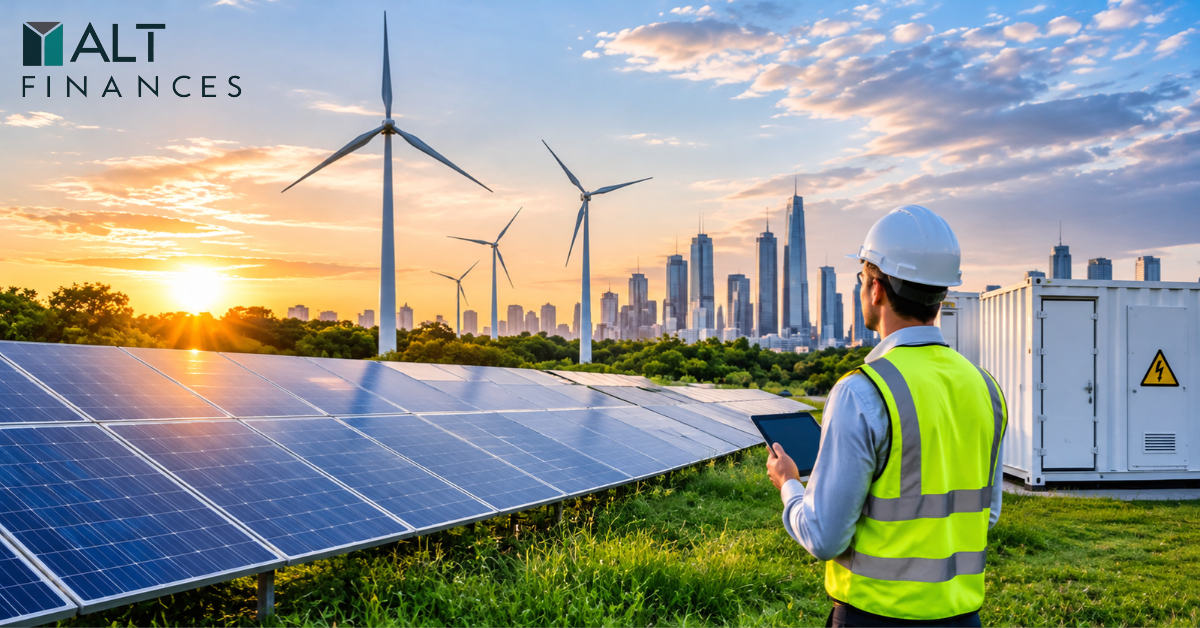
Renewable Energy Investment Opportunities are expanding beyond the construction of solar farms and wind turbines. As electricity demand increases, investors are looking more closely at the infrastructure required to generate, store, transmit and deliver power. Battery storage, electricity grids, hybrid energy projects and emerging technologies are becoming important parts of the investment landscape heading into 2027.
The financial scale is substantial. The International Energy Agency (IEA) estimates that global energy investment will reach approximately $3.4 trillion in 2026. Around $2.2 trillion is expected to go toward a broad group of lower-emissions and electricity-related areas, including renewables, nuclear power, grids, storage, low-emissions fuels, energy efficiency and electrification. This figure represents the wider energy system, not renewable generation alone.
For private equity firms, infrastructure funds, pension funds, sovereign wealth funds and private-credit providers, the opportunity is to identify projects with credible revenue models, suitable financing structures and manageable operating risks. However, growing demand for clean electricity does not automatically make every renewable project profitable.
Why Renewable Energy Investment Opportunities Are Growing in 2027
Energy security, industrial electrification and rising electricity consumption are changing how governments and businesses approach power generation. Data centers, artificial intelligence, manufacturing and electric transport are adding to the need for reliable electricity.
The IEA’s World Energy Investment 2026 estimates that total global energy investment will reach $3.4 trillion this year. Approximately $2.2 trillion is expected to go collectively toward renewables, nuclear, grids, storage, low-emissions fuels, efficiency and electrification.
BloombergNEF reported that global energy-transition investment reached a record $2.3 trillion in 2025. Its figures included $690 billion in renewable energy investment, $483 billion in grid investment and $893 billion in electrified transport. These are separate investment categories and should not be treated as interchangeable.
The figures help explain why investors are examining more than electricity generation. Projects also need connections to the grid, storage capacity and infrastructure capable of delivering power when consumers need it.
Solar Energy Investment Opportunities: From Farms to Hybrid Projects
Solar remains a central part of renewable energy investment. Utility-scale solar farms, commercial rooftop installations and distributed solar systems offer different ways for investors to participate.
The IEA’s Renewables 2026 report forecasts almost 4,800 GW of additional renewable capacity between 2026 and 2031. Solar photovoltaic technology is expected to account for more than three-quarters of that expansion.
This creates several solar energy investment opportunities:
- Solar farm investment opportunities: Investors can finance new utility-scale projects, acquire operating facilities or purchase stakes in established solar development platforms.
- Commercial solar portfolios: Developers can install systems for industrial facilities, warehouses and businesses under long-term power arrangements.
- Corporate power purchase agreements: Companies can agree to purchase electricity under negotiated contracts, potentially giving project owners greater revenue visibility.
- Solar-plus-storage projects: Combining solar generation with batteries can help projects supply electricity at more useful times.
However, solar generation alone does not guarantee attractive returns. Electricity prices can fall when many solar facilities produce power simultaneously. Grid congestion, curtailment, delayed connections and changes in government incentives can also affect revenue.
Investors therefore need to assess the project’s location, electricity market, offtaker, financing costs and contractual arrangements rather than relying only on equipment costs or capacity growth.
Battery Storage: A Major Area for Clean Energy Investment Opportunities
Battery energy storage is becoming a significant investment area because electricity supply and demand do not always occur at the same time.
A battery system can store electricity when generation is abundant and release it when demand or market prices are higher. Depending on local market rules, storage assets may also earn revenue by providing frequency regulation and other grid-support services.
Battery projects can generate income through energy arbitrage, capacity payments, ancillary services or contracted arrangements. The available revenue streams depend on the electricity market and the project’s operating design.
For private equity firms and infrastructure investors, battery storage can offer exposure to the supporting infrastructure behind renewable generation. However, the risks include battery degradation, replacement costs, technology changes, competition between storage projects and unpredictable price spreads.
A project that looks attractive under current market conditions may produce weaker returns if more storage capacity enters the same market. Investors must therefore evaluate expected revenue over the asset’s operating life rather than relying on short-term electricity-price conditions.
Wind Energy Investment Opportunities: Onshore and Offshore Projects
Wind remains an important source of renewable electricity, but the investment characteristics of onshore and offshore projects differ.
Onshore wind can offer opportunities where permitting, transmission access and electricity procurement arrangements are established. Investors may participate through operating wind portfolios, development-stage projects, repowering older facilities or specialist maintenance businesses.
Offshore wind projects generally require substantially more capital and involve complex construction, marine infrastructure, supply-chain and financing requirements. Higher interest rates, equipment costs and auction conditions have challenged project economics in some markets.
For private capital, the distinction is between long-term demand for wind power and the financial viability of a particular project. Strong wind resources do not compensate for an uneconomic construction contract, an unreliable grid connection or an electricity purchase agreement that fails to cover costs.
Grid Infrastructure Investment: Opportunities Beyond Renewable Generation
Some of the most important renewable energy investment opportunities may lie in the infrastructure connecting electricity producers and consumers.
Transmission lines, substations, transformers, distribution networks and grid-management technologies are essential to expanding renewable capacity. Without sufficient network capacity, new solar and wind projects can face connection delays or restrictions on how much electricity they can deliver.
The IEA’s 2026 renewable-energy outlook identifies grid investment, storage deployment and permitting reform as important conditions for accelerating renewable capacity growth.
These assets can attract institutional investors because some electricity networks operate under regulated frameworks or long-term investment arrangements. Their revenue characteristics can differ from those of merchant power-generation projects.
This is closely connected to the wider infrastructure investing market. Investors are evaluating the systems that support energy generation, digital infrastructure and industrial activity together.
However, regulated returns are not automatic. Investors must examine regulatory approval, construction schedules, permitted revenue frameworks, cost overruns and the financial condition of counterparties.
Geothermal Energy Investment Opportunities and Emerging Technologies
Beyond solar and wind, geothermal energy is attracting attention because it can provide electricity or heat with different operating characteristics from weather-dependent generation.
Geothermal energy investment opportunities include conventional geothermal plants, exploration and drilling services, equipment suppliers and enhanced geothermal systems. The latter seek to access heat in geological formations that may not have the natural fluid conditions required by conventional projects.
The commercial challenge is that geothermal development involves resource uncertainty, drilling costs, site-specific geology and lengthy development periods. A technically promising resource is not necessarily an economically viable power project.
Other alternative energy investment opportunities include long-duration energy storage, renewable hydrogen and specialist power-management technologies. These markets should be assessed individually. Renewable hydrogen, for example, depends on electricity costs, electrolyser utilization, transport infrastructure and credible customer demand.
Investors should distinguish commercially established technologies from early-stage businesses that still depend on subsidies, technological improvements or future market development.
Where Renewable Energy Investment Opportunities Are Emerging Globally
Investment opportunities vary considerably by country and region.
United States: Solar, battery storage and electricity infrastructure are attracting attention as electricity demand grows. Investors must consider tax-credit eligibility, trade policy, permitting, interconnection and changes in federal and state incentives.
Europe: Grid modernization, storage and selected wind projects remain important areas. Financing costs, auction design, permitting and electricity-market structures can determine whether individual projects are viable.
India: Solar, wind, storage and domestic manufacturing offer opportunities as electricity demand expands. The IEA expects India to become the second-largest market for renewable capacity growth between 2026 and 2031, after China.
Middle East: Large-scale solar and wind developments are supported by energy-diversification strategies and partnerships involving governments, sovereign investors and international developers.
Africa and other emerging markets: Distributed solar, mini-grids and utility-scale projects can help address electricity-access gaps. However, currency exposure, offtaker creditworthiness, political conditions and financing availability require careful assessment.
Sustainable Energy for All’s September 2026 analysis of 23 economies across Africa, Latin America and Asia found that emerging and developing economies outside China receive a relatively small share of global energy investment. Its research argues that the challenge is increasingly about creating the conditions needed to attract commercial capital, not simply increasing public funding.
For investors, this can create opportunities for partnerships involving development finance institutions, commercial lenders and private project developers.
How Private Capital Invests in Renewable Energy Opportunities
Renewable energy projects use several financing structures, depending on their development stage, revenue arrangements and risk profile.
- Private equity: Investors acquire stakes in developers, operating platforms or renewable-energy businesses, seeking growth through project development, acquisitions or eventual exits.
- Infrastructure funds: These funds may acquire operating solar, wind, storage or grid assets with established cash flows.
- Project finance: Lenders provide debt against a project’s expected cash flows, contracts and assets.
- Private credit: Specialist lenders may finance developers, equipment providers or projects that do not fit conventional bank lending requirements.
- Joint ventures: Developers, utilities and institutional investors share capital requirements, expertise and project risks.
- Blended finance: Development banks or public institutions provide concessional capital or risk support to help attract commercial investment.
The financing of these assets is part of the wider infrastructure debt market, where institutional lenders assess long-term projects and the cash flows supporting their debt.
Investors typically examine power purchase agreements, electricity-price exposure, construction costs, operating expenses, debt levels, tax treatment and exit options. A long-term contract may improve revenue visibility, but the creditworthiness of the buyer and the contract’s terms remain important.
Risks Investors Should Evaluate Before Pursuing Renewable Energy Investment Opportunities
Renewable energy investment carries risks that can materially affect returns.
Interest rates influence the cost of financing capital-intensive projects. Changes to subsidies, tax incentives and energy regulation can alter project economics. Construction delays, equipment shortages and grid-connection problems can postpone revenue generation.
Investors also need to consider electricity-price volatility, technology performance, battery degradation, currency movements and political risk. In emerging markets, a project may generate electricity successfully but still face payment delays or foreign-exchange restrictions.
Due diligence should examine the project’s expected cash flows under different scenarios, the strength of its offtaker, the experience of its developer and the availability of reliable grid infrastructure.
The same discipline applies to valuations. A growing market does not justify paying any price for an asset, particularly when several investors are competing for established projects.
Conclusion: Evaluating Renewable Energy Investment Opportunities in 2027
Renewable Energy Investment Opportunities in 2027 are not limited to solar farms and wind turbines. Battery storage, electricity transmission, grid modernization, geothermal development and specialist energy platforms are expanding the range of assets available to private capital.
The IEA’s capacity forecasts point to substantial renewable-energy expansion through 2031, while BloombergNEF’s investment research shows that capital is already flowing into generation and supporting infrastructure. Yet commercial conditions differ across technologies and markets.
For institutional investors, private equity firms, infrastructure funds and private-credit providers, the central task is to identify projects with realistic costs, dependable revenue arrangements and manageable risks. Renewable energy demand may continue to grow, but investment returns will depend on the quality of individual assets and the financial structures behind them.
Frequently Asked Questions
1. What are the biggest renewable energy investment opportunities in 2027?
Solar power, battery storage, wind energy, grid infrastructure and selected geothermal projects are important areas to examine. The most attractive opportunity depends on project economics, regulation, financing and electricity-market conditions.
2. Why are green energy investment opportunities attracting private capital?
Private investors are examining renewable generation, storage and supporting infrastructure as electricity demand grows. Project contracts, financing structures and regulatory conditions help determine whether these opportunities can deliver acceptable returns.
3. Are solar farm investment opportunities still attractive?
Solar remains a major source of expected renewable capacity growth. However, project returns depend on electricity prices, grid access, power purchase agreements, construction costs and local policy.
4. What are geothermal energy investment opportunities?
They include conventional geothermal power plants, enhanced geothermal systems, drilling services and specialist equipment providers. Resource quality, exploration costs and project development timelines are important risks.
5. How do investors make money from renewable energy projects?
Revenue may come from electricity sales, long-term power purchase agreements, regulated infrastructure returns, storage services, operating cash flows and the sale of developed assets.
6. What are the biggest risks of clean energy investment opportunities?
Key risks include interest rates, policy changes, construction delays, grid congestion, power-price volatility, technology performance, currency exposure and counterparty creditworthiness.
7. Are alternative energy investment opportunities the same as renewable energy investments?
Not necessarily. Alternative energy is a broader term that can include emerging technologies and energy sources with different commercial and environmental characteristics. Renewable energy generally refers to sources such as solar, wind, geothermal, hydropower and sustainable bioenergy.
Investment disclaimer: This article is for informational purposes only and does not constitute financial or investment advice. Renewable energy projects involve construction, regulatory, technology, financing, market and operational risks. Investors should conduct independent due diligence and consult qualified professional advisers.

Ana Goldenberg is a Contributing Editor at Alt Finances with a career rooted in the high-stakes worlds of banking and private placements. From profiling global philanthropists to managing complex financial operations at Wells Fargo, she bridges the gap between editorial storytelling and disciplined financial expertise.