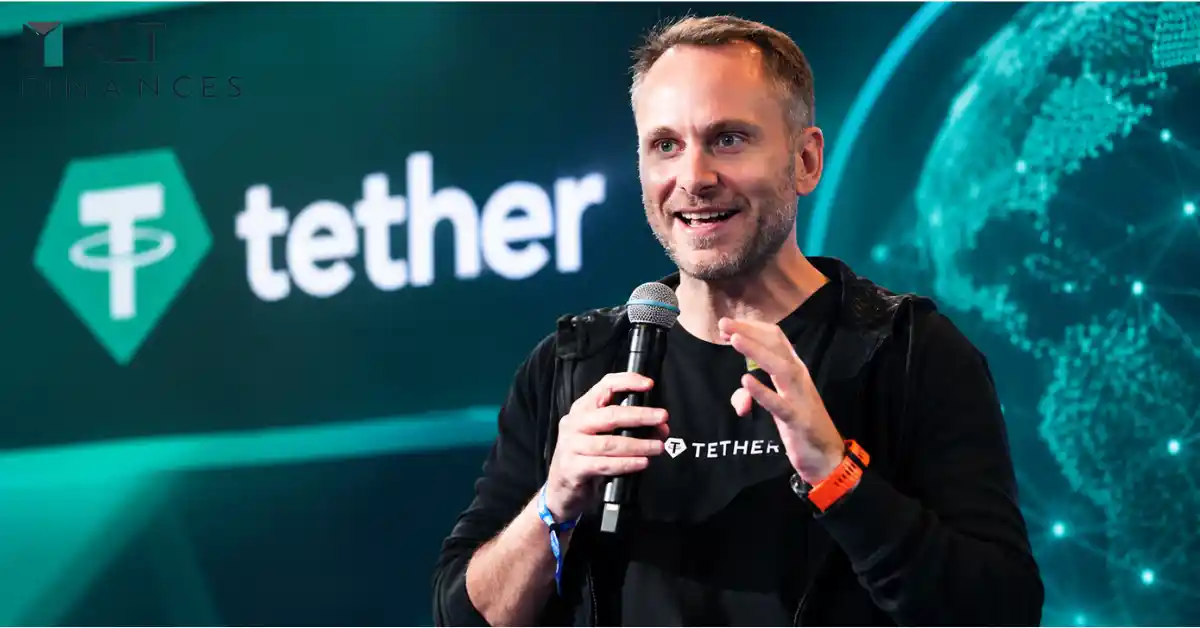
Paolo Ardoino has become closely associated with Tether and its USDT stablecoin. But by 2026, describing his role only in terms of stablecoins no longer captures the direction of the company. Under Ardoino, Tether is increasingly investing in gold, payment infrastructure, blockchain technology, artificial intelligence, energy and private credit.
The expansion is significant because Tether has developed an unusually large financial base from its stablecoin operation. At the end of June 2026, approximately $184.6 billion of USD₮ was in circulation. Tether reported $1.5 billion in second-quarter net operating profit, primarily driven by its U.S. Treasury and repo portfolio, while assets exceeded liabilities by about $4.11 billion.
That financial capacity gives Ardoino more room to pursue investments outside the core stablecoin business. The question for investors is whether these investments represent a coherent strategy to build digital financial infrastructure or whether diversification could eventually introduce risks that are harder to manage.
Tether’s Stablecoin Engine Comes First
Before examining Ardoino’s expansion strategy, it is important to understand where Tether’s financial capacity comes from.
USDT is designed to maintain a value of approximately one U.S. dollar. Tether holds reserves intended to support the tokens in circulation, with the company’s June 2026 report showing that short-duration U.S. government securities and other liquid assets remained central to the reserve structure.
The economics are different from those of a conventional technology company.
As the amount of USDT in circulation increases, the reserve base can also become larger. Tether can earn income on assets such as Treasury securities and repurchase agreements while maintaining liquidity for potential redemptions.
That reserve economics is important to Ardoino’s broader strategy.
Tether reported approximately $1.5 billion of net operating profit in Q2 2026, while continuing to reduce secured lending exposure. It also said its physical gold holdings increased by 14 tonnes during the quarter.
The distinction between Tether’s reserve assets and investments made through Tether Investments is important. The latter is where the company has increasingly deployed capital into businesses and infrastructure beyond the core USDT reserve operation.
From Digital Dollars to Digital Gold
Gold has become one of the clearest extensions of Ardoino’s strategy.
Tether’s XAU₮ is a token designed to represent ownership of physical gold, with each token representing one fine troy ounce of gold held in Swiss vaults. In February 2026, Tether Investments also announced a $150 million investment in Gold.com, acquiring approximately 12% of the company. The partnership is intended to connect physical and tokenized gold distribution.
This is more than a conventional cryptocurrency investment.
Tether is attempting to connect a traditional store of value with blockchain-based ownership and settlement. XAU₮ was also recognized as an Accepted Spot Commodity within Abu Dhabi’s ADGM framework in July 2026, subject to applicable permissions and approvals.
There is evidence that Tether is also willing to change course when products do not attract sufficient demand. In June, the company announced that it would wind down Alloy by Tether and aUSD₮ after reviewing user activity, market demand and liquidity, while concentrating resources on XAU₮ and other areas.
That is an important detail in assessing Ardoino’s strategy: expansion does not necessarily mean keeping every experiment alive.
Building the Rails for Digital Payments
Another major part of the strategy is infrastructure.
In February 2026, Tether announced an investment in t-0 network, a settlement platform designed for licensed financial institutions. The system uses USD₮ as settlement infrastructure while allowing institutions to transact across currencies.
Tether also invested in LayerZero Labs, whose technology provides interoperability between blockchain networks. Tether said the investment supports infrastructure for payments, settlements, custody and the movement of tokenized assets across different blockchains.
The pattern is significant.
Rather than simply encouraging people to hold USDT, Tether is investing in systems that could make stablecoins more useful for payments, settlement and financial applications.
The company has made similar investments elsewhere. In February, it invested $100 million in Anchorage Digital, a federally regulated digital-asset bank focused on custody, settlement and other institutional services.
These investments suggest that Ardoino is interested not only in the digital dollar itself, but also in the infrastructure through which digital dollars move.
Why Ardoino Is Betting on AI and Physical Infrastructure
Tether’s expansion becomes considerably broader when AI and physical infrastructure are included.
In June 2026, Tether announced that it would lead support for a NEURA Robotics Series C financing of up to $1.4 billion, describing the investment as part of its strategy around physical AI and robotics.
Tether has also invested in AI-related businesses. In March, it announced an investment in Eight Sleep at a reported $1.5 billion valuation, linking the investment to AI-driven health technology and its QVAC computing architecture.
At first glance, robotics and sleep technology appear far removed from stablecoins.
That is precisely where caution is needed.
Tether says its investment arm focuses on technology, infrastructure and real-world utility. Its portfolio spans financial services, AI, energy, biotechnology, education and other sectors.
But strategic alignment is not the same as proven economic synergy. Investors should therefore distinguish between Tether’s stated rationale for an investment and evidence that the investment will strengthen the company’s core business.
Private Credit Is the Next Extension of the Model
Private credit provides a more direct connection between Tether’s digital-money infrastructure and traditional finance.
In September 2026, Tether and Fasanara Capital launched StableFund, an evergreen private-credit vehicle initially anchored by $400 million in combined sponsor capital and targeting up to $3 billion in third-party institutional capital. The fund is designed to provide financing to small and medium-sized businesses.
This development also connects with AltFinances’ recent coverage of the Private Credit Reset, where Tether’s StableFund launch was examined in the wider context of changing private-credit risk.
StableFund does not mean Tether has become a conventional private-credit manager. Instead, it demonstrates another possible use of Tether’s financial and digital infrastructure: connecting stablecoin-enabled transactions with financing in the real economy.
That could become strategically important, but private credit brings its own risks, including underwriting losses, borrower defaults, illiquidity and valuation uncertainty.
The Risks of Becoming More Than a Stablecoin Company
Diversification can create opportunities, but it can also make a business harder to understand.
Tether now has exposure to areas with very different economics. Stablecoins depend heavily on liquidity, reserves, regulation and adoption. Gold depends on commodity markets and custody arrangements. Private credit depends on underwriting and repayment. AI and robotics require significant capital and technological execution. Energy projects involve infrastructure, power prices and local regulatory conditions.
Tether’s experience in Uruguay illustrates why infrastructure expansion carries execution risk.
Reuters reported in August 2026 that Tether’s bitcoin-mining plans in Uruguay collapsed after a dispute over power supply with the state-owned utility. Tether had planned roughly $120 million of investment in two mining sites, but operations eventually ceased and employees were laid off.
The episode does not invalidate Tether’s broader infrastructure strategy. It does, however, demonstrate that capital and ambition cannot eliminate operational risks.
There are also regulatory risks around stablecoins, reserve management and digital-asset services, alongside the possibility that changes in crypto-market conditions could affect demand for USDT.
Unique Insight: Tether Is Becoming a Capital Allocation Platform
The most interesting development in Paolo Ardoino Tether strategy may therefore be less about any individual investment.
It is the emergence of a model in which the stablecoin business provides financial capacity while Tether Investments deploys capital into businesses that may expand the infrastructure surrounding digital money.
The strategy has several layers:
USDT → liquidity and financial capacity → investments → payment, asset and technology infrastructure → greater potential utility for digital assets.
Some investments fit this model directly. Payment infrastructure and blockchain interoperability, for example, have an obvious relationship with stablecoins.
Others are more distant.
Gold has a clear connection through XAU₮. Private credit can connect through stablecoin-based financing. Robotics, health technology and energy are less directly connected and therefore require a greater leap from strategic rationale to measurable economic benefit.
That distinction will become increasingly important as Tether’s investment portfolio expands.
Conclusion
Paolo Ardoino’s role at Tether is evolving from leading a company primarily identified with USDT toward managing a broader collection of financial and technology ambitions.
Tether’s stablecoin business remains the foundation. Its Q2 2026 results show the scale behind that foundation, with roughly $184.6 billion of USDT in circulation and $1.5 billion in quarterly net operating profit.
But Ardoino is using that financial base to pursue investments in gold, payments, blockchain infrastructure, AI, robotics and private credit.
The strategy could eventually make Tether more than a stablecoin issuer. It could become a broader capital allocation and digital-infrastructure platform.
Whether that creates a more resilient business or simply exposes Tether to a wider range of risks remains unresolved.
That may be the most important part of the Ardoino story in 2026: Tether’s next phase will depend not only on the growth of USDT, but on how effectively it converts the economics of stablecoins into durable businesses and infrastructure beyond them.
FAQs
Who is Paolo Ardoino?
Paolo Ardoino is the CEO of Tether, the company behind USDT. He has become a central figure in the development of Tether’s broader digital-asset and investment strategy.
What does Tether do beyond stablecoins?
Tether’s activities and investments now extend into tokenized gold, payment infrastructure, blockchain interoperability, digital-asset custody, AI, robotics, energy and private credit.
Why is Tether investing in gold?
Tether operates XAU₮, a token backed by physical gold, and has also invested in Gold.com. The strategy connects tokenized assets with physical-gold distribution.
Is Tether expanding into AI and private credit?
Yes. Tether has invested in AI-related businesses and supported a large robotics financing round. It also launched StableFund with Fasanara Capital, a $400 million initial private-credit vehicle targeting up to $3 billion in institutional capital.
What are the biggest risks in Tether’s diversification strategy?
Key risks include regulation, reserve and liquidity management, capital allocation, private-credit losses, technology execution, infrastructure costs and the possibility that investments outside stablecoins may not generate the expected strategic or financial benefits.
Investment Disclaimer
This article is for informational and educational purposes only and does not constitute investment, financial, tax or legal advice. It does not recommend Tether, USDT, gold or any other investment. Readers should conduct independent research and consult qualified professionals before making financial decisions.
Contributing Editor for Alt Finances, vision-driven with 20+ years in family office, asset management, and corporate development. Holds UN Special Consultative Status and is 100 Women in Finance Board Chair. Tulane University – A.B. Freeman School of Business.