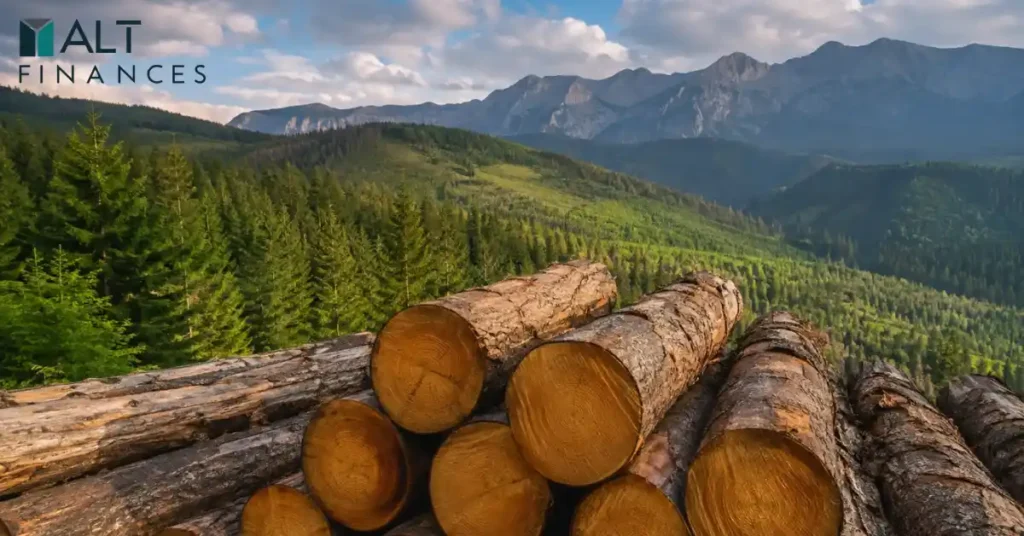
Some of the most durable alternative investments are not built in factories, traded on exchanges, or issued by corporations they grow slowly on land.
That characteristic has made timberland investing an established part of the real-asset universe. For institutional investors and sophisticated private-market investors, forests can provide exposure to biological growth, timber demand and underlying land value, while offering potential cash flows through harvesting. But the investment case is more nuanced than simply expecting trees to become more valuable.
Timberland follows a distinctive economic chain: land ownership → forest growth → timber production → harvest revenue → asset appreciation → portfolio value. The result is an asset whose performance can be influenced by both biological processes and financial markets.
The distinction matters. Timberland does not automatically appreciate every year, and returns can vary substantially according to geography, species, management, timber prices, land values, operating costs and environmental conditions.
How Timberland Investing Generates Value
The defining feature of timberland investing is that investors can potentially receive value from more than one source.
Biological growth is the first. Trees add volume as they mature. If market conditions remain unchanged, additional timber volume can still increase the potential value of the standing inventory. Growth rates, however, vary considerably by species, climate, soil quality and management practices.
Harvest revenue provides another potential source of cash flow. Forest owners can sell timber at different stages of maturity, depending on the management plan and local market conditions. Harvesting does not necessarily mean liquidating the entire asset; well-managed forests can be managed on a rotational basis.
Land value creates a separate component. The investor owns, directly or indirectly, the underlying real estate as well as the biological asset. Land values can be influenced by location, accessibility, alternative uses, conservation considerations and broader real-estate conditions.
Finally, there is optionality. Depending on the property and applicable regulations, value may potentially arise from recreation, conservation easements, carbon markets or alternative land uses. These opportunities are highly property-specific and should not be treated as automatic sources of return.
The key point is that timberland is not simply a bet on rising timber prices. It combines a productive biological asset with real estate.
Timberland Is Different From a Conventional Commodity
A commodity investment generally depends heavily on the market price of the commodity. Timberland is different because the investor controls an asset that continues to grow biologically.
That creates a form of flexibility that conventional commodity exposure does not provide. A forest owner may have some discretion over when timber is harvested, subject to biological, contractual, regulatory and market considerations.
If timber prices are temporarily unattractive, a manager may be able to delay harvesting and allow additional biological growth. Conversely, attractive market conditions can influence harvest timing. That flexibility is often described as optionality, although it does not eliminate market risk.
Timber markets are also highly regional. Species, transportation costs, mill capacity, local inventories and demand from nearby processors can all affect what a particular forest is worth.
There is therefore no single universal “timber price” that determines the value of every timberland asset.
Why Timber Demand Matters
Timberland economics ultimately connect forests with the wider economy.
Housing construction is particularly important for many wood products. Recent U.S. Forest Service research found that residential construction is a dominant driver of U.S. softwood lumber demand, reinforcing the connection between housing activity and forest-product markets.
Other end markets include remodeling, packaging, paper and pulp, engineered wood products, infrastructure and industrial applications. The mix differs by species and geography.
The global picture is also broader than traditional lumber. The Food and Agriculture Organization has examined rising demand for wood products alongside the development of mass timber, manmade cellulose fibers and other uses of wood in a changing bioeconomy. Its 2050 outlook projected higher consumption of primary processed wood products under its business-as-usual scenario.
For investors, this means timberland exposure is ultimately connected to multiple layers of supply and demand rather than a single commodity market.
Timberland and Inflation Sensitivity
Timberland is sometimes described as an inflation-sensitive real asset. There is an economic rationale for that argument, but it should not be confused with guaranteed inflation protection.
Land is a physical asset, while timber is a tangible product whose prices can respond to changes in construction costs, demand, supply conditions and broader economic activity. Replacement costs and economic growth can also influence land and forest values.
But the relationship is not one-directional.
Timber prices can decline during periods of weak demand. Land values can fall. Operating costs can rise. A forest can suffer physical damage even while the broader economy experiences inflation.
Consequently, timberland may possess inflation-sensitive characteristics, but investors should evaluate the actual forest, market and investment structure rather than assume that inflation automatically produces positive returns.
Why Institutions Have Considered Timberland
Timberland is not a theoretical alternative asset. Institutional investment in the category has been tracked for decades.
The National Council of Real Estate Investment Fiduciaries, or NCREIF, maintains a Timberland Property Index covering privately held U.S. timber properties acquired for investment purposes. NCREIF states that the properties in the index have been acquired at least partly on behalf of institutional investors and are held in a fiduciary environment. The index dates back to 1987.
That institutional history reflects several characteristics investors may find useful:
- Long-duration exposure: Forests are productive assets managed over extended periods.
- Biological growth: Timber volume can increase without requiring the same type of capital expenditure associated with manufacturing capacity.
- Real-asset exposure: Investors gain exposure to land and natural resources.
- Potential cash flow: Harvesting can generate revenue under an appropriate management strategy.
- Diversification: Timberland can provide exposure to an asset whose economics differ from conventional securities.
NCREIF also maintains a Timberland Fund and Separate Account Index, demonstrating that institutional exposure can be obtained through pooled and separately managed structures rather than only through direct ownership.
However, index performance should not be interpreted as representative of every timberland investment. NCREIF itself notes that its Timberland Index represents a particular institutional investment universe and may not represent the entire timberland market.
Direct Ownership, Funds and Other Structures
Investors can access timberland through different structures, each with distinct economics.
Direct ownership provides the greatest control over land, harvesting and management decisions but requires substantial expertise and capital.
Timberland funds pool assets and delegate management to specialist investment managers. This can provide diversification across properties but introduces management fees, fund-level governance and liquidity constraints.
Private equity vehicles may use timberland as part of broader natural-resource strategies and can employ different levels of leverage and value-creation approaches.
Timber REITs provide a more security-like route to forestry exposure, generally offering greater tradability than privately held forests, although the investor does not receive the same direct ownership characteristics.
Managed forestry portfolios can provide customized exposure for larger investors while retaining professional forest-management expertise.
These structures should not be treated as interchangeable. Fees, leverage, liquidity, governance, valuation methods and exposure to individual forests can materially affect outcomes.
Climate, Sustainability and Carbon Optionality
The physical nature of timberland also creates risks that conventional financial assets do not face in the same way.
Wildfire, drought, hurricanes, storms and pest outbreaks can damage forests. Climate conditions can influence growth rates and the geographic suitability of particular species. Regulatory changes and environmental restrictions can also affect harvesting or land-use decisions.
At the same time, sustainable forest management can be important to long-term productivity and asset stewardship.
Carbon markets introduce another potential dimension. Forests can store carbon, and some projects may generate carbon credits under applicable methodologies and regulatory frameworks. But carbon revenue should not be treated as automatic. Eligibility, additionality, permanence, verification requirements, market prices and project design can all determine whether credits have economic value.
For investors, environmental exposure therefore represents both a potential source of value and a source of risk.
The Risks Behind the Timberland Thesis
The long-term nature of forests can create diversification characteristics, but it can also make timberland relatively illiquid.
Investors must examine:
Land quality. Timber inventory. Species mix. Geography. Timber prices. Harvest strategy. Operating costs. Transportation infrastructure. Manager expertise. Natural-disaster exposure. Regulatory conditions. Financing structure. Exit strategy.
Concentration can also matter. A forest dependent on one regional mill or a limited number of timber buyers may have different economics from a diversified portfolio.
Likewise, two forests with similar acreage can have very different investment profiles because of differences in species, age, growth rates, accessibility and local demand.
That is why the label “timberland” tells an investor relatively little by itself.
The Deeper Timberland Investing Thesis
The deeper timberland investing thesis is not simply that trees grow, so the investment grows.
It is that timberland combines a productive biological asset with ownership of the underlying real estate.
A bond depends primarily on contractual payments. A commodity depends largely on market prices. Traditional property investments depend heavily on rents and property values.
Timberland can potentially combine:
Biological Growth + Harvest Revenue + Land Value + Timber Demand + Optionality
That combination creates a distinctive real-asset profile.
But the critical investment question is not whether trees will become more valuable. It is whether a particular forest can generate attractive risk-adjusted returns after accounting for timber prices, operating costs, natural-disaster exposure, liquidity, management, land value and the timing of harvests.
That is what separates timberland from the simplistic idea of buying land and waiting for appreciation.
Conclusion
Timberland investing has become an established component of the alternative-asset and real-asset universe because it combines land ownership with biological growth and exposure to timber demand.
Trees grow.
Timber can be harvested.
Land can appreciate.
Demand can create cash flow.
Management determines outcomes.
Risk determines returns.
None of those characteristics guarantees positive performance. Timberland values and cash flows can move in different directions depending on geography, species, market conditions, forest management and investment structure.
The most important questions for investors are therefore straightforward: Where is the forest? What species does it contain? How quickly does it grow? Who manages it? What are the local timber markets? What risks threaten the asset? How liquid is the investment? And what is the exit strategy?
The appeal of timberland investing is not that trees always rise in value. It is that a well-managed forest can potentially create value through both the growth of a biological asset and the appreciation of the land beneath it giving investors exposure to an economic engine that traditional financial assets cannot replicate.
Frequently Asked Questions
What is timberland investing?
Timberland investing involves gaining economic exposure to forestland and its timber resources, either through direct ownership or investment structures such as funds and managed portfolios.
How does timberland generate investment returns?
Potential returns can come from biological growth, timber harvesting, changes in land value and, where applicable, additional opportunities such as conservation or carbon markets.
Why do institutional investors invest in timberland?
Institutional investors may consider timberland for its long-duration real-asset exposure, biological growth characteristics, potential cash flow and diversification potential. NCREIF’s institutional timberland indexes demonstrate that the asset class has an established institutional investment history.
Is timberland a good alternative asset?
Timberland can be a distinctive alternative asset, but suitability depends on the property, investment structure, investor objectives, liquidity requirements and risk tolerance.
Can timberland protect against inflation?
Timberland can have inflation-sensitive characteristics through land values, timber prices and economic activity, but it should not be treated as a guaranteed inflation hedge.
What risks are associated with timberland investments?
Major risks include illiquidity, timber-price volatility, land-value changes, wildfire, drought, storms, pests, climate exposure, regulation, operating costs, financing and valuation uncertainty.
How do timber prices affect timberland returns?
Timber prices can directly affect harvest revenue and therefore influence investment cash flows. However, timberland value also depends on biological growth, land value, management and local market conditions.
Can investors earn income from timberland?
Potentially. Forest owners can generate revenue through timber harvesting, although the timing and amount of cash flow depend on forest composition, management strategy and market conditions.
What role do carbon credits play in timberland investing?
Carbon credits can provide an additional potential source of economic value for qualifying forestry projects, but revenue is not automatic and depends on project methodology, verification, additionality, permanence, regulation and market conditions.
How can investors gain exposure to timberland?
Potential structures include direct ownership, timberland funds, private investment vehicles, managed forestry portfolios and publicly traded timber-focused securities such as timber REITs.
Why is timberland investing important for alternative-investment portfolios?
Timberland offers a combination of biological growth, land ownership, timber-market exposure and potential cash flow that differs from conventional financial assets. Its diversification value, however, depends on the specific portfolio and investment structure.
Investment & Real-Asset Disclaimer: This article provides general informational content and does not constitute financial, investment, legal, tax, environmental, or forestry advice. Timberland investments can involve significant liquidity, market, operational, environmental, climate, valuation, and natural-disaster risks. Historical performance does not guarantee future results, and timberland values and cash flows can vary materially by geography, forest composition, market conditions, management strategy, and investment structure. Investors should conduct independent due diligence and consult qualified professional advisers before making investment decisions.

Contributing Writer for Alt Finances with experience in luxury events, travel, fashion, and the arts. Active investor through her family office across real estate, energy, and private equity. University of Miami – BBA.