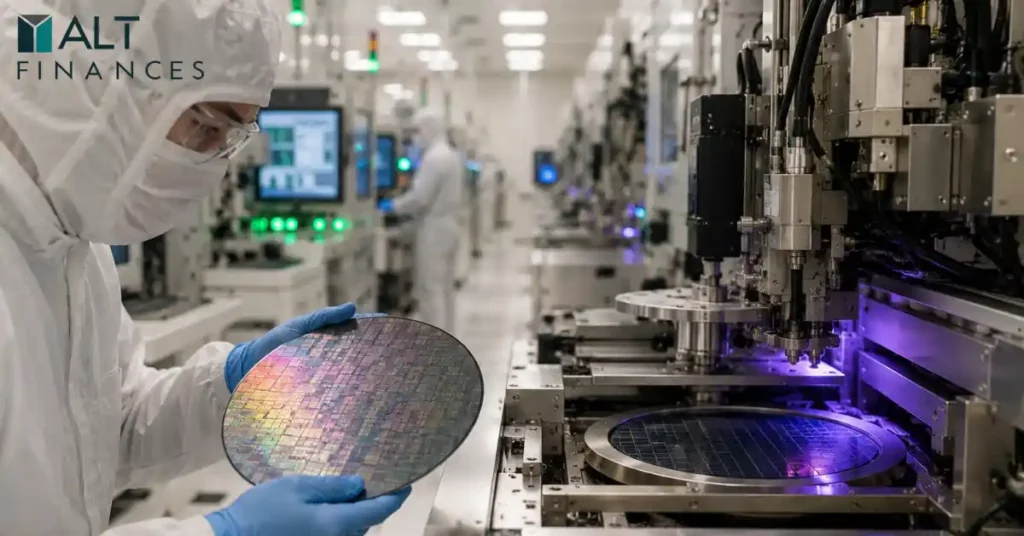
The most valuable part of the AI economy may increasingly depend on something investors rarely see: the physical capacity required to manufacture its chips.
AI models, data centers, advanced vehicles and increasingly automated industries all depend on semiconductor production. But semiconductor manufacturing capacity cannot be created as quickly as demand for computing can accelerate. Fabs require enormous capital commitments, specialized equipment, skilled labor, reliable energy and water supplies, supplier ecosystems and years of planning.
That is changing the way governments and investors view chip manufacturing. Semiconductor capacity is no longer simply an industrial resource. It is becoming a strategic asset connected to technology leadership, supply-chain resilience, national security and long-term capital allocation.
McKinsey Global Institute estimates that roughly $1 trillion of investment is expected to flow into semiconductors through 2030, while global semiconductor revenues could exceed $1.6 trillion annually by then.
The investment question is therefore moving beyond who designs the next important chip. It increasingly concerns who controls the physical infrastructure required to produce it.
Why Semiconductor Manufacturing Capacity Matters More Than Ever
The AI boom has made the relationship between computing demand and physical production capacity increasingly visible.
Leading-edge chips used in advanced computing and AI are manufactured by a very limited number of companies. McKinsey notes that leading-edge semiconductors at two- and three-nanometer nodes are currently produced by only three companies globally, while Taiwan and South Korea remain central to advanced semiconductor production.
That concentration creates strategic value.
A company can possess valuable chip-design intellectual property without controlling enough manufacturing capacity to satisfy customers. Likewise, a country can have a strong technology sector while remaining dependent on overseas fabrication.
The distinction between chip design and chip manufacturing capacity is therefore becoming increasingly important for investors.
| Semiconductor Capacity Component | Why It Matters | Investment Implication |
|---|---|---|
| Fabs | Convert designs into physical chips | High capital intensity and utilization risk |
| Semiconductor equipment | Enables lithography, etching, deposition and inspection | Specialized suppliers can capture value across multiple fabs |
| Advanced packaging | Connects and packages increasingly complex chips | Important bottleneck as chip architectures become more sophisticated |
| Energy | Fabs require reliable, high-quality power | Supports investment in specialized power infrastructure |
| Water | Manufacturing requires substantial high-quality water supplies | Creates regional infrastructure requirements |
| Skilled labor | Engineers and technicians support yield and uptime | Deep talent pools can improve operating economics |
| Supplier ecosystems | Chemicals, gases, materials and services support production | Cluster effects can create durable competitive advantages |
The important point is that a fab does not operate in isolation. Its investment value depends on the ecosystem surrounding it.
Why Building Fabs Is So Difficult and Expensive
A semiconductor fab is one of the clearest examples of capital being committed long before revenue arrives.
The economics involve much more than the headline construction cost. McKinsey’s analysis of a 28-nanometer fab found that equipment represented roughly 35 percent of levelized production cost, while materials accounted for about 25 percent. Utilities and construction each represented roughly 10 to 15 percent.
But geography can materially change those economics.
McKinsey’s comparison found that labor productivity, construction costs and energy prices are major differences between semiconductor manufacturing locations. In its base-case comparison, excluding equipment, construction costs for a comparable 400,000-wafer-per-year plant were at least twice as high in Europe and the United States as in Taiwan.
Time matters too.
A fab that takes longer to build begins generating revenue later, while competitors may already be producing at scale. That creates a difficult investment equation:
Capital Expenditure + Construction Time + Ramp-Up Risk → Future Utilization + Pricing Power + Cash Flow
The economics become even more complicated when technology changes rapidly.
A manufacturing process that is strategically important today can become less advanced as newer nodes emerge. The investor therefore has to distinguish between scarcity that is durable and scarcity that exists only during a particular technology cycle.
The New Strategic Competition for Chip Capacity
Semiconductor manufacturing is increasingly being shaped by a competition between economic efficiency and strategic resilience.
Taiwan remains the benchmark for advanced semiconductor manufacturing, supported by manufacturing expertise, supplier proximity and an established ecosystem. South Korea is also a major producer, while China has expanded substantial capacity, particularly across mature and advanced nodes. The United States and Europe are supporting additional domestic capacity to reduce import dependence and strengthen strategic supply chains.
This has elevated the importance of companies such as TSMC, Samsung and Intel without reducing the importance of the wider ecosystem. Equipment companies such as ASML occupy another strategically important position because advanced manufacturing depends on highly specialized tools.
The result is a semiconductor supply chain in which geography itself has become part of the investment thesis.
The cheapest location is not necessarily the preferred location.
Automotive and industrial customers may value proximity, supply security and multisourcing even when production costs are higher. McKinsey notes that these considerations increasingly influence where new capacity is built.
AI Is Turning Manufacturing Capacity Into Infrastructure
AI is strengthening this strategic argument.
Data centers require large quantities of advanced processors, memory and supporting electronics. Robotics, autonomous systems and industrial automation add another layer of semiconductor demand. Automotive systems increasingly depend on chips for sensing, computing and control.
This means semiconductor manufacturing is becoming connected to a much broader infrastructure investment cycle.
The chain looks increasingly like:
AI Models → AI Hardware → Semiconductors → Fabs → Equipment → Materials → Energy → Infrastructure
A constraint anywhere in that chain can affect the economics of the entire system.
That does not mean every semiconductor investment will benefit equally. The key distinction is between capacity that is scarce and capacity that is economically valuable.
A fab with weak utilization, high depreciation and limited pricing power may be strategically important but financially disappointing.
The Investment Ecosystem Around a Fab
The investment opportunity therefore extends well beyond semiconductor manufacturers.
Foundries represent the obvious exposure, but the construction and operation of fabs creates demand for equipment, chemicals, specialty gases, advanced packaging, industrial construction, power infrastructure, water systems and highly specialized services.
This creates a potentially broader investment ecosystem.
For investors, the attraction can come from companies that sell essential inputs to multiple manufacturers rather than relying on the economics of a single fabrication facility.
But specialization can also create concentration risk. A supplier may have strong pricing power during capacity expansion but face weaker demand when capital expenditure slows.
The most attractive businesses may therefore be those combining technical barriers to entry, diversified customers, recurring demand and exposure to long-term capacity expansion.
Industrial Policy Is Changing Semiconductor Capital Allocation
Governments are now influencing semiconductor investment decisions alongside corporations.
The United States, European Union, Japan, South Korea and China have all used combinations of subsidies, tax incentives, industrial policy and other measures to encourage domestic semiconductor production. McKinsey’s analysis shows that public support can materially change the economics of projects that would otherwise have higher production costs.
This creates a new consideration for investors:
The economics of a semiconductor fab are no longer determined entirely by the market.
Government policy can influence where capacity is built, how quickly projects are completed and which technologies receive support.
But subsidies cannot permanently compensate for weak economics.
The strongest investment cases are likely to combine policy support with three underlying advantages:
Speed + Ecosystem + Demand Visibility
McKinsey argues that predictable policy, supplier ecosystems and long-term customer commitments can materially improve the investment case for new fabs.
| Strategic Trend | Impact on Semiconductor Manufacturing | Potential Capital Opportunity |
| AI expansion | Increases demand for advanced chips | Fabs, equipment and packaging |
| Supply-chain diversification | Encourages geographically distributed capacity | Regional semiconductor infrastructure |
| Industrial policy | Reduces selected project costs | Subsidized manufacturing projects |
| Advanced nodes | Raises technical barriers | Leading-edge equipment and foundries |
| Automotive localization | Increases demand for regional supply | Mature-node and specialty capacity |
| Data-center growth | Expands processor and memory requirements | AI hardware and semiconductor suppliers |
| Geographic diversification | Reduces dependence on concentrated production | New fabs and supporting infrastructure |
The Risks of Treating Capacity as a Strategic Asset
Strategic importance does not automatically translate into investment returns.
Semiconductor manufacturing remains highly cyclical. Demand can weaken, customers can delay orders and new capacity can arrive just as a technology cycle changes.
There is also a risk of overcapacity.
Governments may have strategic reasons to support domestic production even when a project is not the lowest-cost producer. Multiple regions simultaneously expanding capacity could eventually create excess supply in particular segments.
Investors must therefore consider:
- Utilization rates
- Pricing power
- Capital intensity
- Depreciation
- Technology transitions
- Customer concentration
- Construction delays
- Cost overruns
- Energy costs
- Geopolitical disruption
- Government-policy changes
McKinsey’s research highlights an especially important issue: later entrants can face weaker economics because incumbent producers may have already captured the highest-margin phase of a technology node and accumulated years of yield improvement, utilization and depreciation benefits.
This is why strategic necessity and financial attractiveness should never be treated as the same thing.
The Unique Insight: Capacity Is Becoming Economic Power
The deeper investment thesis is not simply:
“Chips are becoming more important.”
It is:
Control over the physical capacity to produce advanced chips can become a form of strategic economic power.
For decades, investors could focus heavily on intellectual property, software and semiconductor design. The AI era is forcing greater attention onto the physical infrastructure underneath those technologies.
A company may design an exceptional processor. But without access to the right manufacturing process, packaging capacity, equipment and supporting infrastructure, that intellectual property cannot reach the market at scale.
This makes semiconductor manufacturing capacity different from ordinary industrial capacity.
Its value can extend beyond the revenue generated by the fab itself. It can influence national resilience, technology leadership, supply-chain security and the ability of entire industries to expand.
The investment question therefore becomes:
Which parts of the semiconductor production ecosystem possess durable scarcity, pricing power and strategic relevance?
Conclusion
Semiconductor manufacturing capacity is moving from an often-invisible industrial constraint toward a major strategic investment theme.
AI needs chips.
Chips need fabs.
Fabs need equipment, energy, water, capital, skilled labor and specialized suppliers.
Governments increasingly want greater control over that capacity, while corporations need reliable access to production as computing demand expands.
But scarcity alone is not enough.
The strongest investment opportunities will depend on the interaction between technology leadership, utilization, pricing, capital efficiency, ecosystem depth and strategic relevance.
The key question is no longer simply:
Who designs the next great chip?
It is:
Who controls the manufacturing capacity required to produce the chips on which the next technology cycle depends?
That shift makes semiconductor manufacturing capacity not merely an industrial consideration, but an increasingly important question for global capital allocation.
Frequently Asked Questions
What is semiconductor manufacturing capacity?
Semiconductor manufacturing capacity refers to the physical production capability available to manufacture chips at particular process nodes and volumes. It includes fabs, equipment, labor, utilities and supporting supply chains.
Why is semiconductor manufacturing capacity becoming strategically important?
AI, data centers, automobiles and industrial technologies increasingly depend on reliable chip supplies. At the same time, advanced production remains concentrated among a limited number of manufacturers and regions, making capacity relevant to technology leadership and supply-chain resilience.
Why are semiconductor fabs so expensive to build?
Fabs require sophisticated manufacturing equipment, specialized construction, utilities, materials and highly skilled personnel. The capital commitment also occurs well before a new facility reaches high-volume production.
How does AI increase demand for chip manufacturing?
AI data centers require advanced processors and memory, increasing demand across parts of the semiconductor ecosystem. McKinsey identifies the AI data-center boom as a major driver of semiconductor demand toward 2030.
Why is semiconductor manufacturing concentrated in certain regions?
Manufacturing benefits from established supplier networks, skilled labor, manufacturing experience, infrastructure and accumulated process expertise. These ecosystem advantages can make established semiconductor hubs more competitive than newly built facilities.
How do governments support domestic semiconductor manufacturing?
Governments can use subsidies, tax incentives, workforce programs and other industrial-policy measures to encourage domestic production and strengthen strategic supply chains.
What role does ASML play in semiconductor production?
ASML is a major supplier of highly specialized semiconductor manufacturing equipment, particularly lithography systems. Its position illustrates how the investment value of semiconductor production extends beyond the companies that actually fabricate chips.
What are the risks of investing in semiconductor manufacturing?
Key risks include cyclical demand, overcapacity, high depreciation, construction delays, cost overruns, technology transitions, customer concentration, geopolitical disruption and changing government policy.
Why does semiconductor capacity matter to AI infrastructure?
AI infrastructure ultimately depends on physical chips. Semiconductor manufacturing capacity determines how quickly advanced processors and related components can be produced and supplied at scale.

Contributing Writer for Alt Finances with experience in luxury events, travel, fashion, and the arts. Active investor through her family office across real estate, energy, and private equity. University of Miami – BBA.