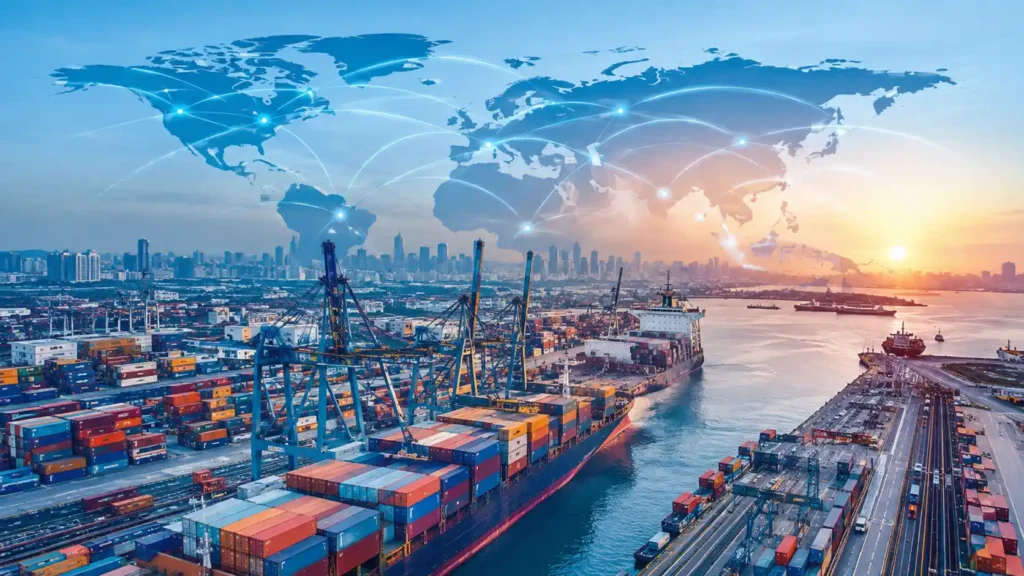
The geography of investment is increasingly being shaped by something that rarely appears on a corporate balance sheet: the physical routes connecting economies. Global capital flows are beginning to respond not only to the size of domestic markets, but also to the infrastructure that determines how efficiently goods, energy, data and people can move between them.
That shift matters because ports, railways, power networks, logistics hubs and industrial zones can influence where companies build factories and where investors commit long-term capital. As tariffs, geopolitical tensions and supply-chain disruptions encourage companies to diversify production, infrastructure is becoming part of the strategic calculation behind cross-border investment.
UNCTAD‘s latest investment research shows how closely these forces are connected. Global foreign direct investment remained weak amid geopolitical fragmentation and trade tensions, while multinational companies continued restructuring supply chains toward regions including Southeast Asia, Eastern Europe and Central America.
The result is a new investment map in which trade routes can become capital routes and strategic connectivity can become an economic asset in its own right.
Why Trade Corridors Matter to Investors
A major trade corridor can create an ecosystem rather than simply a transportation route.
A new port can attract warehouses. Better rail connections can make an industrial zone more competitive. Reliable electricity can support manufacturing. Telecommunications infrastructure can attract data centers and financial services. Over time, these connected investments can reinforce one another.
That creates a potentially important feedback loop:
Trade → Infrastructure → Manufacturing → Employment → Services → Investment
For investors, the implication is significant. The most valuable opportunity may not sit at the beginning or end of a corridor. It may emerge around the supporting infrastructure that makes the route commercially useful.
This is particularly relevant as companies balance efficiency against resilience. IMF research finds that diversifying supply sources can improve resilience to major trade shocks, although diversification can also reduce efficiency and raise costs.
Therefore, ports and logistics companies, infrastructure funds, industrial-property developers, energy providers and telecommunications operators can all become indirect beneficiaries of changing trade patterns.
How Trade Corridors Are Redirecting Global Capital Flows
The traditional model of globalization concentrated manufacturing where labor, infrastructure and access to major consumer markets offered the strongest combination of cost and scale. That model has not disappeared, but it is becoming more complicated.
Companies are increasingly considering nearshoring, friend shoring and reshoring alongside conventional cost calculations. Political alignment, tariff exposure, supply-chain security and access to critical resources now influence location decisions.
The IMF has documented the rise of so-called connector economies, where countries can benefit as production and trade are reallocated amid U.S.-China tensions. Vietnam, for example, has shown evidence of increased domestic production and greenfield FDI in some strategic sectors.
UNCTAD’s investment data also illustrates the broader shift. Southeast Asia recorded $225 billion of FDI in 2024, while India maintained strong momentum in greenfield investment. At the same time, North American investment benefited from major semiconductor projects.
The significance for global capital flows is that infrastructure can pull investment toward locations that previously sat outside the core of global manufacturing.
| Trade Corridor Investment Theme | Primary Growth Driver | Key Risk |
|---|---|---|
| Nearshoring hubs | Supply-chain resilience | Higher production costs |
| Port and logistics networks | Rising regional trade | Trade-volume uncertainty |
| Industrial zones | Manufacturing relocation | Weak tenant demand |
| Energy corridors | Energy security | Policy and commodity volatility |
| Critical-mineral routes | Strategic resource demand | Export restrictions and price swings |
| Digital infrastructure | Data and industrial connectivity | Technology obsolescence |
The investment lesson is not that every emerging logistics hub will succeed. Rather, capital is increasingly evaluating connectivity as part of an asset’s strategic value.
The Geopolitics Behind the New Trade Map
Trade infrastructure has also become geopolitical infrastructure.
The India–Middle East–Europe Economic Corridor, China’s Belt and Road Initiative, North American manufacturing networks and emerging critical-mineral routes reflect different approaches to connectivity. Some are commercial projects; others also carry strategic and diplomatic objectives.
That distinction matters.
The Belt and Road Initiative has helped China build commercial and infrastructure relationships across Asia, the Middle East, Africa and Europe. China’s outbound investment is also increasingly concentrated in strategic areas such as mining and energy, rather than the broader global asset-buying spree seen a decade ago. Reuters reported that Chinese overseas acquisitions reached a five-year high in the first quarter of 2026, with energy and mining prominent among the deals.
Meanwhile, geopolitical disruptions can quickly change the economics of established routes. The WTO warned in March 2026 that conflict in the Middle East was putting additional pressure on trade through energy-price and transport disruptions.
Critical minerals provide another example. The IEA reported that investment in critical minerals declined 9% in 2025 as geopolitical tensions and price volatility made investors more cautious, even while governments pushed to diversify supply.
For institutional investors, this means geopolitical investment risk is becoming inseparable from infrastructure risk. A strategically important route can attract government support, but it can also become more exposed to sanctions, conflict, export restrictions and diplomatic tensions.
Where the Investment Opportunities May Emerge
The most interesting opportunities may sit one layer beneath the headline infrastructure project.
Ports need cranes, storage and logistics software. Rail networks need rolling stock, maintenance and power. Industrial parks need electricity, water and telecommunications. Manufacturing clusters need suppliers. Data centers need reliable energy and fiber connections.
That creates multiple avenues for private capital, institutional investors and sovereign wealth funds.
| Infrastructure Asset | Investment Opportunity | Primary Risk |
| Ports | Terminals, logistics and warehousing | Trade rerouting |
| Railways | Freight infrastructure and services | Construction and utilization |
| Industrial parks | Manufacturing and commercial property | Vacancy risk |
| Energy infrastructure | Power generation and transmission | Regulation and price volatility |
| Data centers | Digital connectivity | Power constraints and obsolescence |
| Critical minerals | Mining, processing and transport | Commodity-price volatility |
| Telecommunications | Fiber and network infrastructure | Regulatory and technology risk |
This is why infrastructure investment can extend far beyond buying an interest in a physical corridor. Investors can instead gain exposure to the economic activity created around it.
For long-term investing, that distinction is crucial. A route may take years to become commercially significant, while supporting assets can sometimes generate value earlier. However, investors must distinguish between an announced project, a financed project, infrastructure under construction and an operational corridor.
Strategic ambition alone does not create cash flow.
Emerging Markets and the New Investment Geography
Emerging markets may be among the biggest beneficiaries of this shift.
Countries positioned between major economic blocs can become manufacturing or logistics connectors. Southeast Asia demonstrates this possibility, while parts of Central America, Eastern Europe, the Middle East and Africa are also seeking greater integration into global supply chains.
The opportunity extends beyond factories. Greater connectivity can encourage financial services, commercial real estate, energy infrastructure and logistics investment.
However, the same characteristics that create opportunity can increase risk. Emerging markets may face weaker institutions, currency volatility, political instability, infrastructure gaps and changing regulatory frameworks.
IMF research offers an important warning: connector economies can benefit from trade reallocation, but their position can also make them vulnerable to deeper geoeconomic fragmentation over the longer term.
The implication for investors is straightforward: being located between two major markets is not enough. The country must also offer the political stability, infrastructure quality and commercial environment needed to turn geographic position into durable economic value.
Why Not Every Trade Corridor Will Succeed
A map can make a proposed corridor look inevitable. Capital markets cannot afford that assumption.
Large infrastructure projects face financing challenges, construction delays, regulatory barriers and changing political priorities. A route designed around expected trade volumes may struggle if those volumes fail to materialize. Competing corridors can also divert traffic and undermine projected returns.
Debt sustainability presents another concern, particularly where infrastructure requires substantial public financing.
The difference between strategic ambition and commercial viability is therefore critical.
A government may consider a corridor essential for national security even when its immediate financial return is modest. Private investors, by contrast, must consider utilization, pricing power, financing costs and exit opportunities.
This distinction is especially important for alternative investments and infrastructure funds. Long-duration capital can benefit from structural growth, but it also has limited flexibility when a project becomes economically obsolete.
The Future of Global Capital Flows
The next phase of globalization may be less about abandoning international trade and more about reorganizing it into overlapping regional networks.
Companies are diversifying suppliers. Governments are prioritizing strategic infrastructure. Investors are examining energy security, critical minerals and manufacturing capacity alongside traditional economic indicators.
UNCTAD’s 2026 outlook describes an international investment environment increasingly shaped by geopolitical fragmentation, industrial policy and supply-chain restructuring.
At the same time, world trade itself remains substantial. UN Trade and Development reported that global trade in goods and services exceeded $35 trillion in 2025, even as geopolitical forces reshaped trade patterns and global value chains.
That suggests globalization is not disappearing. It is becoming more regional, more strategic and potentially more infrastructure-intensive.
The emerging sequence looks increasingly like:
Energy → Manufacturing → Logistics → Technology → Consumers
Where those connections become strongest, global capital flows may follow.
Unique Insight
The deeper shift is that global capital flows are increasingly becoming a function of connectivity rather than geography alone.
A country’s attractiveness to investors may depend not only on its population, GDP or domestic consumption, but also on its position inside a network of:
Ports → Rail → Energy → Manufacturing → Logistics → Financial Markets
That makes trade corridors increasingly similar to investment corridors.
The most valuable locations may not be the largest economies. They may be the strategic intersections where energy, manufacturing, technology and transportation converge.
For investors, this creates a more complex opportunity set. A port can benefit from increased trade, an industrial zone from manufacturing relocation, a power network from rising electricity demand and a financial center from growing cross-border investment.
Yet connectivity also creates vulnerability. A geopolitical shock can turn a strategic advantage into an operational liability almost as quickly as infrastructure can create economic opportunity.
The emerging investment map will therefore reward not simply access, but resilient access.
Conclusion
Trade corridors are becoming more than routes for moving goods. They are increasingly shaping where factories are built, where infrastructure capital is deployed, where energy systems expand and where emerging markets compete for foreign direct investment.
For investors, the most important development may be the gradual convergence of trade policy, infrastructure investment and geopolitical strategy.
That convergence is reshaping global capital flows.
The winners will not necessarily be the countries with the largest economies or the most ambitious infrastructure announcements. They may be the regions capable of connecting energy, manufacturing, logistics, technology and consumers reliably over decades.
For institutional investors, sovereign wealth funds, family offices and private capital, that creates a new way to evaluate global markets: not simply by asking where economic activity exists, but by asking which physical and strategic networks will determine where it develops next.
Frequently Asked Questions
What are trade corridors?
Trade corridors are interconnected transportation, logistics and infrastructure networks that facilitate the movement of goods, energy and economic activity between major markets. Their importance increasingly extends beyond transportation into manufacturing and investment.
How do trade corridors affect global capital flows?
They can influence where companies build factories, where infrastructure is developed and where foreign direct investment is directed. Better connectivity can make certain regions more attractive to institutional and private capital.
Why are investors paying attention to trade corridors?
Because infrastructure can shape long-term economic activity. Ports, logistics hubs, energy networks and industrial zones can become critical assets when supply chains are reorganized.
How do trade corridors influence foreign direct investment?
Companies may follow infrastructure when choosing new manufacturing locations. Better transport, energy and logistics can reduce supply-chain friction and make emerging markets more competitive.
What is nearshoring and how does it affect investment?
Nearshoring involves moving production closer to major consumer markets. It can increase demand for factories, logistics networks, industrial property and supporting infrastructure in nearby countries.
How does friendshoring change global supply chains?
Friendshoring encourages companies to source from countries considered strategically aligned or politically reliable. It can redirect manufacturing and investment toward trusted regional partners.
Which industries benefit from trade corridor development?
Potential beneficiaries include ports, logistics, industrial real estate, energy infrastructure, telecommunications, manufacturing, critical minerals and financial services.
Why are emerging markets attracting corridor-related investment?
Some emerging markets occupy strategic positions between major economic blocs and can offer expanding labor forces, lower production costs and access to growing consumer markets.
What are the biggest risks of investing around trade corridors?
Key risks include geopolitical conflict, political instability, construction delays, weak demand, currency volatility, regulation, competing routes, sanctions and stranded infrastructure.
How do geopolitical tensions affect global trade routes?
Tensions can redirect shipping, increase transport and energy costs, trigger sanctions or encourage governments and companies to build alternative supply routes.
Why is infrastructure important to global capital flows?
Infrastructure determines how efficiently economies connect with suppliers, consumers and resources. As supply chains become more strategic, that connectivity can influence corporate location decisions and investment allocation.
Why are global capital flows increasingly influenced by trade corridors?
Because investment decisions increasingly depend on the networks connecting economies. Global capital flows can follow the infrastructure that links energy, manufacturing, logistics, technology and consumers.

Contributing Writer for Alt Finances with experience in luxury events, travel, fashion, and the arts. Active investor through her family office across real estate, energy, and private equity. University of Miami – BBA.