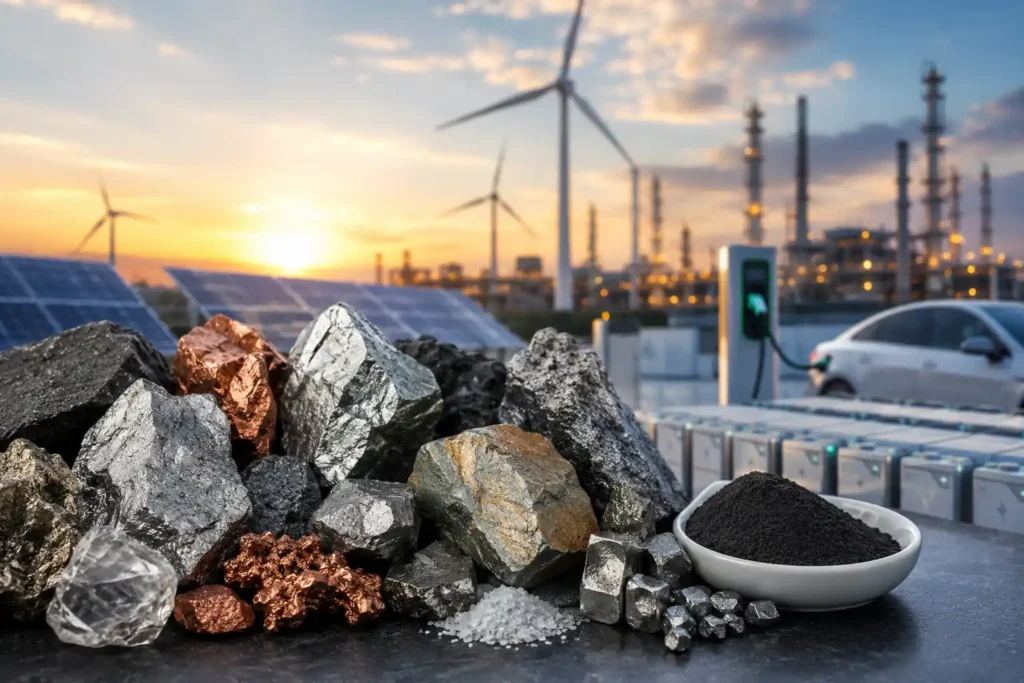
For decades, strategic reserves were almost synonymous with emergency crude oil stockpiles. Governments built these reserves to protect their economies against supply disruptions, geopolitical conflicts, and sudden price shocks. Today, however, that definition has expanded dramatically. As the global economy becomes increasingly dependent on advanced technologies, clean energy systems, and digital infrastructure, strategic reserves now encompass a much broader range of critical resources.
The shift reflects profound changes in global supply chains, energy security, and national economic priorities. Policymakers increasingly recognize that access to critical minerals, rare earth elements, semiconductor materials, and battery metals can influence industrial competitiveness as much as access to oil once did. Recent supply chain disruptions, geopolitical tensions, and accelerating industrial policies have reinforced the importance of safeguarding resources that underpin everything from electric vehicles and artificial intelligence to defense manufacturing and renewable energy.
Rather than serving solely as emergency stockpiles, modern strategic reserves are evolving into long-term economic security instruments. Governments are combining reserve programs with infrastructure investment, domestic manufacturing incentives, and resource partnerships to strengthen resilience while reducing dependence on highly concentrated international supply chains. Institutions including the International Energy Agency (IEA), U.S. Geological Survey (USGS), OECD, World Bank, and IMF have all highlighted the growing importance of diversified supply chains for the energy transition and broader economic stability.
Why Strategic Reserves Are Expanding Beyond Oil?
The traditional purpose of strategic petroleum reserves remains relevant. Oil continues to power transportation, aviation, petrochemicals, and military operations, making emergency petroleum inventories an important safeguard during geopolitical crises or natural disasters. However, today’s economic vulnerabilities extend far beyond crude oil.
Modern economies increasingly depend on minerals and materials that often originate from geographically concentrated regions. A disruption affecting lithium production, rare earth processing, or semiconductor manufacturing can interrupt entire industries despite ample energy supplies.
Several structural forces explain why governments are broadening the concept of strategic reserves.
Geopolitical Competition
International competition has intensified around access to natural resources that support technological leadership and national security. Export controls, trade restrictions, sanctions, and diplomatic disputes have demonstrated that resource access can become a geopolitical tool.
Countries are therefore pursuing strategic mineral reserves alongside bilateral partnerships, overseas mining investments, and domestic production incentives to reduce vulnerability.
Energy Transition
Electrification requires significantly larger volumes of minerals than traditional fossil fuel systems. Electric vehicles, battery storage, wind turbines, and solar infrastructure rely heavily on lithium, nickel, cobalt, copper, graphite, and rare earth elements.
The International Energy Agency has repeatedly noted that clean energy technologies are substantially more mineral-intensive than conventional energy systems, increasing the importance of secure supply chains.
Industrial Policy
Governments increasingly view industrial competitiveness as a matter of national resilience. Public investment programs now encourage domestic processing, refining, recycling, and manufacturing of strategically important materials.
Policies such as semiconductor incentives, battery manufacturing subsidies, and critical mineral strategies illustrate how industrial policy increasingly overlaps with resource security.
Supply Chain Diversification
The COVID-19 pandemic exposed the vulnerability of globally optimized supply chains. Production delays, transportation bottlenecks, and shortages affected industries ranging from automobiles to consumer electronics.
As a result, governments and corporations now prioritize diversification instead of relying on a single supplier or region for essential inputs.
Why this matters to investors?
The expansion of strategic reserves signals a structural rather than cyclical shift. Investors should recognize that government policy, infrastructure investment, and industrial reshoring increasingly influence commodity demand alongside traditional market forces. Long-term capital allocation decisions may therefore depend as much on geopolitical developments as on commodity price cycles.
Which Resources Are Becoming Strategic?
Governments are no longer focusing on one commodity. Instead, they are building resilience across multiple resource categories that support economic growth, technological innovation, and national security.
Lithium Supply Chains
Lithium has become central to the global electrification movement because rechargeable batteries power electric vehicles, stationary energy storage systems, and numerous consumer technologies.
Although lithium resources exist across multiple continents, refining capacity remains relatively concentrated. This imbalance has encouraged governments to support domestic processing facilities, recycling technologies, and international partnerships designed to strengthen the lithium supply chain.
Copper Demand
Copper plays a foundational role in electrification. Electric vehicles require significantly more copper than conventional automobiles, while renewable energy projects, transmission networks, and expanding data centers all increase long-term copper demand.
Rather than viewing copper solely as an industrial metal, policymakers increasingly recognize it as critical infrastructure supporting economic modernization.
Nickel, Cobalt, and Graphite
Battery chemistry continues to evolve, but nickel, cobalt, and graphite remain important components across many battery technologies.
Each mineral presents unique supply risks. Production is often geographically concentrated, while processing capacity may depend on a limited number of countries. Governments therefore seek diversified sourcing, recycling capabilities, and strategic inventories to reduce potential disruptions.
Rare Earth Elements
Despite their name, rare earth elements are relatively abundant in the Earth’s crust but difficult to economically separate and refine.
These materials support permanent magnets used in wind turbines, electric vehicles, advanced electronics, aerospace equipment, and defense technologies. Processing capacity remains heavily concentrated, making supply diversification a strategic priority for many economies.
Semiconductor Materials
Modern economies increasingly depend on semiconductor supply chains for computing, artificial intelligence, telecommunications, medical devices, defense systems, and industrial automation.
Rather than stockpiling finished computer chips alone, governments are also examining supplies of specialty gases, silicon wafers, advanced chemicals, and other materials essential for semiconductor manufacturing.
Before comparing these reserve categories, it is helpful to examine their differing strategic objectives.
| Strategic Reserve | Primary Purpose | Key Challenge |
|---|---|---|
| Petroleum | Protect against fuel supply disruptions | Price volatility and geopolitical shocks |
| Critical Minerals | Support manufacturing and energy transition | Limited processing capacity |
| Rare Earth Elements | Secure advanced technology and defense production | Highly concentrated refining |
| Semiconductor Materials | Protect technology and industrial production | Complex global supply chains |
The comparison illustrates that today’s strategic reserves serve different policy objectives. Petroleum reserves primarily stabilize energy supplies, whereas critical minerals, rare earth elements, and semiconductor materials protect industrial production and technological competitiveness. Governments therefore face a more complex balancing act than simply maintaining emergency fuel inventories.
Why this matters to investors?
The widening scope of strategic reserves highlights how resource security is reshaping capital markets. Infrastructure investment, processing facilities, recycling technologies, and supply chain diversification may benefit from sustained policy support, while concentrated supply chains remain exposed to geopolitical and regulatory risks. Investors should evaluate structural demand drivers rather than assuming every strategic commodity will experience similar long-term performance.
Investment Opportunities and Risks
The expansion of strategic reserves is reshaping how governments and institutional investors think about long-term capital allocation. Rather than reacting only to commodity price swings, policymakers increasingly invest across the entire value chain from mining and refining to recycling, transportation infrastructure, and advanced manufacturing. Nevertheless, the investment landscape remains highly complex.
Commodity markets are inherently cyclical. Prices respond not only to demand growth but also to new mine development, technological innovation, and macroeconomic conditions. Consequently, periods of strong demand can eventually encourage additional supply, placing downward pressure on prices.
Government intervention is another defining characteristic of strategic commodities. Subsidies, export controls, environmental regulations, and domestic content requirements can materially influence supply chains and investment returns. While supportive policies may accelerate development, they can also change as political priorities evolve.
Technological substitution introduces additional uncertainty. Battery manufacturers continue to refine chemistries that reduce dependence on scarce materials, while advances in recycling may lessen the need for newly mined resources over time.
Resource nationalism presents another challenge. Governments may impose export restrictions, revise mining regulations, or seek greater control over strategic assets during periods of geopolitical tension. These measures can strengthen domestic resilience but also increase uncertainty for international investors.
At the same time, infrastructure investment remains essential. New mines alone cannot resolve supply constraints without corresponding investments in refining capacity, transportation networks, electricity grids, and processing facilities.
Comparing Strategic Reserve Categories
Different reserve categories serve distinct strategic objectives, resulting in varying risk profiles and long-term investment considerations.
| Resource Category | Investment Opportunity | Primary Risk |
|---|---|---|
| Petroleum | Energy infrastructure and storage | Long-term demand uncertainty from energy transition |
| Critical Minerals | Mining, refining, recycling, processing | Policy changes and supply concentration |
| Rare Earth Elements | Advanced manufacturing and defense supply chains | Processing concentration and geopolitical risk |
| Semiconductor Materials | Semiconductor ecosystem and industrial infrastructure | Technology cycles and complex global supply chains |
The comparison demonstrates that opportunities extend well beyond raw commodities. Processing capacity, logistics, industrial equipment, recycling technologies, and supply chain infrastructure increasingly attract both public and private capital.
Petroleum continues to play an important role in global energy systems despite the energy transition. However, long-term demand growth is expected to moderate as electrification expands across transportation and industry.
Critical minerals benefit from structural demand linked to electrification, renewable energy, and battery production. Even so, their markets remain sensitive to policy changes, permitting delays, and technological developments.
Rare earth elements occupy a unique position because they support advanced manufacturing, defense technologies, robotics, and clean energy applications. Their strategic importance stems as much from concentrated refining capacity as from overall production levels.
Semiconductor-related materials represent another rapidly evolving category. Artificial intelligence, cloud computing, telecommunications, and industrial automation continue to expand semiconductor demand, increasing interest in securing resilient supply chains for specialty materials and manufacturing inputs.
Why this matters to investors?
Structural trends appear stronger than short-term commodity cycles. Nevertheless, successful capital allocation requires understanding government policy, technological evolution, and supply chain dynamics rather than relying solely on expectations of higher commodity prices. Diversification across industries connected to strategic resources may provide broader exposure than concentrating on any single commodity.
The Future of Strategic Resource Security
The next decade is likely to redefine how governments approach economic resilience. Strategic reserves increasingly support objectives extending well beyond emergency preparedness.
Artificial intelligence is driving unprecedented investment in data centers, advanced chips, and digital infrastructure, all of which depend on reliable semiconductor supply chains and substantial quantities of industrial metals.
Meanwhile, the energy transition continues to expand demand for transmission networks, renewable generation, battery storage, and electric mobility. These developments reinforce the strategic importance of lithium, copper, graphite, nickel, cobalt, and rare earth elements.
Defense modernization represents another structural driver. Advanced weapons systems, aerospace technologies, satellites, and communications infrastructure require sophisticated materials with highly specialized supply chains.
Industrial reshoring further reinforces these trends. Governments increasingly seek domestic manufacturing capacity for strategically important products, encouraging investments in processing facilities, recycling capabilities, and resilient logistics networks.
Taken together, these developments suggest that resource security is becoming an enduring component of economic strategy rather than a temporary response to recent geopolitical disruptions.
Why this matters to investors?
Long-term economic resilience increasingly depends on diversified supply chains instead of lowest-cost production alone. Investors should monitor structural themes such as reshoring, industrial policy, infrastructure investment, and technological innovation because these factors may influence capital allocation across multiple sectors for years to come.
Conclusion
The definition of strategic reserves has expanded well beyond petroleum. Governments now recognize that economic resilience depends on securing access to critical minerals, rare earth elements, semiconductor materials, and other strategic commodities that support modern industry.
Geopolitical competition, energy transition, AI infrastructure expansion, defense modernization, and industrial reshoring have fundamentally altered national priorities. Consequently, strategic reserves increasingly function as long-term economic security tools rather than simple emergency stockpiles.
For investors, these developments underscore the importance of focusing on structural trends instead of short-term market movements. Commodity investing, infrastructure investment, and supply chain diversification all present potential opportunities, but outcomes remain dependent on government policy, technological innovation, global demand, and geopolitical developments. Understanding these interconnected forces is likely to prove more valuable than attempting to forecast any single commodity cycle.
Frequently Asked Questions
What are strategic reserves?
Strategic reserves are government-controlled stockpiles of essential resources maintained to reduce the impact of supply disruptions, geopolitical events, natural disasters, or other emergencies that could threaten economic stability or national security.
Why are countries expanding reserves beyond oil?
Governments increasingly recognize that critical minerals, semiconductor materials, and battery metals are essential to modern economies, making broader resource security a strategic priority alongside traditional energy security.
Which critical minerals are considered strategic?
Many countries classify lithium, nickel, cobalt, graphite, copper, and selected rare earth elements as strategic because they support clean energy, advanced manufacturing, defense systems, and digital technologies.
Why are rare earth elements important?
Rare earth elements enable high-performance magnets, electronics, wind turbines, electric vehicles, aerospace equipment, and numerous defense applications that require reliable supply chains.
How do strategic reserves affect commodity markets?
Government purchasing and reserve policies can influence market expectations and supply availability, although broader economic conditions, production growth, and technological developments remain major pricing factors.
What role do strategic reserves play in national security?
They strengthen resilience by ensuring access to essential materials required for defense, infrastructure, energy systems, healthcare, and critical industries during periods of disruption.
Why are governments investing in battery metals?
Battery metals support electrification, renewable energy storage, and electric vehicle manufacturing, making them increasingly important to long-term industrial policy and economic competitiveness.
How do semiconductor supply chains influence strategic planning?
Semiconductors power AI systems, telecommunications, healthcare equipment, defense technologies, and industrial automation, encouraging governments to strengthen domestic manufacturing and secure critical production inputs.
What are the biggest risks to strategic resource security?
Key risks include geopolitical tensions, supply concentration, export restrictions, environmental permitting challenges, technological substitution, and disruptions across global supply chains.
Why are strategic reserves becoming increasingly important?
As economies become more dependent on advanced manufacturing, digital infrastructure, clean energy, and resilient supply chains, governments increasingly view strategic reserves as long-term tools for economic security and sustainable industrial development.

Contributing Editor for Alt Finances, vision-driven with 20+ years in family office, asset management, and corporate development. Holds UN Special Consultative Status and is 100 Women in Finance Board Chair. Tulane University – A.B. Freeman School of Business.