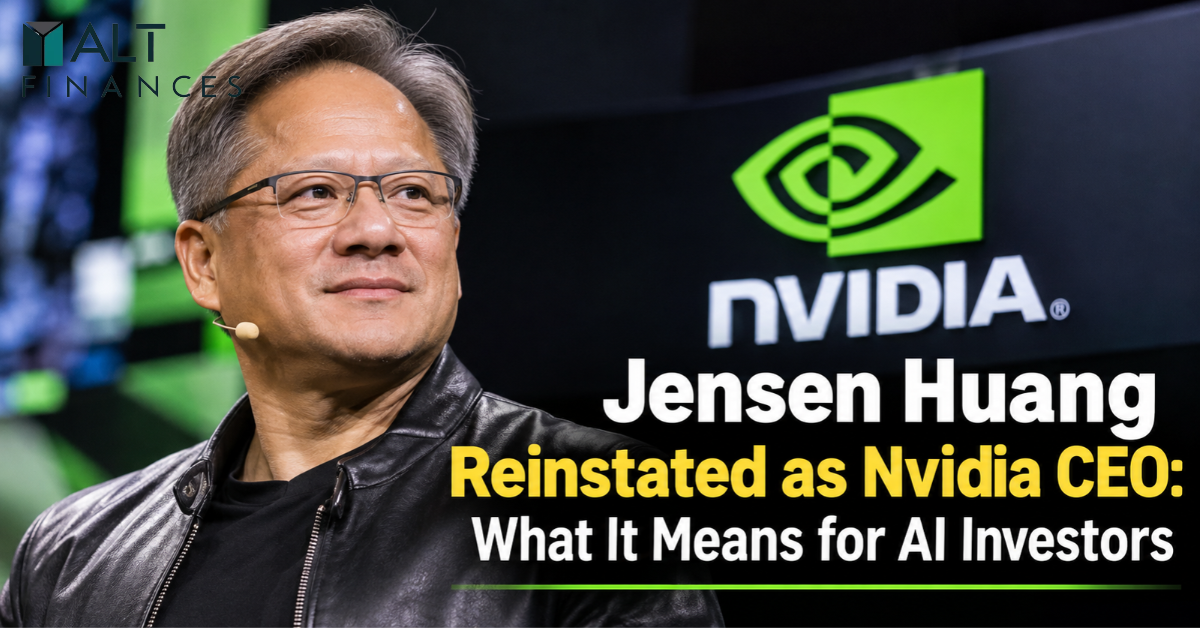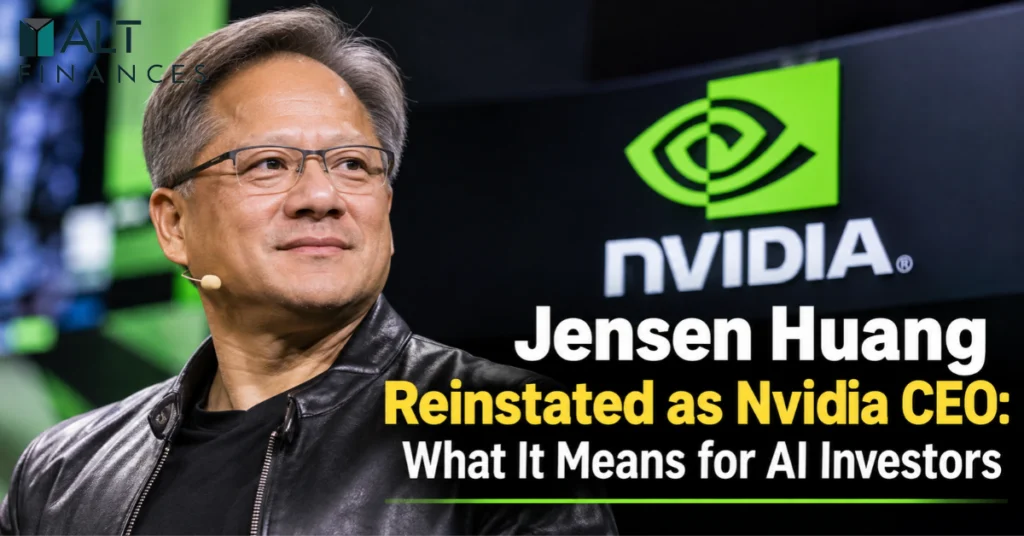
On November 23, 2026, Nvidia’s board voted unanimously to bring back co-founder Jensen Huang as president, CEO and board member, effective immediately, eleven days after he resigned. The move settles a leadership question at the world’s most closely watched AI chipmaker. But a continuing board investigation, government scrutiny and new compliance changes mean investors still have plenty to watch.
Few corporate stories in 2026 have moved as fast as this one. In under two weeks, Nvidia went from a resignation to a reversal. Jensen Huang reinstated as Nvidia CEO is now one of the biggest leadership stories of the year for anyone who owns, tracks or builds around AI stocks. This guide explains what happened, why the board changed course, how markets and political figures reacted, and what Huang’s return to Nvidia could mean for investors heading into 2027. It builds on our earlier look at Nvidia’s leadership transition.
What Happened: Nvidia Reinstates Jensen Huang
According to Nvidia’s official press release, the board of directors voted unanimously to reinstate Huang as president and chief executive officer and as a member of the board. The company said the decision followed a series of discussions and meetings with Huang, after which the board was satisfied with his candor and ability to lead Nvidia. The same announcement was filed with the U.S. Securities and Exchange Commission in an SEC Form 8-K filing.
The board also said it received input from senior levels of the U.S. government and, based on that input, is confident that Huang’s reinstatement poses no national security risk. Colette Kress, who served as interim CEO, continues in her role as chief financial officer. Harvey C. Jones remains board chair.
In the release, Huang said he was honored to return to Nvidia and described the company as leading at the start of a new industrial revolution. He also thanked the board, Kress, employees, shareholders and partners for their support.
Timeline: From Resignation to Nvidia CEO Comeback
- November 10: Anthropic’s updated IPO filing disclosed that Nvidia had agreed to take part in a private share placement tied to the offering.
- November 11: Media reports, including from The New York Times, described a second alleged personal relationship involving Huang, adding to pressure on the company.
- November 12: Nvidia announced that its board had accepted Huang’s resignation with immediate effect.
- November 17: Nvidia reported third-quarter fiscal 2027 results and announced a new board committee on national security and export control.
- November 19: Anthropic’s shares were scheduled to begin trading on the Nasdaq under the ticker ANT.
- November 23: Nvidia’s board reinstated Huang as president, CEO and director.
The reinstatement came only days after the board had ruled out his return, according to ABC News reporting, which makes the reversal even more notable.
Why the Board Brought Huang Back
Nvidia’s stated reasoning is straightforward. Board chair Harvey Jones said the board believes Huang is the right person to lead the company and that his return serves the interests of stockholders, employees, partners and customers.
Several practical factors help explain the decision:
- Founder influence. Huang co-founded Nvidia and has been closely identified with its strategy for decades, from gaming graphics to the data-center chips that train modern AI models.
- Customer and partner confidence. Nvidia’s biggest customers plan multi-year infrastructure builds. Leadership uncertainty can complicate long-term planning on both sides.
- Stock pressure. Shares slumped after the resignation, according to Canadian press coverage, which added urgency for a resolution.
- Government input. The board’s statement that it consulted senior U.S. officials suggests it wanted to address national security questions before acting.
Importantly, the board did not close the matter. It said the independent-director committee investigating reports that Huang was the target of a foreign intelligence effort will proceed to conclusion, and that Huang supports the investigation and will cooperate. Nvidia also said it will continue to cooperate with ongoing government investigations and inquiries.
Reaction: Trump, Tech Leaders and Employees
Political and industry reaction was quick. Before the decision, CBS News reported that President Donald Trump said he “would not mind” seeing Huang reinstated, and that he also floated former Apple CEO Tim Cook as a possible replacement. After the announcement, ABC News reported that Trump congratulated Nvidia on what he called a “great” decision.
CBS News also reported that Elon Musk, other technology executives and Nvidia employees had signed a petition calling for Huang’s return. We did not find direct on-the-record quotes from those signatories in the sources reviewed, so this article does not attribute any to them.
It is also worth noting that, according to Associated Press reporting carried by Canadian outlets, Huang has lobbied Washington to loosen limits on sales of Nvidia chips to China. That policy debate is one reason his status carries weight well beyond the company itself.
Market Reaction: How Investors Responded
Investors reacted strongly. Local news coverage reported that Nvidia shares jumped by more than 30 percent in early trading on Monday after the announcement. Readers should check a live quote for the current price, since early-session moves can change quickly.
Whatever the final closing figure, the direction was clear: markets treated the news as a relief. That fits a pattern seen across 2026, when market volatility in individual stocks and sectors stayed high even when broad indices looked calm. A single company’s leadership news can swing sentiment for an entire group of AI-linked stocks, from chip designers and memory makers to cloud providers and data-center suppliers.
The Anthropic IPO Timing and Nvidia’s $10 Billion Commitment
The timing of the reinstatement drew attention because it followed the debut of Anthropic’s public offering. According to reporting on Anthropic’s filing, seven technology companies agreed to buy about $26 billion of non-voting shares at the IPO price through a private placement. Nvidia and Google were each reported at about $10 billion, with AMD, Broadcom, Micron, Microsoft and TSMC taking smaller amounts. Trading was scheduled to begin November 19 under the ticker ANT.
Two points of accuracy matter here:
- The ticker ANT refers to Anthropic, the AI company behind the Claude assistant, not to any other company with a similar name.
- The commitment pre-dated the resignation. The agreement was disclosed in the filing before Huang stepped down on November 12. The purchase was due to be completed at the IPO price while he was out of the role. Check the latest filings for the final settled amount rather than relying on early reports.
For investors, the link matters for one reason. Nvidia’s large investments in AI customers tie its chip sales to those customers’ funding and growth, so the health of the AI IPO market and Nvidia’s own leadership stability are connected stories.
What It Means for AI Investors
The return of Huang as Nvidia CEO cuts both ways. A balanced view includes the upside, the risks and a short watch list.
The Bullish Case
- Continuity. Huang’s return removes the near-term uncertainty over who sets Nvidia’s product roadmap and customer strategy.
- Board unity. A unanimous vote signals that directors, after weeks of scrutiny, backed one clear direction.
- Government dialogue. The board’s reported consultation with senior U.S. officials may help reduce one source of regulatory uncertainty.
- Stronger controls. New committees and a planned chief compliance officer could improve oversight of export and trade rules over time.
The Bearish Case and Risks
- The investigation is not finished. The independent committee’s review continues, and its findings could still matter.
- Export policy risk. Rules on advanced chip sales to China remain a major swing factor for Nvidia’s revenue and for investor sentiment.
- Key-person risk. The episode shows how heavily the company’s identity and market value rest on one founder.
- Valuation risk. A sharp one-day rally can price in good news quickly, leaving less room for disappointment.
What to Watch Next
- Updates from the board’s independent investigation.
- Any new U.S. export rules affecting advanced AI chips.
- The selection of Nvidia’s first chief compliance officer.
- Demand signals from large AI infrastructure customers.
- How newly listed AI companies trade as the year ends.
Investors following broader AI and crypto integration themes should also note how AI-linked assets can move together when a bellwether like Nvidia makes headlines.
Governance and Compliance Changes at Nvidia
Beyond the CEO decision, Nvidia outlined structural steps. It formed a National Security and Export Control Committee made up solely of independent directors to oversee trade compliance and national security risks. That committee is engaging counsel with national security experience. The company is also searching for a chief compliance officer who will oversee compliance across Nvidia and report to the Nominating and Corporate Governance Committee.
These steps matter because Nvidia sits at the center of both the AI boom and the technology policy debate between Washington and Beijing. Stronger governance will not remove that exposure, but it can show shareholders that the board is taking it seriously.
Bottom Line
With Jensen Huang reinstated as Nvidia CEO, the company has resolved its most visible leadership question in time for the new year. Markets welcomed the news, political figures weighed in, and the board has promised a more rigorous compliance structure. Yet the investigation is still open, export policy remains unsettled and one-day rallies are not a forecast. For AI investors, the sensible approach is to follow verified filings and official statements, size positions carefully and avoid treating any single headline as a trading signal.
Frequently Asked Questions
When was Jensen Huang reinstated as Nvidia CEO?
Nvidia announced on November 23, 2026 that its board unanimously reinstated Jensen Huang as president, CEO and board member, effective immediately. He had resigned on November 12.
Why did Nvidia bring back Jensen Huang?
The board said it was satisfied with Huang’s candor and ability to lead after a series of meetings, and that it believes he is the right person to lead Nvidia. It also said it consulted senior U.S. government officials and is confident his return poses no national security risk.
Is the investigation into Nvidia over?
No. The board said its independent-director committee will continue its investigation to conclusion, and that Nvidia will keep cooperating with ongoing government investigations and inquiries.
How did Nvidia stock react to Huang’s return?
Local news reports said Nvidia shares rose by more than 30 percent in early trading on November 23. Check a live market quote for current figures.
Who is leading Nvidia now?
Jensen Huang resumed his role as president and CEO. Colette Kress, who was interim CEO, continues as chief financial officer, and Harvey Jones remains board chair.
What does the Anthropic IPO have to do with this?
Nvidia agreed to buy about $10 billion of shares in a private placement tied to Anthropic’s IPO, which was scheduled to begin trading on November 19 under the ticker ANT. The agreement was disclosed before Huang’s resignation.
This article is for general information only and is not financial, investment or legal advice. Figures and events reflect public reports as of November 23, 2026 and may change. Allegations mentioned are reports only and are not established facts.

Administrator at Alt Finances, leading editorial strategy and contributing in-depth coverage of investing, wealth management, alternative assets, and global financial markets. Through research-driven articles and analysis, he helps readers understand the ideas, industries, and market forces shaping modern finance.