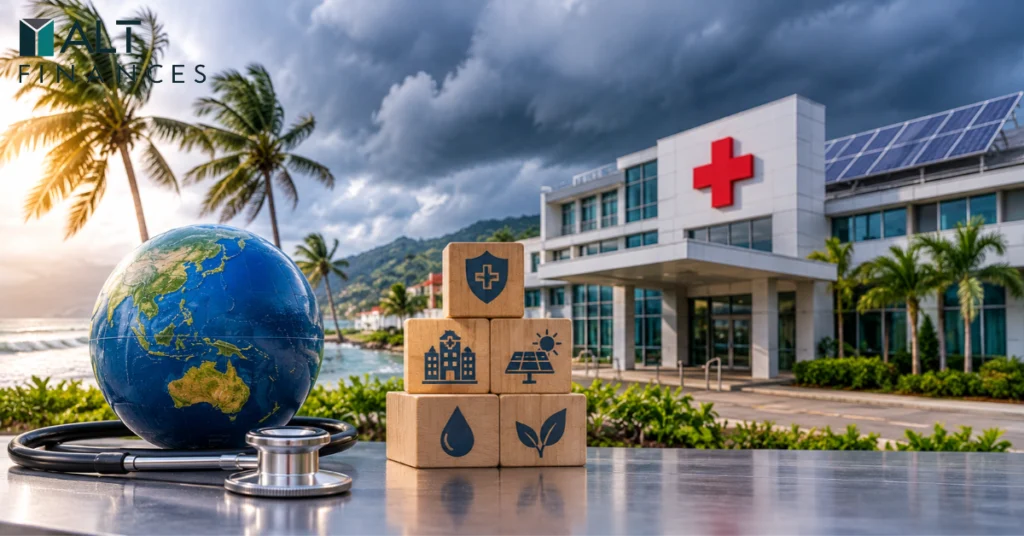
Climate change is creating a financial problem for healthcare systems that extends well beyond the cost of treating climate-related illness. Hospitals, clinics, pharmaceutical supply chains and medical infrastructure increasingly face exposure to extreme heat, flooding, storms, water shortages and electricity disruptions. When these systems fail, the consequences include damaged facilities, interrupted treatment, higher operating costs and additional pressure on public budgets.
For investors, this creates a developing infrastructure challenge: healthcare facilities must become more resilient, but the capital required to protect them is not consistently reflected in healthcare investment plans.
The issue is attracting greater attention in 2026. Governments, development banks and institutional investors are examining how to finance healthcare systems that can maintain essential services under worsening climate conditions. However, the opportunity is not simply a new commercial market. It sits at the intersection of infrastructure investment, public finance, climate adaptation and social protection.
Understanding the Climate-Health Investment Gap
The scale of the financing shortfall is becoming clearer. The 2026 Lancet Countdown’s health adaptation finance indicator examined 79 countries reporting adaptation plans. Of these, 48 identified health-related adaptation requirements totalling approximately US$3.3 billion annually. Declared international finance for health adaptation in those countries amounted to approximately US$1.1 billion in 2024, equivalent to one-third of their stated annual requirements.
This comparison is important, but it needs context. The figures reflect countries with disclosed, costed needs and tracked international finance, rather than every country’s domestic spending or the complete global requirement. The researchers also identify gaps in reporting and inconsistent timeframes. The figures therefore indicate a substantial funding shortfall within the measured group, not a definitive global market-size estimate.
The Asian Development Bank’s October 2026 paper, Closing the Financing Gap for Climate-Resilient Health Systems, highlights another problem: funding remains fragmented, difficult to access and insufficient, particularly in vulnerable countries. It identifies five priorities, including stronger financial institutions, better coordination of domestic and international funding, improved access to public finance, private-sector participation and financing mechanisms suited to different health-system needs.
The challenge is not only raising additional money. It is directing capital towards projects that can be implemented, maintained and measured.
Why Healthcare Infrastructure Needs Climate Protection
Healthcare facilities are unusually sensitive to operational disruption. Hospitals depend on reliable electricity, clean water, temperature-controlled storage, functioning medical equipment and accessible transport networks. A failure in any of these systems can affect patient care.
Extreme heat increases demand for cooling while putting additional pressure on electricity networks. Flooding can damage buildings, medical equipment, access roads and nearby utilities. Storms may interrupt power and communications, while drought and water shortages threaten sanitation, sterilisation and essential clinical operations.
The risks also extend beyond hospital buildings. Pharmaceutical products, vaccines and some medical supplies require controlled storage and transport conditions. Disrupted logistics or unreliable refrigeration can compromise supply continuity. Meanwhile, changing disease patterns can increase demand for diagnostics, medicines and healthcare services in areas that may already have limited capacity.
The World Bank warns that climate change is expected to increase healthcare pressures while making it harder for health systems to respond. Its analysis estimates that excess health costs in low- and middle-income countries could reach at least US$21 trillion by 2050. This is a modelled estimate of broader climate-related health costs, not a forecast of hospital repair bills or an investable market.
For healthcare operators, the financial consequences are more immediate: emergency repairs, temporary closures, higher energy consumption, insurance costs, disrupted revenue and unplanned public expenditure. Preventative investment can reduce some of these exposures, although the savings depend on local conditions and the quality of implementation.
Where Investment Opportunities Are Emerging
Climate-resilient healthcare involves several areas of infrastructure and technology.
Resilient hospitals and clinics: Retrofitting existing facilities and designing new buildings to withstand flooding, storms and extreme temperatures can protect valuable assets. Better drainage, elevated critical equipment, stronger building systems and climate-informed site selection may reduce future disruption.
Energy and cooling: Hospitals require dependable electricity around the clock. Solar installations, battery storage, efficient cooling systems and backup power can improve continuity while reducing exposure to unreliable grids and volatile energy costs. Projects may offer measurable savings where energy expenses are high and financing arrangements are well structured.
Water security: Water-efficient equipment, treatment systems, storage and alternative supply arrangements can help facilities maintain sanitation and clinical operations during shortages.
Pharmaceutical storage and logistics: Temperature-controlled warehouses, reliable refrigeration, monitoring systems and more resilient distribution networks can protect medicines and vaccines from supply interruptions.
Digital infrastructure: Climate-risk analytics, disease surveillance, early-warning systems and telehealth platforms can help healthcare providers prepare for emergencies and maintain access when physical facilities become difficult to reach.
These opportunities do not all have the same financial characteristics. Energy systems, cooling upgrades and contracted logistics services may generate measurable revenue or operating savings. Flood protection, emergency preparedness and disease surveillance often produce wider public benefits that are harder for a private investor to capture directly.
How Climate-Resilient Healthcare Gets Financed
Public budgets remain essential because governments are responsible for healthcare access, emergency preparedness and much of the underlying infrastructure. However, limited fiscal capacity and competing spending priorities can delay resilience projects.
Development finance institutions and multilateral banks can provide long-term loans, technical assistance and concessional capital. Climate funds and grants may support projects that are socially important but cannot service commercial debt on their own.
Blended finance can combine public or philanthropic capital with private investment to reduce particular risks or improve project affordability. It may be useful for renewable energy, resilient facility upgrades and healthcare supply-chain infrastructure in markets where commercial financing is otherwise difficult. However, it cannot make an economically unviable project sustainable simply by adding private capital.
Private equity and infrastructure funds may participate where there is a credible revenue model. Examples include energy-as-a-service contracts, hospital infrastructure concessions, cooling systems, medical logistics and digital healthcare services. Public-private partnerships can also help deliver facilities and supporting infrastructure, provided contracts allocate construction, operating and climate risks transparently.
Green bonds and sustainability-linked financing may provide additional funding channels. Their credibility depends on clear use-of-proceeds rules, measurable performance targets and transparent reporting. A hospital project should not be labelled climate-resilient merely because it includes solar panels or carries a sustainability designation.
Why Institutional Investors Are Paying Attention
The World Economic Forum’s January 2026 analysis describes resilient health as an emerging investment frontier. It connects climate-related health risks with productivity, insurance liabilities, healthcare expenditure and supply-chain stability.
For institutional investors, healthcare resilience can fit within longer-term infrastructure strategies. Hospitals and essential medical services are critical assets, while energy, water and digital systems supporting them may offer opportunities for contracted services and operational improvements.
The International Finance Corporation provides examples of how private finance can contribute. Its work includes support for health facilities, pharmaceutical operations and resource-efficient buildings. In the Philippines, for example, IFC’s investment in Ayala’s US$100 million social bond supports the development of a specialty cancer hospital. In Thailand, its investment in Principal Capital has supported healthcare expansion incorporating resource-efficient design.
These examples demonstrate that private capital can support healthcare infrastructure. They should not, however, be interpreted as proof that every resilience project offers attractive investment returns. A cancer hospital or hospital-network expansion may have a commercial operating model, while flood protection for a rural public clinic may depend primarily on government or development funding.
The Barriers to Closing the Gap
The central difficulty is measuring the financial return on prevention. A hospital that avoids flood damage may protect patient care and prevent emergency expenditure, but the avoided loss does not necessarily appear as additional revenue. Benefits may be spread across governments, insurers, patients and local economies.
Developing countries face additional constraints. Borrowing costs can be high, public budgets are limited and basic infrastructure may already be inadequate. Projects can also struggle with limited technical capacity, weak climate-risk data and fragmented responsibilities between health, finance, energy and infrastructure agencies.
High-income countries have greater access to capital, insurance markets and established infrastructure systems, but they still face expensive retrofits and ageing facilities. Their challenge is often upgrading existing assets without disrupting services. In lower-income and climate-vulnerable countries, the problem may be more fundamental: financing essential healthcare capacity while protecting it against future climate exposure.
There is also an equity concern. Commercial investors may favour urban hospitals, established healthcare groups and projects with predictable revenue. Remote clinics and vulnerable communities may have the greatest need but the weakest ability to pay. Public grants and concessional finance therefore remain necessary to prevent investment from concentrating only in profitable locations.
Conclusion: Healthcare Resilience as a Long-Term Investment Priority
Climate-resilient healthcare is becoming a more important part of infrastructure and adaptation finance. The 2026 financing evidence shows that declared international funding remains below the costed needs reported by many developing countries, while the ADB’s latest work highlights the need for better coordination and more accessible financing.
There are genuine opportunities for private investors in energy, cooling, logistics, digital systems and healthcare infrastructure. But resilience cannot be treated as a conventional asset class in which every project is expected to generate a direct financial return.
Its broader value lies in protecting essential services, reducing future losses and strengthening economic stability. The most effective financing models will combine commercial capital where revenue is credible with public and concessional funding where the benefits are primarily social. In that sense, climate-resilient healthcare is not simply a new investment theme. It is becoming a necessary condition for protecting the long-term value of healthcare infrastructure itself.
Frequently Asked Questions
1. What is climate-resilient healthcare infrastructure?
It refers to hospitals, clinics, utilities, supply chains and healthcare services designed or upgraded to continue operating during climate-related hazards such as heatwaves, floods and storms.
2. What is the climate-health investment gap?
It is the difference between the funding required to protect healthcare systems from climate risks and the finance currently identified or made available for those measures.
3. Why is climate change creating financial risks for healthcare systems?
Climate hazards can damage facilities, interrupt electricity and water supplies, disrupt medical logistics, increase operating expenses and raise demand for healthcare services.
4. Where are the biggest investment opportunities?
Potential areas include resilient hospital construction, renewable energy, efficient cooling, water infrastructure, pharmaceutical logistics, early-warning systems and climate-risk analytics.
5. How can private investors finance climate-resilient hospitals?
They may invest through hospital ownership, infrastructure funds, public-private partnerships, energy-service contracts or financing for specific facility upgrades, depending on the project’s revenue model and risk allocation.
6. What role do development banks and blended finance play?
Development banks can provide long-term or concessional financing and technical support. Blended finance can help attract private capital to projects where public benefits or market risks make conventional financing difficult.
7. Is climate-resilient healthcare becoming an alternative investment opportunity?
Some parts of the sector offer investable commercial opportunities, but many essential resilience measures depend on public or development finance. It is best understood as an emerging infrastructure investment theme and a core element of climate adaptation.

Ana Goldenberg is a Contributing Editor at Alt Finances with a career rooted in the high-stakes worlds of banking and private placements. From profiling global philanthropists to managing complex financial operations at Wells Fargo, she bridges the gap between editorial storytelling and disciplined financial expertise.