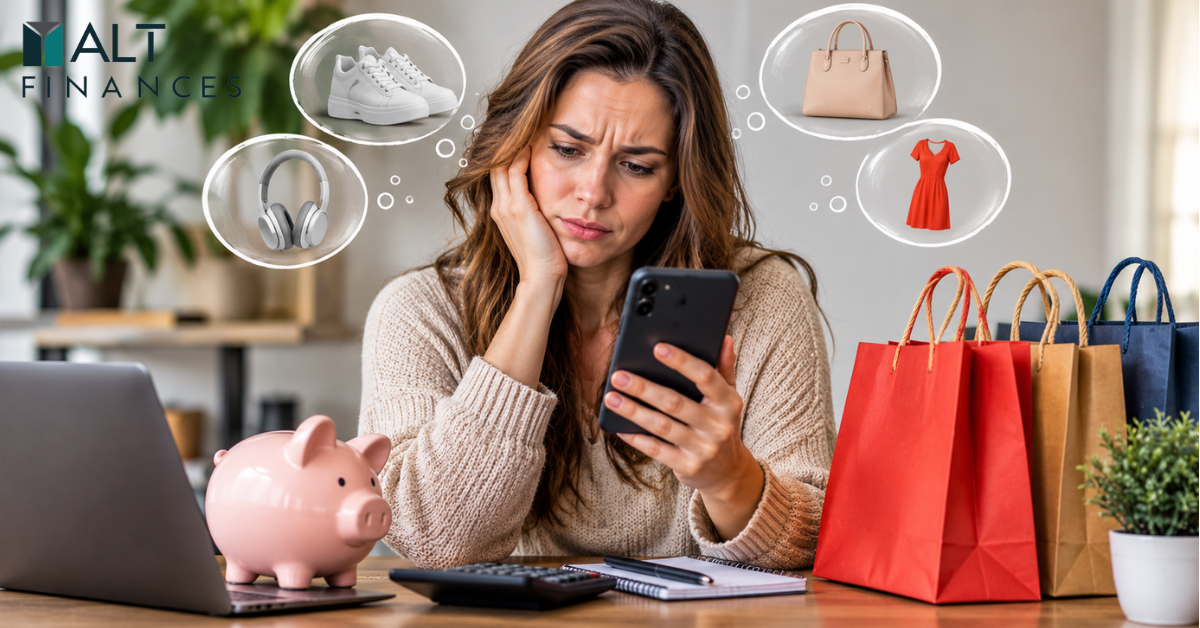
You open a shopping app to look for one item, notice a limited-time offer, and end up buying three things you never planned to purchase. The order feels satisfying at first. A few days later, when checking your bank balance, you may wonder whether those purchases were worth it.
This familiar experience illustrates the psychology of impulse spending: the way emotions, habits, marketing and purchasing environments influence decisions about money. An occasional spontaneous purchase is not necessarily a problem. However, repeated unplanned spending can gradually compete with essential bills, emergency savings and long-term financial goals.
The solution is not simply to exercise more willpower. Stress, boredom, social pressure and the convenience of digital payments can make buying feel easier than stopping to think. Understanding these influences can help people build practical safeguards around their spending.
As shopping becomes increasingly integrated with smartphones, personalized advertising and installment-payment options, learning to recognize spending triggers is an important part of personal financial management in 2026.
What Is Impulse Spending?
Impulse spending occurs when someone makes an unplanned purchase with little consideration beforehand. The decision may happen in seconds, driven by an attractive offer, a sudden desire or an emotional response.
It differs from planned spending, in which a person considers a purchase in advance, compares alternatives and checks whether it fits the budget.
Not every impulse purchase is financially harmful. Buying an inexpensive treat occasionally may fit comfortably within a person’s spending plan. Problems are more likely when purchases repeatedly exceed available funds, create debt or undermine priorities such as paying bills and saving for emergencies.
Behavioral finance the study of how psychological factors influence financial decisions helps explain why people do not always act according to their long-term interests. A person may understand the importance of saving but still prefer an immediate reward over a future benefit.
Recognizing this conflict is the first step toward changing a habit without treating every unplanned purchase as a personal failure.
The Emotional Triggers Behind Impulse Purchases
Stress, boredom and emotional rewards
Shopping can offer a temporary distraction from an unpleasant feeling. Someone experiencing a difficult day may purchase clothing, electronics or food because browsing and buying provide something enjoyable to focus on.
Excitement can have a similar effect. A promotion, new product or anticipated event may create an urge to act before the opportunity disappears.
However, the immediate reward does not necessarily resolve the underlying emotion. If shopping becomes a repeated response to stress or boredom, the person may return to the same behavior whenever those feelings arise.
Stress can also complicate decision-making. The American Psychological Association’s research on stress and decision-making explains how stress may make careful evaluation more difficult and encourage people to rely on simpler, more habitual responses.
A useful approach is to identify what happens immediately before an unplanned purchase. Was it frustration, loneliness, boredom, celebration or a desire for reassurance? Recognizing the pattern creates an opportunity to choose a different response.
Present bias and instant gratification
Present bias describes the tendency to give immediate rewards greater weight than future benefits. Spending money today provides an immediate, tangible experience, while the benefit of saving may feel distant.
For example, spending $60 on an unplanned purchase may feel more rewarding in the moment than keeping that money toward an emergency fund. Repeated decisions of this kind can make a larger financial goal harder to achieve.
Discounts can intensify the effect. A shopper may focus on the amount supposedly saved rather than the total price paid. But a discounted item that was never needed does not automatically represent a financial saving.
Social influence also matters. Seeing friends buy new products or encountering carefully curated lifestyles online can make spending feel normal or necessary. Comparing purchases with other people’s lifestyles can encourage decisions based on appearances rather than personal priorities.
How Marketing and Digital Payments Encourage Spending
Digital shopping has reduced the effort required to make a purchase. Saved card details, one-click checkout, shopping notifications and personalized recommendations allow consumers to move from seeing an item to buying it with very little delay.
These features are convenient, but convenience can also remove opportunities to reconsider a decision.
Limited-time promotions, countdown timers and messages about low stock may create urgency. Targeted advertising can repeatedly present products related to browsing activity, keeping potential purchases in view even when the shopper had no intention of buying them.
Buy-now-pay-later (BNPL) services introduce another consideration. Dividing a purchase into installments can make the initial payment appear manageable, but it does not eliminate the total cost. Several payment plans can overlap, creating obligations that are harder to track.
Important 2026 update: An April 2026 article in the American Psychological Association’s Monitor on Psychology examined how BNPL services and digital shopping environments may increase spending risks. The article highlighted how installment payments can make the full cost less prominent at the point of purchase and how online shopping removes some of the natural pauses that occur in physical stores.
The lesson is not that every digital payment or installment plan is harmful. Rather, consumers should assess the total price, payment schedule and affordability before committing.
The Financial Cost of Unplanned Spending
The financial impact of impulse spending often develops through repetition rather than a single large purchase.
Consider someone who spends an extra $12 on three separate days each week. That amounts to $36 weekly, or approximately $1,872 over 52 weeks if the pattern continues. This is an illustration, not a prediction of what every shopper will spend, but it shows how modest purchases can accumulate.
Repeated overspending can have several consequences:
- Less money for savings: Funds used for unplanned purchases are no longer available for emergencies, education or other priorities.
- Greater reliance on credit: If spending exceeds available cash, credit cards or installment plans may cover the difference. Interest and fees can increase the cost of purchases.
- Budget disruption: Small purchases can make it harder to estimate how much remains for groceries, transport, housing and other essentials.
- Delayed financial goals: Money spent impulsively cannot simultaneously contribute to paying down debt or building investments.
A realistic spending plan helps make these trade-offs visible. People developing a longer-term approach to their finances can also explore the basics of investing in mutual funds to understand how planned investing differs from day-to-day spending decisions.
Practical Ways to Control Impulse Spending
1. Use a waiting period
For nonessential purchases, wait 24 hours before buying. For expensive items, consider extending the pause to 48 hours or longer.
Add the item to a wishlist rather than immediately checking out. During the waiting period, ask whether you still want it, whether you already own something similar and whether the purchase fits your budget.
The aim is to create space for a deliberate decision, not to prohibit every enjoyable purchase.
2. Set a discretionary spending limit
Create a budget that separates essential expenses, savings, debt payments and optional spending. Set a realistic amount for discretionary purchases and track how much remains throughout the month.
A budget should reflect actual income and costs rather than an idealized lifestyle. If a strict limit is difficult to maintain, start with a manageable adjustment and review the results regularly.
3. Track purchases and emotional triggers
Record unplanned purchases, including their cost, time and circumstances. Note whether the purchase followed stress, boredom, a social event or an online promotion.
After a few weeks, look for recurring patterns. Someone who frequently shops late at night, for example, might benefit from removing shopping apps from their phone or establishing a no-purchase rule after a certain time.
Tracking also reveals where money is going without requiring judgment about every transaction.
4. Make shopping less automatic
Unsubscribe from promotional emails that encourage unnecessary purchases. Turn off shopping notifications, remove saved payment details and avoid browsing retail apps when there is nothing specific to buy.
These small changes introduce additional steps between desire and payment. The Consumer Financial Protection Bureau’s guidance on managing spending discusses the challenges people face when trying to follow budgets and the value consumers place on feedback that helps them monitor spending.
5. Create alternatives to emotional spending
If shopping has become a way to manage difficult feelings, identify alternative activities that provide relief or enjoyment. A walk, a conversation with a friend, exercise, a hobby or time away from screens may help interrupt the routine.
The alternative does not need to eliminate the emotion. It simply provides another option before money is spent.
6. Connect spending decisions to longer-term goals
Give savings a clear purpose, such as an emergency reserve, a planned trip or future education costs. Automating a manageable transfer to savings after receiving income can reduce the need to make the same decision repeatedly.
For readers building broader financial habits, understanding low-cost index funds can be one part of learning about long-term investing. Investment decisions should come after essential expenses, suitable emergency savings and relevant debt obligations have been considered.
Conclusion
The psychology of impulse spending shows why better financial habits require more than willpower. Emotions, immediate rewards, advertising and frictionless payment systems can all influence how people use their money.
Recognizing personal triggers, pausing before nonessential purchases, tracking spending and setting realistic limits can make financial decisions more intentional. Progress does not require eliminating every spontaneous purchase. It means making room for enjoyment while protecting essential expenses, savings and future goals.
With consistent safeguards, consumers can build a healthier relationship with spending and make choices that better reflect what matters to them.
Frequently Asked Questions
1. What causes impulse spending?
Common influences include stress, boredom, excitement, social pressure, attractive promotions and the desire for immediate rewards. Easy digital checkout can also reduce the time spent considering a purchase.
2. How does emotional spending affect financial health?
When emotional spending becomes frequent, it can reduce savings, disrupt budgets and contribute to debt. The effect depends on how often it happens, how much is spent and whether essential financial commitments are affected.
3. How can I stop impulse buying?
Start by identifying triggers, setting a discretionary spending limit, tracking purchases and introducing a waiting period for nonessential items. Reducing shopping notifications and saved payment details can also help.
4. Does waiting before purchasing really help?
A waiting period creates time to compare the purchase with your needs and budget. It will not prevent every unnecessary purchase, but it can reduce decisions made entirely in the heat of the moment.
5. How can I avoid impulse purchases when shopping online?
Use a shopping list, disable promotional notifications, remove saved payment details and leave items in your basket before deciding. Check the full price and any installment obligations before confirming an order.
6. When should someone seek help for compulsive spending?
Consider speaking with a qualified mental health professional or financial counselor if spending feels difficult to control, repeatedly causes serious debt or conflict, or continues despite harmful consequences. Occasional impulse buying alone does not establish a psychological disorder.
Disclaimer: This article is for informational purposes only and does not constitute individualized financial or psychological advice.

Contributing Editor for Alt Finances, vision-driven with 20+ years in family office, asset management, and corporate development. Holds UN Special Consultative Status and is 100 Women in Finance Board Chair. Tulane University – A.B. Freeman School of Business.