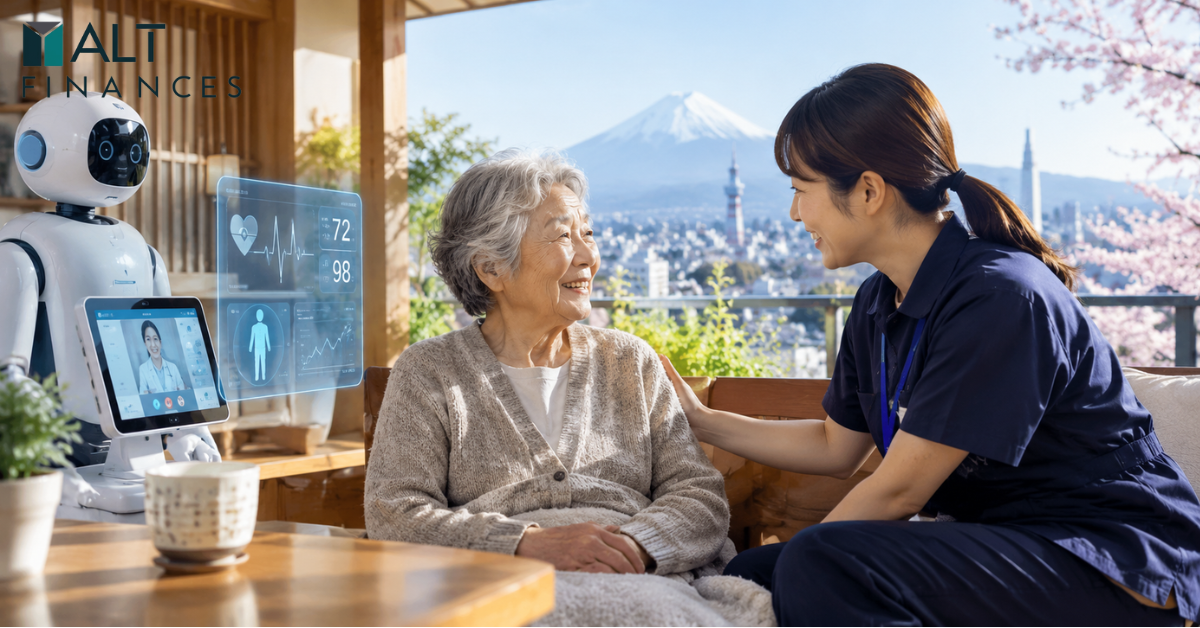
Japan faces a challenge that will become increasingly familiar around the world: helping people live not only longer, but healthier, more independent and socially connected lives. In September 2026, Japan’s population of people aged 100 and over surpassed 100,000, while older adults already represented nearly 30% of the population, according to a report published by the World Economic Forum.
Longer life expectancy is a significant achievement, but it also raises difficult questions. Who will provide care as demand increases? How can older adults maintain independence? And can technology help without making later life more isolated?
Japan’s response combines healthcare innovation, artificial intelligence (AI), assistive technology and community support. Its experience offers a useful lesson: technology may improve the experience of ageing, but it cannot replace the relationships, accessible services and human attention that make life meaningful.
Why Japan Is Rethinking Healthy Ageing
Japan’s demographic shift affects more than hospitals and care homes. A growing older population increases demand for long-term care while a smaller working-age population can make it harder to staff essential services and support public finances.
The distinction between lifespan and healthy life expectancy is therefore important. Lifespan measures how long people live; healthy life expectancy estimates how long they live in good health. A longer life does not necessarily mean a person can remain free from illness or carry out everyday activities without assistance.
The World Economic Forum’s report on Japan’s approach to healthy ageing describes the country’s efforts to use technology alongside social and community initiatives. These include tools intended to support self-care, maintain social participation and help older people remain independent for longer.
The objective is not to prevent every age-related condition. It is to help people retain their abilities, make choices and participate in society for as long as possible.
How AI and Robotics May Support Elder Care
Japan has been supporting the development and adoption of technologies for long-term care. In 2024, its Ministry of Economy, Trade and Industry and Ministry of Health, Labour and Welfare revised national priority areas for care technology, including systems intended to improve care quality, reduce the burden on care workers and support older people’s independence.
The potential applications are practical rather than futuristic.
- Monitoring systems: Sensors can help detect movement patterns or possible falls and alert caregivers when attention may be needed.
- Assistive robotics: Devices can support mobility, transfers, rehabilitation and physically demanding care tasks.
- Digital care records: Connected systems can help care teams share information and coordinate support.
- AI-enabled tools: Some systems aim to support monitoring, communication or early identification of changes that may warrant further assessment.
These applications are not all equally mature. Some technologies are available for use in care settings, while others remain under development or require more evidence about their effectiveness and affordability. Their presence in a national policy framework does not mean they have been adopted universally or proven successful in every setting.
The practical test is whether a tool solves a real problem. If a sensor helps a care worker identify a fall risk earlier, it may improve safety. If a robot reduces the physical strain of moving a person, it may help preserve staff capacity. But equipment that is difficult to use, expensive to maintain or poorly integrated into care routines can add work rather than reduce it.
Technology should support professional judgement, not replace it.
Why Human Connection Remains Essential
Healthy ageing involves more than physical health. Relationships, social participation and the ability to make decisions also contribute to wellbeing.
The World Health Organization explains that social connection and reducing loneliness are important public health concerns. Social isolation and loneliness can affect physical and mental health, while effective responses may include community groups, befriending, accessible transport and suitable digital services.
Japan’s approach illustrates why technology and human connection need to be considered together. Digital communication tools may help someone stay in contact with family. Monitoring systems may help a person live more independently at home. Community services, mobile shops and accessible local facilities can also help older people maintain everyday contact and participation.
However, an AI companion is not the same as a trusted friend, relative or trained care worker. A conversational system may offer interaction, but it should not be assumed to eliminate loneliness or provide the emotional and clinical support that a person may need.
The risk is that technology becomes a substitute for human attention because it appears cheaper or easier to scale. A system designed to save staff time is valuable only if the resulting time is used well. If it simply reduces personal contact, the efficiency gain may come at the expense of wellbeing.
Japan’s Longevity Strategy: Prevention and Independence
A sustainable approach to ageing cannot depend entirely on treating problems after they emerge. Preventive healthcare, rehabilitation, suitable housing, physical activity and accessible community services can all help people maintain functional ability.
AI may contribute by identifying patterns in health information or helping services prioritise follow-up. Yet a warning generated by an algorithm is not a diagnosis. Data can be incomplete, systems can make mistakes, and health information must be handled securely. Clinical assessment and human oversight remain essential.
Independence also depends on the environment in which a person lives. A mobility aid is less useful where pavements are inaccessible. Remote consultations cannot solve every problem for someone without reliable internet access. Home-based care requires trained staff, suitable housing and a way to respond when a person’s needs change.
This is why Japan’s experience should be understood as a wider care-system challenge, not simply an AI initiative. Technology works best when healthcare providers, families, local authorities and community organisations can coordinate around the needs and preferences of each individual.
The Longevity Economy: Opportunity With Real-World Constraints
Japan’s ageing population is contributing to demand for assistive devices, care technology, home-based services, rehabilitation and digital health infrastructure. These areas form part of the broader longevity economy, which includes the products and services people may need as they live longer.
But demographic demand does not automatically make a business commercially successful. Care technology must be affordable for the organisations or households expected to pay for it. Providers may need evidence that a product improves outcomes or reduces costs before adopting it. Regulations, reimbursement arrangements, staff training and maintenance can also determine whether a promising system can scale.
There is a further question about who benefits from the savings. A monitoring tool might reduce hospital visits, for example, but the organisation paying for the technology may not be the one receiving the financial benefit. Without an appropriate funding model, a socially useful product can struggle to achieve widespread adoption.
For readers considering the economic implications of longer lives, retirement planning is another important part of the picture. Longer lives can mean longer periods of retirement, greater exposure to future care costs and a need to think carefully about income, savings and support over time. These are planning challenges, not reasons to assume that every ageing-related business represents an attractive investment.
The Risks of an AI-First Approach
Technology-led care creates several risks that policymakers and service providers need to address.
Privacy and consent: Monitoring systems can collect sensitive information about movement, routines and health. Older adults should understand what is collected, why it is needed and who can access it.
Safety and reliability: An inaccurate alert or a missed warning can have serious consequences. Systems need testing, maintenance and clear procedures for human intervention.
Digital exclusion: Not everyone has the same access to devices, connectivity or digital skills. Services must remain accessible to people who cannot or do not wish to use a particular technology.
Workforce pressures: Automation may reduce some repetitive tasks, but it cannot remove the need for trained staff, personal care and accountability. Technology should improve working conditions and care quality rather than become an excuse to under-resource services.
Unequal access: If effective tools are available only to people who can afford them, technology may widen existing differences in health and independence.
These risks do not mean Japan should avoid innovation. They mean that the success of a system must be measured by outcomes for people, not simply by how many devices have been installed.
What Other Countries Can Learn From Japan
Japan’s experience is relevant to countries facing different levels of population ageing, workforce pressure and healthcare capacity. However, its approach cannot be copied wholesale. Each country has its own care system, public finances, housing conditions, workforce and cultural expectations.
Three principles are broadly useful.
First, assess technology against a clearly defined need. Second, involve older adults and care workers in decisions about how systems are designed and used. Third, measure whether an intervention improves safety, independence, access or quality of life not merely whether it reduces costs.
Human connection must remain part of that measurement. A service that keeps someone physically safe but leaves them isolated may not meet the wider goals of healthy ageing.
Conclusion
Japan’s longevity strategy is about more than helping people reach the age of 100. Its deeper challenge is to make additional years healthier, more independent and socially connected while maintaining a care system that people can access and afford.
AI, sensors and assistive robotics may help care workers, support earlier intervention and enable more people to live independently. But technology alone cannot guarantee better ageing. Its value depends on reliable implementation, fair access, privacy safeguards and the continued presence of human care.
For societies preparing for longer lives, the central lesson is straightforward: innovation should strengthen the relationships and services that support people, not replace them. A successful longevity strategy will be measured not only by how long people live, but by the dignity, choice, connection and quality of life they experience along the way.
Frequently Asked Questions
What is Japan’s longevity strategy?
It is an evolving approach to supporting longer, healthier and more independent lives through healthcare, care technology, prevention and social participation. It should not be understood as a single programme or a completed solution to population ageing.
How is AI being used in elderly care in Japan?
Potential and emerging uses include monitoring systems, digital care coordination and tools intended to support self-care or identify changes that may need attention. Adoption and evidence vary by application.
Can AI companions eliminate loneliness?
There is not sufficient evidence to conclude that AI companions can eliminate loneliness. Digital tools may offer interaction, but meaningful relationships, community participation and appropriate human support remain important.
Does eldercare technology replace human caregivers?
No. It can assist with selected tasks and may reduce some physical or administrative burdens, but personal care, professional judgement and human relationships remain essential.
What does Japan’s experience mean for the longevity economy?
It highlights demand for services that support independence and care, while showing that adoption depends on affordability, evidence, regulation, workforce capacity and real-world outcomes.
Disclaimer: This article is for informational purposes only and is not individualized medical, financial or investment advice.

Ana Goldenberg is a Contributing Editor at Alt Finances with a career rooted in the high-stakes worlds of banking and private placements. From profiling global philanthropists to managing complex financial operations at Wells Fargo, she bridges the gap between editorial storytelling and disciplined financial expertise.