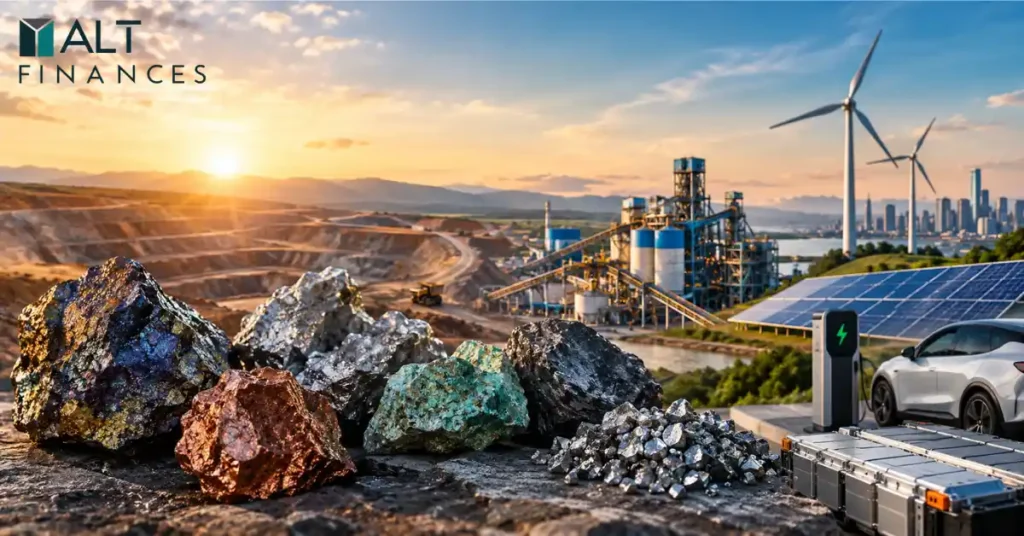
In commodity markets, scarcity becomes valuable when an industrial system cannot easily function without the material in short supply. That is increasingly relevant to critical minerals investment, as electrification, digital infrastructure, advanced manufacturing and defence depend on materials whose supply can be geographically concentrated, difficult to expand and slow to replace.
The investment question is therefore becoming more complicated than whether demand for a mineral is rising. It is whether supply can respond, who controls the processing capacity, how easily the material can be substituted, and whether scarcity creates enough economic value to compensate investors for geological, operational and political risk.
The emerging chain is straightforward:
Industrial Demand → Supply Constraint → Scarcity → Strategic Value → Pricing Power → Investment Opportunity
But the final step is never automatic.
What Makes a Mineral “Critical”?
“Critical” does not simply mean rare. It is an economic and policy classification that generally combines the importance of a material with the risk that its supply could be disrupted.
The United States, European Union and other jurisdictions use different methodologies and lists. The EU’s framework, for example, identifies critical raw materials according to economic importance and supply risk, while its strategic raw materials framework focuses on materials particularly important to strategic sectors such as energy, digital technology, aerospace and defence.
The U.S. Department of Energy similarly assesses materials according to supply risk and importance to energy technologies, incorporating factors such as producer diversity, political and regulatory conditions, competing demand and substitutability.
This distinction matters for investors. A mineral becomes economically significant when it combines several characteristics:
Essential + Difficult to Substitute + Geographically Concentrated + Slow to Develop + Strategically Important
That combination can turn resource scarcity into economic scarcity.
The Critical-Minerals Premium
The concept of a critical-minerals premium is best understood as the additional strategic value that can emerge when an essential material is difficult to source reliably.
Normal commodity value is primarily determined by supply, demand, costs and market conditions. Strategic scarcity adds another dimension: the economic cost of disruption.
Supply concentration illustrates the point. The OECD reports that the three largest producing countries account for more than two-thirds of global production of cobalt, lithium and nickel, while concentration is even higher for graphite and rare earth elements.
The IEA’s 2026 outlook also finds that refining remains highly concentrated. The average share of the largest refined supplier for key energy minerals reached 70% in 2025, up from 68% in 2020.
That concentration can matter even when a market is not technically short of material. A supply chain can appear adequately supplied while remaining vulnerable to a disruption affecting its dominant producer or processor.
The premium, however, is not permanent. It can disappear when:
New Supply + Substitution + Recycling + Demand Reduction
outpaces demand growth.
Geological Scarcity Is Not Investable Scarcity
Four different concepts need to be separated.
Geological scarcity concerns how much of a mineral exists and where it occurs.
Economic scarcity concerns whether extracting that material is commercially viable at prevailing technology, costs and prices.
Supply-chain concentration concerns how much production or processing depends on a small number of countries, companies or facilities.
Investable scarcity is the final step: whether scarcity creates durable economic value for a particular asset, company or infrastructure operator.
USGS makes an important distinction between resources and reserves. A resource represents material for which economic extraction is currently or potentially feasible, while reserves are the portion that could be economically extracted at the time of determination. Reserves can change as prices, technology, exploration and extraction economics change.
That means a large mineral deposit is not automatically a valuable investment.
The economics still depend on:
Geology + Grade + Cost Curve + Infrastructure + Permitting + Processing + Commodity Prices + Capital Requirements + Management
Why Supply Is So Difficult to Expand
Mining supply responds slowly to price signals.
The sequence can involve:
Price Signal → Exploration → Feasibility → Permitting → Financing → Construction → Production
Each stage introduces uncertainty and capital requirements. A higher commodity price can improve project economics, but it does not instantly create a producing mine.
Infrastructure can be equally important. Remote deposits may require roads, railways, electricity, water systems and export facilities. Environmental requirements and community relations can affect project development as well.
This creates an important investment distinction. The market may value an undeveloped resource based on expected future production, while an operating mine is already exposed to actual costs, grades, recovery rates, financing requirements and commodity prices.
For critical minerals investment, the question is therefore not simply whether a deposit exists. It is whether the asset can become a competitive source of supply.
The Processing Bottleneck
The most valuable bottleneck may sit beyond the mine.
The mineral value chain extends from:
Mining → Concentration → Processing → Refining → Component Manufacturing → End-Use Demand
The IEA’s 2026 analysis highlights this problem. Supply diversification has progressed more slowly in refining and downstream manufacturing than in mining, leaving many supply chains highly dependent on concentrated processing capacity.
This creates opportunities that extend beyond mining companies. Processing facilities, smelters, refiners, recycling plants, logistics infrastructure and specialised equipment can become strategically important assets.
The investment analysis should therefore examine:
Mine Ownership + Processing Access + Refining Capacity + Logistics
rather than mine ownership alone.
Geopolitics Turns Minerals Into Strategic Assets
Critical minerals increasingly sit at the intersection of commodities, trade policy and national security.
The OECD reports that export restrictions on critical raw materials increased fivefold between 2009 and 2024 and reached historically high levels. Between 2022 and 2024, about 16% of global trade in monitored critical raw materials faced at least one export restriction. Exposure was particularly high for cobalt, manganese, graphite and rare earth elements.
Governments are responding by encouraging domestic production, diversification, recycling, strategic projects and alternative supply routes.
The EU’s Critical Raw Materials Act, for example, sets 2030 benchmarks for domestic extraction, processing and recycling while seeking to limit excessive dependence on a single third country.
For investors, geopolitical risk can therefore affect both the expected supply of a mineral and the valuation of assets operating along its supply chain.
Which Minerals Matter Most?
Critical minerals are not one homogeneous asset class.
Lithium is closely connected to battery demand, while copper has broader exposure to electricity networks and industrial infrastructure. Cobalt, nickel and graphite are important to battery supply chains but face different chemistry, processing and substitution dynamics.
Rare earth elements are particularly important for permanent magnets and advanced technologies. Smaller-volume materials such as gallium and germanium can have outsized strategic importance because of their applications in semiconductors, communications and other high-technology industries.
The IEA identifies gallium, magnet rare earths, yttrium, graphite, tungsten, tellurium, cobalt and germanium among materials with high supply-risk exposure, reflecting combinations of concentration, limited substitution and strategic applications.
This demonstrates why volume alone is a poor measure of strategic importance.
AI, Electrification and Industrial Demand
Mineral demand is being influenced by several industrial trends simultaneously.
Electric vehicles and batteries increase demand for selected battery materials. Electricity networks require large quantities of copper and other industrial materials. Renewable generation and storage add further mineral requirements. Meanwhile, semiconductors, advanced manufacturing, aerospace and defence depend on specialised materials with different supply characteristics.
The IEA expects demand for key critical minerals to continue growing strongly across its scenarios, with lithium showing particularly strong growth and copper recording the largest absolute volume increase through 2040. These are projections rather than guaranteed outcomes and depend on technology, policy and deployment assumptions.
That distinction is crucial. Rising demand does not automatically mean rising prices or mining profits.
How Investors Can Gain Exposure
Investors can access the theme through several parts of the value chain:
- Mining equities: direct exposure to company-level production and commodity prices.
- Royalty and streaming businesses: exposure to mining economics without operating the mine directly.
- Commodity funds: greater exposure to underlying commodity prices where suitable instruments exist.
- Private mining projects: potentially higher development and liquidity risk.
- Processing and refining companies: exposure to midstream bottlenecks.
- Infrastructure: exposure to logistics, power and processing systems supporting mineral supply.
- Recycling businesses: exposure to secondary mineral supply.
- Equipment suppliers: exposure to capital spending across the mining industry.
These exposures carry very different risks.
Mining equities can combine commodity-price risk with geological, operating, financing and political risks. A physical commodity does not have the same operating exposure, while a processing company may depend more heavily on throughput, energy costs and feedstock availability.
For institutional investors, family offices and alternative-asset managers, the relevant framework is therefore:
Resource Quality + Production Cost + Supply Concentration + Processing + Infrastructure + Geopolitics + Valuation + Balance Sheet
Recycling and Substitution Could Change the Equation
Scarcity is not static.
Technology can increase mineral intensity in one application while reducing it in another. Battery chemistry can change. Manufacturing can use materials more efficiently. Substitution can reduce demand for a particular mineral. Recycling can create additional supply without developing an entirely new mine.
The IEA estimates that recycling could substantially reduce the need for new mining in coming decades, with secondary supply playing a growing role through 2040.
This creates both an opportunity and a threat for investors. Recycling companies and technologies that recover scarce materials can become valuable parts of the supply chain, while incumbent producers could face weaker demand if technological substitution accelerates.
The critical question is not whether a mineral is critical today. It is whether its strategic importance remains durable.
Institutional Capital and Resource Scarcity
Critical minerals can fit within broader alternative-investment and real-asset strategies because they provide exposure to physical resources, industrial infrastructure and long-term supply-chain themes.
But these assets also introduce commodity volatility, illiquidity, capital intensity, operational uncertainty and regulatory exposure.
The IEA reported that investment in critical-mineral mining declined 9% in 2025 despite strong underlying demand, illustrating the gap between strategic importance and actual capital allocation.
That is an important signal: investors may recognise a long-term supply problem without being willing to finance every project designed to solve it.
The Risk of Mistaking Scarcity for Profitability
Scarce ≠ Profitable.
A strategically important mineral can still produce poor investment outcomes if extraction costs are excessive, ore grades are weak, infrastructure is inadequate, permitting is delayed, financing becomes expensive or the asset is purchased at an excessive valuation.
Investors must distinguish between:
Value of the Resource
Value of the Asset
and
Value of the Equity
Those are not the same thing.
A high-value mineral deposit may belong to a company with excessive debt. A low-cost mine may face political risk. A strategically important processor may operate in a market with weak margins.
This is where critical minerals investment becomes a question of capital allocation rather than simply commodity enthusiasm.
The Deeper Investment Thesis
The deeper critical minerals investment thesis is not simply:
“The world needs more minerals.”
The more important insight is:
Scarcity becomes investable when an essential resource is difficult to substitute, slow to replace and expensive to bring into production.
The value chain can therefore be viewed as:
Resource → Mine → Processing → Refining → Manufacturing → Strategic Supply Chain
The economic premium may accumulate at whichever stage represents the greatest bottleneck.
That means the most valuable asset is not necessarily the largest mineral deposit.
It could be the lowest-cost mine, the only local processor, the critical refinery, the strategic infrastructure, the technology that reduces material intensity, or the recycling capacity that recovers scarce materials.
The investment question becomes:
Where does scarcity actually create pricing power and who controls that bottleneck?
That is the deeper critical minerals investment question.
Conclusion
Critical minerals are becoming increasingly important not simply because modern industries consume more of them, but because certain materials sit at strategically important points in global supply chains.
Industrial Dependence Creates Demand.
Limited Supply Creates Scarcity.
Scarcity Creates Strategic Value.
Processing Creates Bottlenecks.
Bottlenecks Can Create Pricing Power.
Pricing Power Can Attract Capital.
But none of these relationships guarantees superior investment returns.
The economics ultimately depend on the individual mineral, asset and company: production costs, resource quality, processing access, infrastructure, financing, regulation, geopolitical exposure, substitution and the durability of demand.
The emerging critical minerals investment opportunity is therefore not simply a bet on rising commodity demand. It is a bet on the economic value of bottlenecks. As industries compete for materials that are difficult to replace and slow to produce, the assets that control reliable supply may command a premium.
For investors, the challenge is identifying where that scarcity is durable enough to create economic value and where it is merely temporary.
Frequently Asked Questions
What is critical minerals investment?
Critical minerals investment refers to allocating capital across companies, projects, commodities, infrastructure and technologies connected to minerals considered strategically important because of their economic uses and supply risks. Exposure can range from mining equities to processing, recycling and infrastructure.
Why are critical minerals becoming more important?
They are increasingly important because they support energy systems, electricity networks, batteries, digital technologies, advanced manufacturing, aerospace and defence. Supply is also concentrated for many minerals and processing activities, increasing exposure to disruption.
What creates a critical-minerals premium?
A premium can emerge when an essential material has concentrated supply, limited substitutes, difficult expansion requirements and strategic industrial uses. The premium is not permanent and can weaken through new supply, substitution, recycling or lower demand.
Which minerals are considered critical?
Lists vary by jurisdiction and change over time. Common examples include lithium, cobalt, nickel, graphite, copper, rare earth elements, gallium and germanium, although their criticality differs according to the methodology and jurisdiction assessing them.
Why is critical-mineral supply concentrated?
Mineral deposits are geographically uneven, while processing can require specialised technology, infrastructure, scale and established industrial ecosystems. The IEA reports that refining remains particularly concentrated across several major critical minerals.
How does mineral processing affect supply?
Mining produces ore or concentrate, but many end users require refined or processed material. If processing capacity is concentrated, a country can have access to mineral resources while remaining dependent on another country for usable material.
How can investors gain exposure to critical minerals?
Potential routes include mining companies, royalty and streaming businesses, commodity funds, private projects, processing companies, infrastructure, recycling businesses and mining-equipment suppliers. Each carries different commodity, operating, financing, liquidity and geopolitical risks.
Are critical minerals a good alternative investment?
They can provide exposure to natural resources, industrial infrastructure and supply-chain themes, but strategic importance does not guarantee attractive returns. Valuation, costs, capital requirements, liquidity, management and geopolitical risk remain fundamental.
What risks do critical-mineral investors face?
Major risks include commodity-price volatility, geological uncertainty, operating costs, financing requirements, permitting, environmental obligations, political risk, export restrictions, substitution, recycling and changes in technology or demand.
Can recycling reduce critical-mineral scarcity?
Yes. Recycling can create secondary supply and reduce the need for some primary mining. The IEA expects recycling to become increasingly important for several energy-transition minerals, although collection, processing capacity and economics influence how quickly secondary supply can expand.
How does geopolitics affect critical-mineral investments?
Export restrictions, trade policy, resource nationalism and supply-chain concentration can affect availability, costs and market volatility. The OECD reports that export restrictions on critical raw materials have risen substantially over the past 15 years.
Why does scarcity not always mean profitability?
Because the value of a mineral is different from the economics of producing it. High extraction costs, weak grades, expensive infrastructure, regulatory delays, excessive debt or an inflated valuation can prevent resource scarcity from translating into attractive equity returns.
Investment & Commodities Disclaimer: This article provides general informational content and does not constitute financial, investment, legal, tax, commodities, mining or natural-resources advice. Critical-mineral investments can involve substantial commodity-price, geological, operational, regulatory, geopolitical, financing, liquidity, environmental and technology risks. Resource scarcity does not guarantee higher prices or investment returns. Investors should conduct independent due diligence and consult qualified professional advisers before making investment decisions.

Ana Goldenberg is a Contributing Editor at Alt Finances with a career rooted in the high-stakes worlds of banking and private placements. From profiling global philanthropists to managing complex financial operations at Wells Fargo, she bridges the gap between editorial storytelling and disciplined financial expertise.