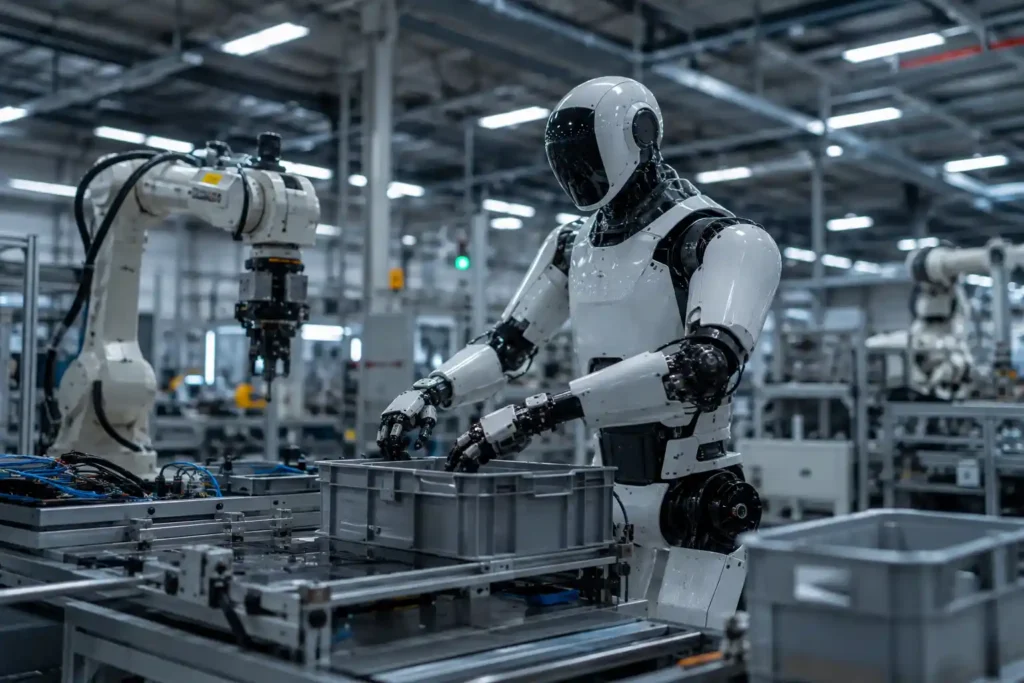
The next major economic consequence of artificial intelligence may come from a place that has little to do with screens. As machines become capable of interpreting their surroundings, making decisions and acting in real time, physical AI is beginning to connect software intelligence with the physical economy. That shift could turn robotics from a specialized automation industry into a broader capital-expenditure theme spanning factories, warehouses, logistics, transportation and infrastructure.
The investment significance is considerable. Software AI can scale through computing infrastructure and digital distribution; physical AI requires machines, sensors, chips, batteries, factories and deployment networks. Consequently, a successful transition from digital intelligence to physical execution could create demand across a much wider industrial ecosystem. Yet the opportunity remains conditional. Investors still need to determine whether increasingly impressive demonstrations can translate into reliable machines, commercially attractive economics and large-scale deployment.
From Digital AI to Physical AI
Traditional AI largely operated inside digital environments. It generated text, analyzed data, recognized images or assisted with software tasks. Physical AI changes the equation by giving intelligent systems a direct relationship with the real world.
Deloitte’s 2026 technology research describes physical AI as the convergence of AI and robotics, with machines increasingly able to perceive, reason, act and adapt in changing environments. Advances in computer vision, sensors, spatial computing, edge processing and machine learning are helping robots move beyond fixed, pre-programmed instructions.
That matters economically because the physical economy is enormous. Manufacturing lines, warehouses, farms, hospitals and transportation systems contain millions of repetitive or difficult tasks that historically required human labor or narrowly programmed machinery.
Physical AI does not eliminate the need for conventional robotics. Instead, it could make existing automation more flexible. A machine that can recognize an unfamiliar object, adjust its movements and learn from previous tasks has a potentially wider range of applications than a robot designed for one tightly controlled process.
For investors, that creates a broader value chain. Chips, sensors, actuators, robotics software, industrial systems, cloud platforms and edge-computing hardware can all participate in the transition. The opportunity therefore extends beyond whichever company ultimately builds the most recognizable robot.
Why Robotics Could Become a New Investment Frontier
Robotics investment has historically depended heavily on predictable environments. Automotive factories, for example, have been well suited to machines performing repetitive tasks under tightly controlled conditions. The next stage involves applying greater intelligence to environments where conditions change constantly.
Warehouse robotics, logistics, manufacturing automation, healthcare systems and autonomous machines are all potential beneficiaries. Humanoid robots receive particular attention because their human-like form could allow them to operate in environments designed around human workers. However, form factor alone does not create an investment thesis.
The critical question is economics.
A robot must perform a useful task reliably enough to justify its purchase, maintenance, integration and energy costs. That means investors should distinguish between technological capability and commercial scalability.
| Physical AI Investment Theme | Primary Growth Driver | Key Risk |
|---|---|---|
| Industrial robotics | Productivity and automation | Deployment complexity |
| Warehouse robotics | Logistics efficiency | Integration and reliability |
| Humanoid robots | Flexible physical work | Unproven economics |
| Autonomous systems | Labor and operational efficiency | Safety and regulation |
| Robotics software | AI-enabled machine coordination | Competitive pressure |
| Sensors and edge AI | Real-time machine intelligence | Hardware commoditization |
The comparison reveals why the robotics opportunity is broader than humanoid robots. Industrial automation may produce revenue sooner, while more general-purpose machines could eventually address a much larger market but carry substantially greater technical and commercial uncertainty.
Deloitte’s research also highlights the importance of onboard processing, sensors, actuators and real-time decision-making as physical AI develops.
For investors, the implication is straightforward: technological progress can expand the addressable market, but capital should ultimately follow demonstrated economics rather than demonstrations alone.
The Economics Behind the Robotics Investment Cycle
One reason physical AI has attracted attention is that several economic forces are developing simultaneously.
Labor shortages can encourage businesses to automate difficult-to-fill roles. Rising labor costs can improve the relative economics of machinery. Manufacturing reshoring can create demand for more productive factories, while supply-chain resilience can encourage companies to invest in domestic or regional automation.
At the same time, improvements in AI models and computing hardware can make robots more capable without requiring every machine to be programmed manually.
This combination could change corporate capital expenditure. Instead of viewing automation purely as equipment spending, manufacturers may increasingly treat intelligent machines as productivity infrastructure.
The effect could extend beyond factories. Warehouses can use autonomous systems to move goods, agricultural operators can automate selected processes, and healthcare providers can deploy specialized robotic systems. Autonomous vehicles represent another branch of the same broader technological direction.
However, capital intensity remains a major constraint. Physical AI requires manufacturing capacity, component supply chains, testing facilities, maintenance networks and physical deployment. Unlike software, hardware cannot be copied and distributed instantly at negligible marginal cost.
That difference could create an important investment distinction: AI software may scale digitally, while physical AI scales through industrial capacity.
For long-term investors, this makes capital expenditure a central part of the thesis. The companies positioned to benefit may include robotics firms, industrial automation providers, semiconductor manufacturers, component suppliers and businesses capable of integrating intelligent machines into existing operations.
Where the Investment Opportunities May Emerge
The most visible investment opportunity may appear to be the robot itself. Yet the economic value of physical AI could spread across multiple layers.
Robotics manufacturers provide the physical platform. Semiconductor companies supply the processing capability. Sensors allow machines to understand their surroundings. Actuators translate digital decisions into movement. Robotics software coordinates perception, planning and control. Meanwhile, industrial automation companies connect these technologies to actual production environments.
Private capital may also play an important role. Robotics startups often require substantial funding before reaching commercial scale because hardware development involves engineering, manufacturing and testing rather than software development alone.
| Robotics Asset | Investment Opportunity | Primary Challenge |
| Robot manufacturers | Direct exposure to automation | High capital requirements |
| Semiconductor infrastructure | Compute and edge intelligence | Technology competition |
| Sensors and components | Picks-and-shovels exposure | Pricing pressure |
| Robotics software | Recurring technology revenue | Rapid innovation |
| Industrial automation | Established customer relationships | Slower deployment cycles |
| Private robotics startups | Early-stage growth potential | Illiquidity and failure risk |
This suggests that investors should think about physical AI as an ecosystem rather than a single industry. The eventual winners may not be the companies with the most impressive prototypes. They could instead be businesses controlling critical components, manufacturing capacity, software, distribution or integration.
That distinction is particularly important for institutional investors and venture capital. Early-stage robotics can offer substantial upside, but it also combines technological risk with manufacturing and commercialization risk. Private equity may find more mature opportunities in automation providers and industrial businesses where robotics can improve operating economics.
Why Humanoid Robots Are Getting So Much Attention
Humanoid robots have become the most visible symbol of physical AI because their form factor suggests a machine could eventually operate in spaces designed for humans.
The investment logic is compelling in theory. A general-purpose machine capable of performing multiple tasks could potentially be deployed across warehouses, factories and other environments without completely redesigning those workplaces.
Yet the distance between a successful demonstration and an economically valuable workforce remains large.
A robot must operate safely, repeatedly and predictably. It must also tolerate maintenance requirements, battery limitations, environmental variation and integration with existing systems. Furthermore, companies need to determine whether deploying robots actually costs less or produces more value than available alternatives.
Recent market enthusiasm illustrates the valuation challenge. Chinese robotics company Unitree’s August 2026 Shanghai IPO attracted extraordinary retail demand, while Reuters reported concerns surrounding its valuation and the limited commercial application of humanoid robots to date.
That contrast captures the broader investment problem: market enthusiasm can arrive before commercial economics are proven.
For investors, humanoid robotics may represent enormous long-term optionality, but it should not be confused with established industrial automation economics.
The Risks of Investing in Physical AI
The same characteristics that make physical AI exciting also create unusual investment risks.
Technological risk remains significant. A machine may perform well under controlled conditions but struggle when exposed to unpredictable environments. Hardware failures can also be more consequential than software bugs because they can interrupt physical operations.
Commercialization presents another challenge. Companies must convince customers that automation generates enough economic value to justify upfront capital expenditure.
Regulation and safety create additional uncertainty, particularly as autonomous systems move into workplaces and public environments. Cybersecurity also becomes more important because connected robots create a bridge between digital networks and physical machinery. Deloitte highlights cybersecurity, fleet orchestration and interoperability as important challenges as physical AI systems become more connected.
Supply-chain dependency adds another layer. Robotics requires semiconductors, sensors, motors, batteries and specialized components. Disruptions in any of those inputs can constrain production.
Finally, valuation risk may become the most familiar problem. When investors price a technology according to distant potential rather than current cash flows, even genuine technological progress may fail to produce attractive investment returns.
For investors, physical AI therefore requires a wider risk framework than conventional technology investing. The analysis must cover engineering, manufacturing, financing, regulation, customer adoption and valuation simultaneously.
The Institutional Investment Case
Institutional investors, venture capital firms, family offices and private equity managers may increasingly evaluate robotics alongside AI infrastructure, semiconductors and industrial investment.
The reason is that physical AI connects two investment worlds that were previously analyzed separately: technology and industry.
An industrial company adopting robotics may generate productivity improvements. A semiconductor company may benefit from greater edge-computing demand. A sensor manufacturer may benefit from increasing machine intelligence. Meanwhile, private capital can finance startups attempting to commercialize new robotic systems.
This creates multiple pathways for capital allocation.
However, institutional investors are likely to differentiate between speculative technology exposure and established industrial cash flows. Mature automation businesses may offer a different risk profile from early-stage humanoid developers, while infrastructure and component companies may capture value without assuming the full risk of building a general-purpose robot.
That makes portfolio construction especially important. Physical AI does not need to become universally adopted for every company in the ecosystem to benefit. Nor will every robotics company benefit equally if adoption accelerates.
The Future of Physical AI
The long-term question is whether physical AI can move from impressive prototypes into economically meaningful deployment.
If it does, autonomous factories, intelligent warehouses, AI-powered manufacturing and advanced industrial automation could become important sources of productivity growth. The implications could extend into healthcare, agriculture, transportation and logistics.
Yet adoption is unlikely to occur at the same pace everywhere. Controlled industrial environments may adopt intelligent robotics earlier than complex public settings. Specialized machines may also prove economically superior to humanoid platforms for specific tasks.
The investment opportunity therefore depends less on predicting exactly what robots will look like and more on identifying where intelligent machines can produce measurable economic value.
Unique Insight
Physical AI may ultimately matter more as an investment theme because it connects artificial intelligence directly to the physical capital stock of the economy.
The deeper chain is:
AI Models → Perception → Robotics → Automation → Capital Expenditure → Productivity
Software AI can spread through digital infrastructure. Physical AI requires factories, chips, sensors, batteries, motors, materials, logistics and maintenance. Consequently, a successful robotics cycle could create investment opportunities far beyond robot manufacturers.
That is the hidden investment angle.
The most valuable business may not necessarily own the most impressive humanoid. It could control a critical sensor, supply specialized chips, provide robotics software, manufacture essential components or operate the industrial infrastructure where autonomous machines generate measurable returns.
In other words, physical AI should increasingly be viewed as an industrial ecosystem, not simply another software trend.
For investors, that distinction matters because it shifts the analysis from “Which robot wins?” toward a more useful question: Which businesses capture value when intelligent machines become part of the economy’s physical capital base?
Conclusion
The next stage of AI may be less about generating information and more about transforming how physical work gets done. Physical AI brings together artificial intelligence, robotics, semiconductors, sensors, automation and industrial capital in a way that could create a new investment frontier.
But the opportunity should not be confused with certainty. The robotics industry still faces substantial technical, commercial, regulatory and valuation challenges. The eventual winners may also emerge from less visible parts of the ecosystem rather than from the companies attracting the most attention.
For long-term investors, the more interesting question is therefore not whether robots will become important. It is where economic value will accumulate as intelligence moves from the digital world into the physical economy.
Frequently Asked Questions
What is physical AI?
Physical AI refers to AI systems that allow machines to perceive, understand, reason about and act within the physical world. It combines AI models with robotics, sensors, computing and autonomous systems.
How is physical AI different from traditional artificial intelligence?
Traditional AI often operates in digital environments. Physical AI connects intelligence to machines that must interact with real-world environments, where safety, movement, timing and physical constraints matter.
Why is robotics becoming an investment frontier?
Robotics could become a larger investment theme as companies seek productivity improvements, automation, manufacturing resilience and solutions to labor constraints. However, commercial adoption remains the key test.
What industries will benefit most from physical AI?
Manufacturing, logistics, warehousing, transportation, agriculture and selected healthcare applications are potential areas of adoption. The pace will depend on economics, safety and deployment complexity.
Are humanoid robots a good investment theme?
Humanoid robots represent a potentially large technological opportunity, but their commercial economics remain uncertain. Investors should distinguish between demonstrations, announced plans and proven large-scale deployment.
How does physical AI affect manufacturing?
It can potentially make factories more flexible by allowing machines to adapt to changing tasks and environments. This could complement existing industrial automation rather than immediately replace it.
What companies are developing physical AI?
The ecosystem includes robotics manufacturers, semiconductor companies, sensor providers, industrial automation firms and AI-software developers. Company claims and commercial deployment should be evaluated separately.
Why are institutional investors interested in robotics?
Institutional investors may view robotics as a potential long-term productivity and industrial-capital theme spanning technology, manufacturing and infrastructure.
What are the biggest risks of robotics investment?
Major risks include technological failure, high capital requirements, uncertain commercial demand, safety regulation, supply-chain constraints, competition and excessive valuations.
How does physical AI affect capital expenditure?
If deployment becomes economically attractive, companies may increasingly treat intelligent machines as productivity-enhancing capital expenditure rather than experimental technology spending.
What role do semiconductors play in robotics?
Semiconductors provide the computing and edge-processing capabilities required for perception, decision-making and control. Increasingly capable onboard processing can reduce dependence on continuous cloud connectivity.
Why is physical AI becoming an important long-term investment theme?
Physical AI connects AI development with robotics, manufacturing, automation and the broader physical capital base of the economy. Its investment importance will ultimately depend on whether technological advances translate into scalable economic value.

Administrator at Alt Finances, leading editorial strategy and contributing in-depth coverage of investing, wealth management, alternative assets, and global financial markets. Through research-driven articles and analysis, he helps readers understand the ideas, industries, and market forces shaping modern finance.